
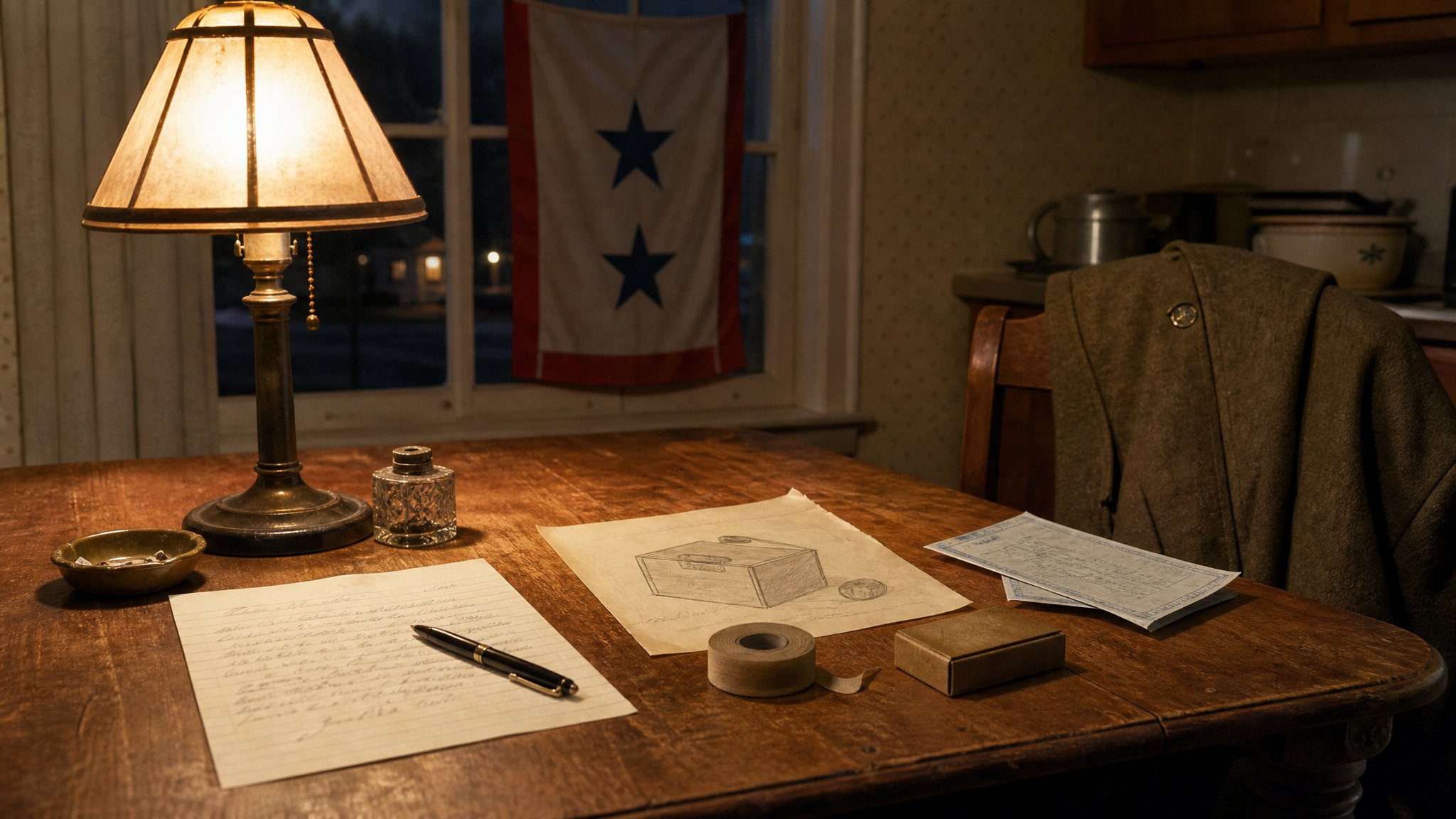
In February 1943, a 51-year-old Illinois munitions worker with two sons at sea wrote to President Franklin D. Roosevelt about a strip of paper tape on an ammunition box.
Vesta Stoudt packed and inspected cartridges for rifle grenades at the Green River Ordnance Plant near Amboy, Illinois. She had seen that the thin paper tape sealing each box could leave a soldier unable to get at his ammunition in a hurry. Her supervisors showed little interest in her fix, a waterproof cloth tape with a pull tab of the same cloth, so on February 10, 1943, she sent it to the White House.
Roosevelt’s office forwarded her letter and diagrams to the War Production Board, which approved the change on March 26. A Johnson & Johnson tape company was given the job of making it, producing a waterproof cotton duck cloth tape that could be torn by hand. It became known as duck tape, and after the war it turned silver to match heating ducts and became the duct tape found in toolboxes across the United States.
Packing Rifle Grenades at the Green River Ordnance Plant
The plant where Stoudt worked had been finished only weeks before she wrote, completed by the War Department on December 15, 1942, on about 8,000 acres in Lee County. It used a Dixon mailing address because the small Amboy post office was not expected to cope with the volume of mail. The Stewart-Warner Corporation ran it for the government, and for most of its life it worked around the clock making bazooka rockets, artillery and naval shells, bombs, rifle grenades and fuses.
At its peak the plant employed about 4,500 people, and the makeup of that workforce changed as the draft pulled local men into uniform. By 1944 nearly three times as many women as men worked there, part of a national shift that left more than 19 million American women in the workforce by the end of the war. The plant was built for the war alone and closed on August 31, 1945, a little over two weeks after Japan announced its surrender. Several of its buildings are still used by private businesses for manufacturing or storage, and its ammunition bunkers still dot the farmland outside Amboy.
Stoudt was born Vesta Oral Wildman in Prophetstown, Illinois, on April 13, 1891, and raised eight children while living for most of her life in nearby Sterling. Two of her sons, Clarence and Lowell, were in the Navy, one in the Pacific and the other with the Atlantic fleet, which gave her a personal stake in the boxes she packed.
Each carton of cartridges had its flaps closed with thin paper tape before it was dipped in wax to keep water out. A tab of tape was left loose so that a soldier could pull it, split the wax seal and open the box. The weakness lay in the tape itself, which was so thin that the tabs often tore away and left a soldier under fire holding a sealed, wax-coated box with no quick way in.
Read next
Herculaneum Scroll Burned by Vesuvius Read in Full by X-ray
Why did Vesta Stoudt write to President Roosevelt?
Stoudt wrote to President Roosevelt because her supervisors at the plant did not act on her idea, even though she had tried it out there and found that it worked. Her solution kept the same basic design and changed the material, using a cloth tape to close the seams and a tab made of the same cloth. In the letter she described the problem and her tape and enclosed diagrams of how it would be applied.
The letter appealed to Roosevelt as a fellow parent with children in uniform. She wrote that she had two sons out there somewhere, one in the Pacific and the other with the Atlantic fleet, and reminded him, “You have sons in the service also.” Her case rested on one line about the men at the front: “We can’t let them down by giving them a box of cartridges that takes a minute or more to open.”
All four of Roosevelt’s sons served in the war, with James in the Marine Corps, Elliott in the Army Air Forces, and Franklin Jr. and John in the Navy. The White House passed the letter to the War Production Board, which Roosevelt had created by Executive Order 9024 on January 16, 1942. Under its chairman, Donald M. Nelson, the board held supreme authority over the procurement of materials and industrial production, allocating scarce supplies and converting civilian factories to military work.
From the board, a suggestion about packing tape from a worker in Lee County went to the Army’s Ordnance Department, which was responsible for ammunition. On March 26, 1943, Howard Coonley wrote back to Stoudt on behalf of the board to say that the Ordnance Department had pressed her idea. He told her that “the change you have recommended has been approved with the comment that the idea is of exceptional merit.”
Stoudt later received a War Worker Award, a monthly honor for outstanding service to the nation’s war effort.
How Johnson & Johnson Turned Her Idea Into Duck Tape
The board gave the manufacturing job to the Industrial Tape Corporation, a Johnson & Johnson operating company that later became Permacel, because of its experience with adhesive tapes. Its tape was made from thin cotton duck cloth coated in plastic so that it shed water, and it was strong enough to hold a carton shut through shipping. It was also designed to be ripped by hand instead of cut with scissors, and the name duck tape followed the cotton duck in its backing.
Servicemen found uses for the tape that went well beyond sealing ammunition boxes. Johnson & Johnson’s history records that the military called it 100-mile-per-hour tape and used it to fix anything from jeep fenders to boots. British forces gave their versions nicknames such as Black Nasty and Harry Black, and in the Falklands War tape sealed a damaged aircraft hangar roof for a year.
From Air Ducts to Apollo 13 and the Moon
After the war the tape moved into civilian hardware stores, where builders found it handy for joining sections of heating and air conditioning ducts. Manufacturers added aluminum powder to turn it silver to match the sheet metal, and in that form duck tape came to be sold as duct tape.
The name the tape took after the war describes the one job it does badly, as researchers at the Lawrence Berkeley National Laboratory showed in 1998. Max Sherman and Iain Walker spent three months pushing hot and cold air through joined ducts in five-minute cycles and baking joints at up to 187 degrees Fahrenheit. Clear tapes, foil-backed tapes, mastic and aerosol sealant all held, while duct tape was the only type that failed, with eleven duct tape products giving way within days. The researchers suspected that heat broke down its adhesive.
The tape fared better in space, where NASA carried it on missions from the Gemini program onward. After an oxygen tank exploded on Apollo 13 on April 11, 1970, the crew sheltered in the lunar module, whose carbon dioxide filters could not keep up with three men. The spare filters from the command module were square and would not fit the lunar module’s cylindrical holders. Engineers in Houston devised an adapter from a plastic bag, cardstock, a spacesuit hose and duct tape, and the crew assembled the device, nicknamed the mailbox, inside the spacecraft.
Stoudt died in 1966, at the age of 75, and apparently never gained financially from the tape. Her family kept a copy of her letter to Roosevelt, and her great-granddaughter, Kari Santo, later shared it with Johnson & Johnson’s historians. The company that had made the tape for the War Production Board now credits a rifle grenade packer from Sterling, Illinois, with its invention.
More from Terribly Interesting
Sources
- Johnson & Johnson
- Sauk Valley News (1891 to 1966, age 75)
- Forces News
- Nautilus
- FDR Presidential Library blog (National Archives)
- Oklahoma Historical Society
- Hackaday
- Sauk Valley News 2021
- Northern Illinois University archives
- Genealogy Trails Lee County
- The National WWII Museum
- ScienceDaily (LBNL release)
- LBNL
- Smithsonian National Air and Space Museum
- NASA Apollo Lunar Surface Journal