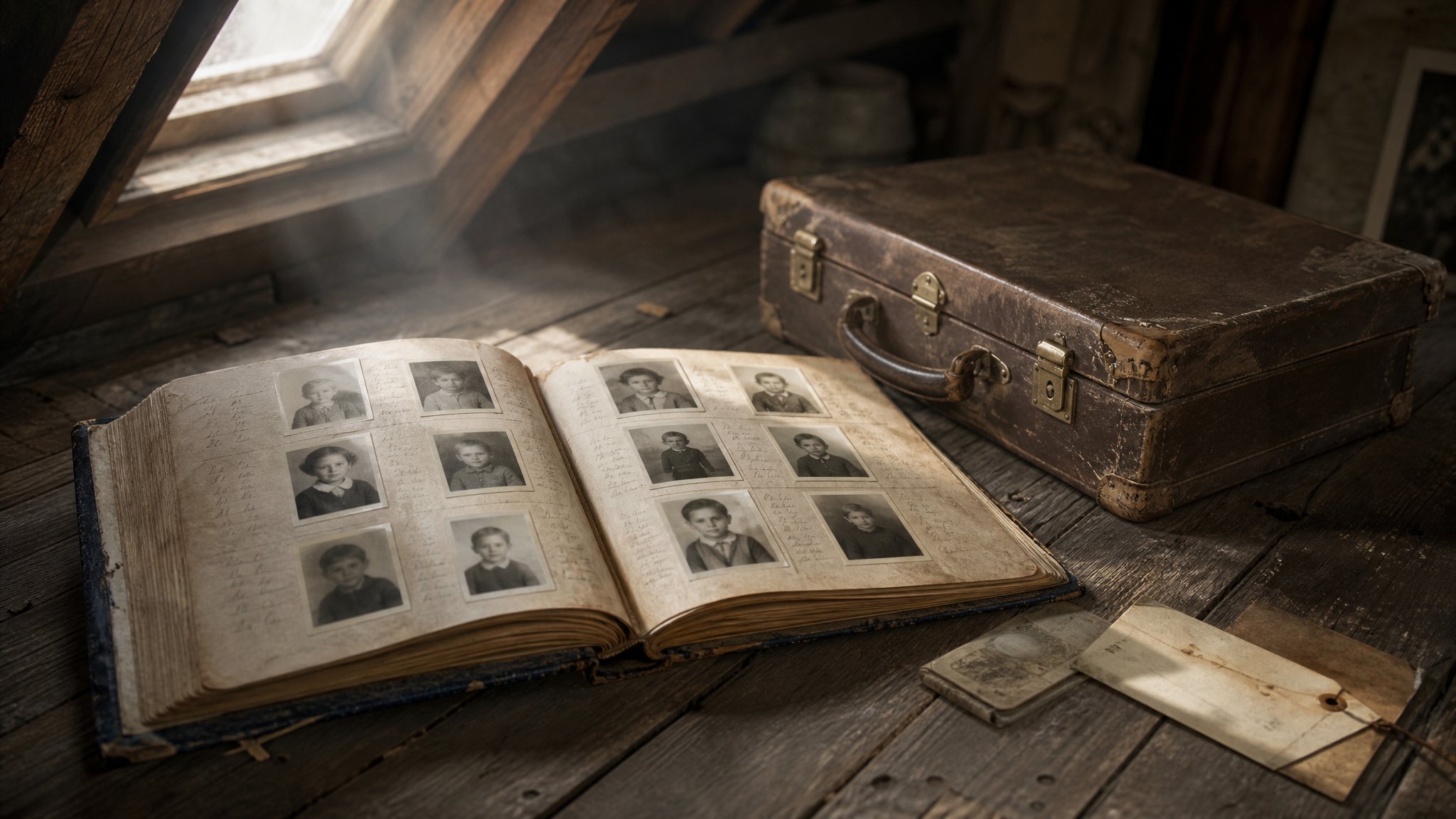
In 1988 Grete Winton found a scrapbook in the attic of her home that listed 669 children, most of them Jewish, whom her husband, Nicholas, had helped bring out of Czechoslovakia to Britain in 1939.
Nicholas Winton was a 29-year-old London stockbroker when he spent about three weeks in Prague around the turn of 1939, among refugees who had fled the German takeover of the Sudetenland. He began compiling a list of children whose parents wanted them sent abroad. Back in London he found them foster homes, raised the money the British government demanded for each child and pushed their papers through the Home Office, while colleagues in Prague put the children on trains. The scrapbook held their names and photographs, the names of their parents and the addresses of the British families who had taken them in.
Winton had said almost nothing publicly about the rescue for nearly fifty years, apart from a mention in his election material when he ran for the town council in Maidenhead in 1954. After the scrapbook surfaced, the BBC program That’s Life! invited him to sit in its studio audience in February 1988, and he found himself among the adults those children had become.
A Canceled Ski Trip and a Hotel Table in Prague
Winton was born in Hampstead, London, on May 19, 1909, to German Jewish parents named Wertheim who had changed the family name to Winton and converted to Christianity. He trained in banks in Hamburg, Berlin and Paris before becoming a broker at the London Stock Exchange, and he was a good enough fencer to be selected for the British team in 1938. Through a socialist friend, Martin Blake, he belonged to a circle of people in London who opposed the government’s policy of appeasing Hitler.
Under the Munich Agreement of September 30, 1938, Czechoslovakia handed the Sudetenland to Nazi Germany. By the end of the year about 200,000 German, Sudeten and Jewish refugees had crowded into what remained of the country. Shortly before Christmas, Winton was about to leave for a skiing holiday in Switzerland. Then Blake, who was in Prague working with the British Committee for Refugees from Czechoslovakia, asked him to come to Prague and help. Winton went, and he joined British and Canadian volunteers who had set up an office at a dining table in a hotel on Wenceslas Square.
The committee’s work in Prague was led by Doreen Warriner, an economist from University College London who had flown in on October 13, 1938, with £450 in donations. She concentrated on getting endangered adults out of the country. Winton turned his attention to the children, taking the names of families who wanted their sons and daughters evacuated. He left Prague in January 1939, two months before German troops occupied the rest of the Czech lands, and he never set foot in the city’s main railway station, from which the children later left.
Foster Families, £50 Guarantees and Forged Permits
After the Kristallnacht pogrom in Germany in November 1938, the British government had agreed to admit refugee children under 17, provided each had a place to live. A guarantee of £50 also had to be deposited to pay for their eventual return home. Working from London with help from his mother, Winton advertised for foster families. Through the summer of 1939 he placed photographs of the children in the magazine Picture Post so that British households could choose a child to take in. He also wrote to governments abroad, including a letter to President Franklin D. Roosevelt, asking them to take children, and apart from Britain only Sweden accepted any.
Because the Netherlands had closed its borders to Jewish refugees after Kristallnacht, every child needed proof that Britain would accept them before the Dutch would let them cross to the ferry at the Hook of Holland. When the Home Office entry permits were slow to arrive before a scheduled departure, Winton later admitted, “So we forged the Home Office entry permits.” The children then crossed Germany and the Netherlands, took the ferry to Harwich and traveled on to Liverpool Street station in London, where most of them met their new families.
The first group left Prague on March 14, 1939, on a 20-seat airplane, the day before German troops marched into Prague, and the rest traveled by train through the spring and summer. Few if any of the 669 children ever saw their parents again, and many of those parents died in the Auschwitz concentration camp.
Read next
Alaska Villagers Used Headlights to Guide a Medevac Plane
Warriner, Chadwick and the Risks in Occupied Prague
After the Germans arrived in March 1939, Warriner and her associates smuggled adults out with forged documents, mostly by train through Poland. They hid hundreds of threatened people in cheap hotels, until the Gestapo raided her office on April 14. A British diplomat, Robert Stopford, warned her that the Germans meant to arrest her, and she left the country on April 23, having helped, in Stopford’s estimate, about 15,000 refugees escape during 1938 and 1939.
Trevor Chadwick, a Latin teacher at his family’s school in Swanage, Dorset, had come to Prague in January 1939 to collect two refugee boys for the school. He then returned to run the children’s transports from the Prague end. He chose the children, escorted the March 14 flight and saw each group off at the station. On June 2 he put 123 children on a train before leaving the country himself, possibly because he feared arrest for forging documents. The Canadian Quaker Beatrice Wellington then carried on the work alone for the British committee until the war began. Meanwhile the American Unitarians Waitstill and Martha Sharp and the British Quaker Tessa Rowntree also worked with the team, and Rowntree escorted the first trainload of children across the Dutch border.
Winton disliked being called the British Schindler, because unlike Oskar Schindler he had never put his own life in danger. He credited Warriner, Chadwick, Stopford, Wellington and others in Prague with the hardest part of the operation. He wrote that Chadwick had carried on the work “even when it became difficult and dangerous when the Germans arrived,” adding, “He deserves all praise.”
The Train That Never Left and the Audience That Stood Up
The last of the transports was due to leave Prague on September 1, 1939, with 250 children aboard, but Germany invaded Poland that morning, the borders closed, and the train never left. Only two of those 250 children are known to have survived the war. Winton at first registered as a conscientious objector and worked with a Red Cross ambulance unit. Then in 1940 he joined the Royal Air Force, leaving it in 1954 with the honorary rank of flight lieutenant.
After the war he worked for refugee and development organizations in Paris, where he met Grete Gjelstrup, a Danish secretary, and they married in Vejle, Denmark, on October 31, 1948. Their younger son, Robin, was born with Down syndrome and died of meningitis the day before his sixth birthday, and Winton founded the local support group that became Maidenhead Mencap. When the scrapbook came to light in 1988 he gave it to Elisabeth Maxwell, a Holocaust researcher, whose letters to the addresses in it traced 80 of the children living in Britain.
On That’s Life! the host, Esther Rantzen, showed the scrapbook on air and introduced Winton to Vera Gissing, one of the children he had helped to rescue. On a later program, with Winton again in the audience, Rantzen asked anyone who owed their life to him to stand, and more than two dozen people around him rose to their feet. When she then asked the children and grandchildren of those rescued to stand as well, the rest of the audience got up.
The rescued children included Alf Dubs, who left Prague in June 1939 at the age of six and later sat in Parliament as the Labour member for Battersea and then in the House of Lords. In 2016 he tabled the amendment under which British local authorities took in unaccompanied child refugees from camps in Europe.
On September 1, 2009, seventy years after the last train failed to leave, a special train of 1930s carriages pulled by steam locomotives set out from Prague’s main station along the original route. It carried some of the surviving children and their families, whose descendants by then numbered more than 5,000. A statue of Winton by the sculptor Flor Kent was unveiled on Platform 1 in Prague as the train departed. When the train reached Liverpool Street on September 4 the 100-year-old Winton was on the platform to meet it.
Winton was knighted in 2003, and in 2014 the Czech Republic gave him its highest honor, the Order of the White Lion. More than 370 of the children on his lists have never been traced.
Winton died in his sleep on July 1, 2015, at the age of 106, exactly 76 years after 241 of the children he had registered left Prague together on a single train.
More from Terribly Interesting
Sources
- Maidenhead Heritage Centre
- widely quoted (AP obituary, Seattle Times
- United States Holocaust Memorial Museum, “Nicholas Winton and the Rescue of Children from Czechoslovakia, 1938-1939”
- Holocaust Memorial Day Trust, “Sir Nicholas Winton”
- Sir Nicholas Winton Exhibition, “Kindertransport”
- Sir Nicholas Winton Exhibition, “Early Life”
- Jewish Virtual Library, “Nicholas Winton”
- Tablet Magazine, “British Schindler Nicholas Winton Dies at 106”