In early 1918, between the acts of a revue at New York’s Hippodrome, Harry Houdini taught soldiers bound for Europe how to escape German handcuffs.
Houdini, the escape artist billed for nearly two decades as the King of Handcuffs, was 43 when the United States entered World War I in April 1917. He tried to enlist and was turned away as too old, so he wrote to Secretary of War Newton D. Baker with a different offer. He proposed teaching servicemen how to free themselves from ropes, handcuffs and even shipwrecks, and the War Department sanctioned the classes. By February 1918 New York newspapers were reporting the lessons, which he gave to rotating groups of soldiers at the Hippodrome while starring in the revue Cheer Up.
The lessons covered the handcuff, rope and chain work he had performed on stages across Europe and America, along with what to do inside a torpedoed ship. That was a practical question for American troops, because a German U-boat had sunk the troop transport Antilles on October 17, 1917. Another sank the liner Tuscania off the Scottish island of Islay on February 5, 1918, with about 200 men lost.
Houdini told the soldiers that people drowned on sinking vessels because they lost their sense of direction. His advice was to stay calm underwater and let the body rise slowly until a hand found the side, floor or deck of the ship. Alongside the classes he sold more than $1 million in Liberty bonds within a year.
How Erik Weisz Became the King of Handcuffs
Houdini was born Erik Weisz in Budapest, Hungary, on March 24, 1874. His father, Rabbi Mayer Samuel Weiss, moved the family to Appleton, Wisconsin, where he led a small Reform congregation. The boy later took his stage name from the French magician Jean-Eugène Robert-Houdin, and through most of the 1890s he worked the cheaper end of the variety circuit, first with a friend and then with his wife, Bess.
His career turned in 1899, when the theater manager Martin Beck saw his handcuff act in St. Paul, Minnesota. Beck offered him the bookings that made escapes the center of his show, and in 1900 Houdini sailed for England. He spent the next five years building his fame across Europe by inviting local police to lock him in their own cuffs and cells.
In Cologne in February 1902 he took a policeman named Werner Graff to court for slander after Graff accused him of fraud and bribery. In front of the judge he opened Graff’s lock by banging it against a metal plate fastened below his knee. Houdini won the case and won again on appeal, and Graff was ordered to pay a heavy fine along with Houdini’s expenses and lost bookings.
The best-known handcuff test of his career came at the London Hippodrome on March 17, 1904, when the Daily Mirror brought him a special pair of cuffs. The newspaper said they had taken a Birmingham locksmith, Nathaniel Hart, five years to make. Houdini needed more than an hour to get free in front of a packed matinee audience, and at one point he cut his coat off with a pen knife held in his teeth. Writers on magic still debate whether the newspaper and the performer arranged the outcome between them.
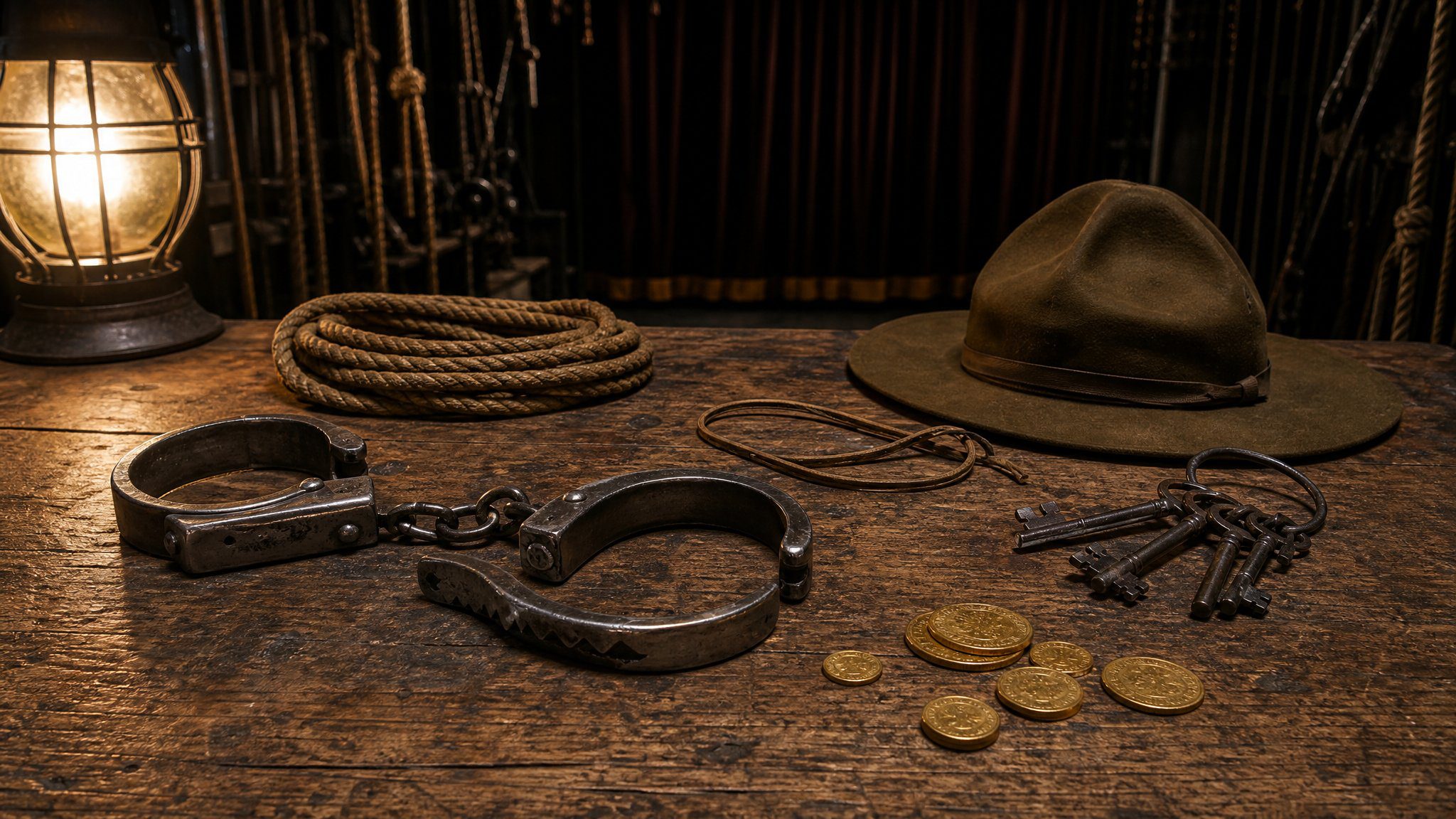
By 1910 Houdini had put some of the trade’s methods into print himself, in a book called Handcuff Secrets. He aimed it at the imitators he mocked as handcuff kings and jail breakers, explaining their duplicate keys and prepared cuffs. It even showed how the screw in an old-fashioned cuff could be drawn back with a loop of shoestring. He told readers that his own deeper methods would stay out of the book.
Read next
The Statue of Liberty Arrived in 214 Crates With No Pedestal Ready
A Classroom Between the Acts of Cheer Up
The Hippodrome stood on Sixth Avenue between 43rd and 44th Streets and had opened in 1905 as a house for large spectacles. Its vast stage had a water tank built into the apron for swimming and diving shows. Houdini joined its patriotic revue Cheer Up, and on January 7, 1918, he made a 10,000-pound elephant named Jennie disappear from a large cabinet onstage. The vanishing elephant anchored the longest continuous engagement of his career, 19 weeks in a single theater.
The theater gave him a room on its promenade level for the soldiers’ lessons. The Evening World reported on February 27, 1918, that he was teaching a regular rotation of soldiers there with the War Department’s approval. A day earlier the Evening Star had described his offer, noting that the Secretary of War had sent Houdini a letter of thanks and that officers could telephone to arrange visits for their men. Many of the lessons took place during the intermissions of Cheer Up, so on a single evening Houdini could escape for a paying audience and then explain the work to soldiers.
On another occasion soldiers from Camp Upton, the Army training camp on Long Island, took their lesson in the Hippodrome’s stage tank, a session the Brooklyn Standard Union reported on March 8, 1918. The water lessons drew on years of being chained and submerged in front of audiences. His milk can escape dated from 1908, and he unveiled the Chinese Water Torture Cell at the Circus Busch in Berlin in September 1912. For more than a year he traveled between training camps to teach and entertain troops.
Liberty Bonds, Gold Coins and a Shirt Sold Twice
Houdini also raised money for the war at Hippodrome bond events, and at one of them a member of the audience offered to buy $1,000 of Liberty bonds if he could get out of his shirt within 30 seconds. He tore it off in six seconds, and the same man bought another $1,000 of bonds for the ruined shirt.
When he performed for troops he often vanished $5 gold pieces in a simple coin trick and then handed them to men about to sail for Europe, giving away about $7,000 during the war. Writers on his war years estimate that by June 1918 he had also given up more than $50,000 in lost salary and his own spending.
He became president of the Society of American Magicians in 1917 and held the post until 1926. On November 11, 1917, he organized a Hippodrome benefit for the families of the men lost on the Antilles. He persuaded the retired master magician Harry Kellar to perform once more, in what proved to be Kellar’s final public appearance. At the end Houdini had him carried off the stage while about 6,000 spectators sang Auld Lang Syne.
After Cheer Up closed, Houdini moved into the Hippodrome’s next production, Everything, which ran from August 22 to November 2, 1918. In that show he escaped from a straitjacket while hanging in the air and produced an American eagle from the folds of the flag.
The Hippodrome closed in 1939 and was demolished, and the office building on its site at 1120 Avenue of the Americas still carries the theater’s name. In 2018, a century after the promenade classes, the Virginia Museum of History and Culture in Richmond displayed a pair of Houdini’s handcuffs in an exhibition on his part in World War I.
More from Terribly Interesting
Sources
- Wild About Harry (citing The Evening World, Feb. 27, 1918, and The Standard Union, Mar. 8, 1918)
- Harry Houdini Circumstantial Evidence (reproducing the Evening Star, Feb. 26, 1918)
- Conjuring Arts Research Center
- Wild About Harry (citing Kalush)
- War History Online
- Library of Congress Information Bulletin
- Wild About Harry biography
- The Vintage News
- Naval History and Heritage Command photo NH 41744, “Sinking of S.S. Antilles, 17 October 1917”
- Genii Magicpedia
- Commonwealth War Graves Commission
- PBS American Experience timeline
- PBS American Experience, “Houdini’s Slander Trial”
- Literary Hub
- London Remembers
- The Daily Magician
- Society for Psychical Research book review
- PBS American Experience, “Escape Secrets”
- Wikipedia used as a map, checked against Wild About Harry, “Houdini and the Hippodrome”
- Wikipedia used as a map, checked against Wild About Harry, “Houdini and the Hippodrome”
- Wild About Harry, “100 years ago Houdini vanished an elephant”
- Society of American Magicians, Houdini Fund page
- Wild About Harry