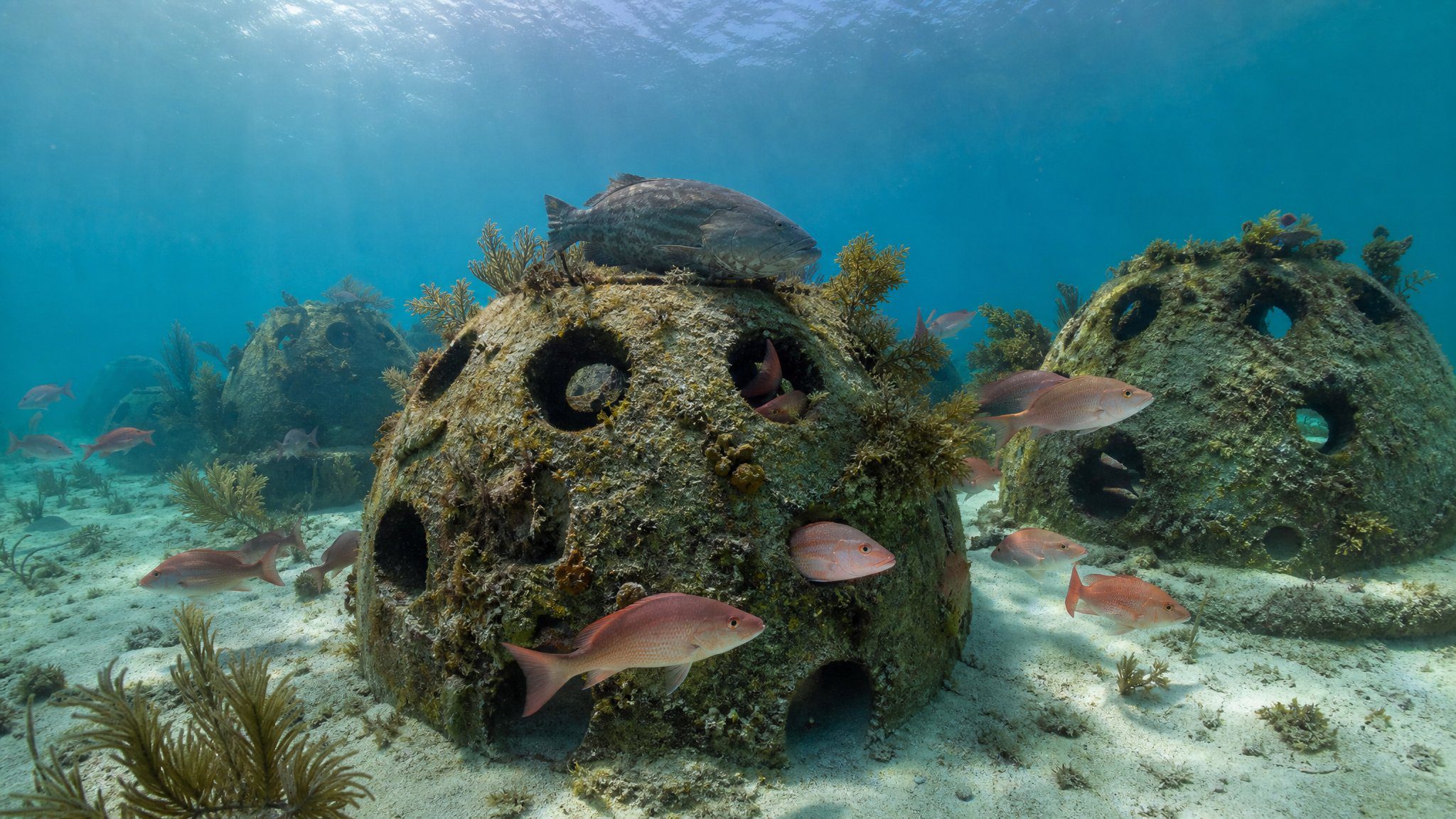
In the spring of 1998, the ashes of a pianist named Carleton Glen Palmer were stirred into wet concrete and cast into a hollow dome bound for the Gulf of Mexico.
Palmer was the father-in-law of Don Brawley, a diver who had spent the 1990s helping to build artificial reef modules called reef balls to rehabilitate damaged reefs off Florida. Shortly before he died in 1998, Palmer told Brawley that he did not want to be buried “in a field with a bunch of old dead people.” Brawley mixed his father-in-law’s cremated remains into a reef ball that was cast in Sarasota, Florida, on May 1, 1998, and placed on the seafloor shortly afterward.
That reef ball became the first Eternal Reef, a memorial that also serves as a habitat for fish, coral and sponges. The idea grew into Eternal Reefs, the memorial-reef organization that by 2024 had placed more than 3,000 memorial reefs at about 25 sites in seven states, from Texas to New Jersey.
Each memorial is a working piece of an artificial reef, set in public waters where anyone can fish or dive, and every family leaves with the exact coordinates of the spot.
A Hurricane on Grand Cayman and a Mold Built Over a Beach Ball
The reef ball itself predates the memorials by several years, and its origins lie with Todd Barber, a diver who had grown up visiting a reef off Grand Cayman. When Hurricane Gilbert tore across the Cayman Islands in September 1988, it destroyed that reef, and Barber set out to design something that could help damaged reefs recover. In 1993 he founded the all-volunteer Reef Ball Development Group, and he and his father, Jerry Barber, went on to develop and patent the design.
Brawley was a diving friend of Barber’s from the University of Georgia, and the two had been college roommates. Eternal Reefs credits them with developing the reef ball concept together after Brawley watched reefs decline while diving in the Florida Keys in the late 1980s. A third Georgia diver, George Frankel, joined them in sinking reef balls along the Florida coast, and he later led Eternal Reefs as its chief executive.
Barber’s reef ball was cast as a hollow module, first over an ordinary beach ball and later around an inflatable bladder, so that it could be deployed without heavy machinery. The trapped air made the finished module buoyant enough to be floated out by swimmers or a small boat before it was sunk into place.
Barber’s group also developed a hardened concrete containing microsilica that brought the surface close to the pH of seawater. They gave it a rough texture so that the larvae of corals, sponges and algae would have somewhere to settle, and holes through the walls let water and nutrients flow through the interior. In 1997 a nonprofit, the Reef Ball Foundation, was set up to carry the work forward, with Kathy Kirbo as its founding executive director and Barber as chairman.
The Request About Red Snapper and Grouper
The memorial idea took shape when two of the Georgia divers faced deaths in their own families, with Frankel expecting to lose his mother and brother and Brawley’s father-in-law terminally ill. Palmer, the pianist in the family, raised the subject himself during a dinner conversation, telling Brawley that he wanted to be cremated and put somewhere in the sea.
Eternal Reefs records his words as: “I can think of nothing better than having all that action going on around me all the time after I am gone. Just make sure that the location has lots of red snapper and grouper.” Palmer died not long after that conversation, and Brawley went to work on the request almost immediately.
A reef ball placement was already planned for Sarasota, so Brawley mixed his father-in-law’s ashes into the concrete for one of the modules being cast there. On May 1, 1998, ten Nautilus and twenty Aquarius reef balls were poured for that project, and Palmer’s was among them. The modules went down to the seafloor off Sarasota shortly afterward, and the first memorial reef has been there ever since.
The two models cast that day are still part of the Eternal Reefs range, in which an Aquarius reef is sized for one person, a Nautilus holds up to two sets of remains and the larger Mariner up to four.
Read next
Why A Widow Kept Visiting Embankment Station For Years
Four Days From Casting to the Seafloor
Eternal Reefs runs each memorial over four days, and families are encouraged, though not required, to take part. On the first day relatives mix the cremated remains into concrete to form what the company calls a pearl, a centerpiece that fits inside the top of the reef ball. A fresh layer of specialized concrete then covers the top, and while it is still damp, families can press in handprints, write messages or set small mementos into the surface.
The third day is a viewing, when families can photograph the finished reef, write final goodbyes and make rubbings of a six-inch bronze plaque bearing a custom inscription. Bronze is the only metal the company uses for the plaques, since it holds up to the corrosion of seawater. On the fourth day the reef is taken out by boat and lowered to its site, and families can watch the placement from the water.
Every family receives two memorial certificates giving the latitude and longitude of the reef. The sites are public reef sites, open to fishing, diving and other recreational use. Relatives who dive can visit the memorial itself, and others can return by boat to the water above it. Pets are commonly included, and Eternal Reefs has said that it is rare to have a project without them, adding them to the reef at no additional cost.
In a 2024 report, NBC described the memorial of Mary Agnes Vodde-Hamilton, who died at 69 and whose daughter, Kailey Newkirk, found that her mother had shared a Facebook post about Eternal Reefs. “She was trying to save literally everything in the world, even on her way out of it,” Newkirk said of her mother.
What Grows on a Concrete Reef
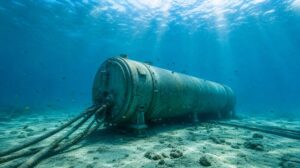
A reef ball is a hollow semicircular dome with an opening at the top and holes through its sides, and reef balls can weigh up to 4,000 pounds. Ordinary concrete has a pH of about 12, while the microsilica mix used in reef balls built for oyster restoration is brought down to about 8.3, close to that of seawater. Researchers at the University of Miami’s Shark Research and Conservation Program noted that the concrete is expected to last about 500 years underwater.
The rough surface traps drifting larvae in its grooves and crevices, and currents moving through the holes carry nutrients across both the inner and outer walls. Eternal Reefs says that significant natural growth appears on its memorials within a few months of placement.
Counts vary with the year, but more than 500,000 reef balls have been deployed in more than 59 countries, from tropical seas to freshwater lakes.
Burial at Sea Rules
Scattering ashes at sea is simple under federal law, which is part of why reef memorials need more paperwork. The Environmental Protection Agency issues a general permit under the Marine Protection, Research and Sanctuaries Act for burial at sea. It allows cremated remains to be placed in ocean waters at least three nautical miles from land, provided the EPA is notified within 30 days. That permit explicitly excludes remains built into an artificial reef or monument, because those materials do not readily break down and could become a hazard to navigation.
Eternal Reefs therefore places its memorials only at reef sites permitted through federal, state and local agencies. It cannot promise a family a particular location until permits for that site are in hand. Its current dedication locations include Sarasota and the Fort Lauderdale and Miami area, and earlier projects have placed reefs off Maryland, Virginia, the Carolinas and Texas.
The first reef balls ever set in open water were three test modules lowered near Peanut Island in Florida’s Intracoastal Waterway in August 1993. In 1994 they were dedicated as a memorial reef, four years before Brawley mixed his father-in-law’s ashes into the concrete off Sarasota.
More from Terribly Interesting
Sources
- Wellcome Collection, “Dying to be in nature” (Matthew Ponsford, August 5, 2020)
- Atlas Obscura, “Bury Me in an Artificial Reef”
- Eternal Reefs
- NBC Miami, April 3, 2024
- Reef Ball Foundation
- UPI Archives, September 13, 1988
- Eternal Reefs FAQ
- Eternal Reefs, What To Expect
- University of Miami Shark Research and Conservation Program (Jon Dorsey, December 7, 2012)
- US EPA, Burial at Sea