

At about 11:16 on the night of August 15, 1977, a radio telescope in Ohio recorded a signal from the direction of Sagittarius that was about 30 times stronger than the background noise.
The telescope was Big Ear, run by the Ohio State University Radio Observatory as part of its search for signals from extraterrestrial intelligence. Nobody was at the telescope when the signal arrived, and a computer printed the readings onto paper. A few days later the astronomer Jerry Ehman, a volunteer on the project, read through the printout. He circled the column of characters 6EQUJ5 and wrote the word “Wow” with an exclamation mark beside it.
The signal lasted about 72 seconds, the full time Big Ear could watch any one point in the sky. It sat in a narrow band close to the frequency at which neutral hydrogen gas emits radio waves. The telescope returned to that part of the sky dozens of times, and other astronomers have searched it with larger instruments. The signal has never been detected again, and its source has never been identified.
The signal in numbers
| Date | August 15, 1977 |
|---|---|
| Telescope | Big Ear, Ohio State University |
| Duration | about 72 seconds |
| Peak strength | about 30 times the noise |
| Frequency | about 1420.4556 megahertz |
| Direction | Sagittarius |
How Big Ear Listened to the Sky
Big Ear was designed by John Kraus, the director of the Ohio State radio observatory, and stood on land beside Ohio Wesleyan University’s Perkins Observatory near Delaware, Ohio.
The telescope did not steer to follow objects across the sky. It held one strip of sky in its beam while the rotation of the Earth carried stars and galaxies through it. That is why any single source could be observed for only about 72 seconds at a time.
The receiver split the incoming radio waves into 50 channels, each 10 kilohertz wide. Every few seconds the computer printed one character per channel to show how far the signal in that channel stood above the background noise. A blank meant nothing unusual, the digits 1 to 9 meant that many times the noise level, and the letters A to Z stood for 10 to 35.
Read next
Richard Feynman’s Glass of Ice Water and the Challenger O-Rings
The Printout Jerry Ehman Circled
Most of the printout was a scatter of blanks, ones and twos. In the second channel, six characters ran down the page as 6, E, Q, U, J and 5. They meant the signal had climbed from about 6 times the noise to a peak of about 30 and fallen away again to 5. That rise and fall matched the shape a real point source in space would trace as the Earth carried it through the telescope’s beam.
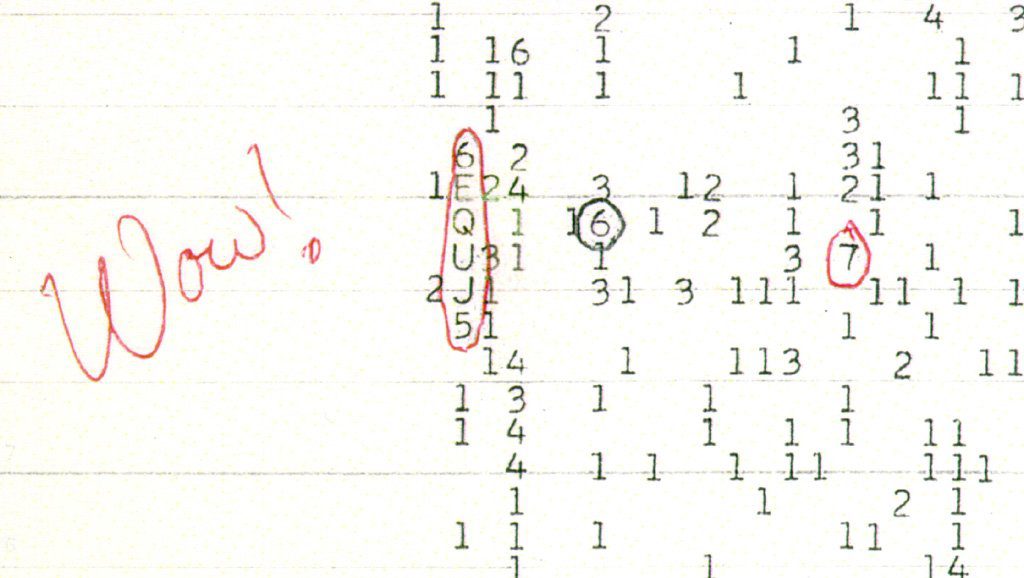
The signal appeared in a single 10-kilohertz channel, and a separate wide-band receiver at the telescope picked up nothing. Ehman measured its frequency at about 1420.4556 megahertz, close to the hydrogen line at 1420.4056 megahertz, the frequency at which neutral hydrogen gas naturally emits.
After circling the readings, Ehman showed them to Bob Dixon, the observatory’s assistant director, and to John Kraus. Big Ear had two feed horns pointing at slightly different parts of the sky, so a fixed source in space should have shown up twice in quick succession. The signal appeared in only one of the two, which meant it had either switched off in the minutes between the two passes or had never been steady at all.
What Caused the Wow Signal?
Nobody knows, because Ehman ruled out every ordinary source he could think of and the signal never came back. He worked through the possible sources one by one and published his analysis on the signal’s 20th anniversary. No planets were near that position in the sky, and asteroids give off too little radio energy. Satellites were ruled out because none were in the beam and the band around 1420 megahertz was protected from transmissions. Aircraft and spacecraft would have moved against the background stars, and Ehman judged a reflection of a signal from the ground unlikely.
The signal came from the direction of the constellation Sagittarius, and Big Ear kept watching the same strip of sky for about a month after the detection without seeing it again. Over the following years the telescope returned to that position more than 50 times and recorded nothing unusual.
In his analysis Ehman stopped short of calling the signal artificial, writing that an extraterrestrial intelligence might have sent it but that its origin remained an open question for him. In 2016 Antonio Paris, an astronomy professor at St. Petersburg College in Florida, proposed that hydrogen around two passing comets had produced it. Ehman and his former colleagues at the observatory rejected the idea, and the Oxford astrophysicist Chris Lintott said the comet’s emission was not bright enough or quick enough to fit.
The Searches That Came Up Empty
The most persistent hunter after Ehman was Robert Gray, a Chicago data analyst and amateur radio astronomer who visited Big Ear and talked to Ehman, Dixon and Kraus. Gray built a radio telescope with a 12-foot dish in Chicago and searched the region from his home for about fifteen years. He also used a 25-meter dish at Oak Ridge, Massachusetts, in 1987. Later he was given four hours on the Very Large Array in New Mexico in September 1995 and four more in May 1996.
The Very Large Array was far more sensitive than Big Ear had been. It found radio sources near the position of the Wow signal, but they were spread across a wide range of frequencies and were almost certainly natural. Gray later worked with the astronomer Simon Ellingsen on a 26-meter dish at Mount Pleasant in Tasmania in 1998 and 1999. Ellingsen observed for seven more hours in 2005 and found no trace of the signal.