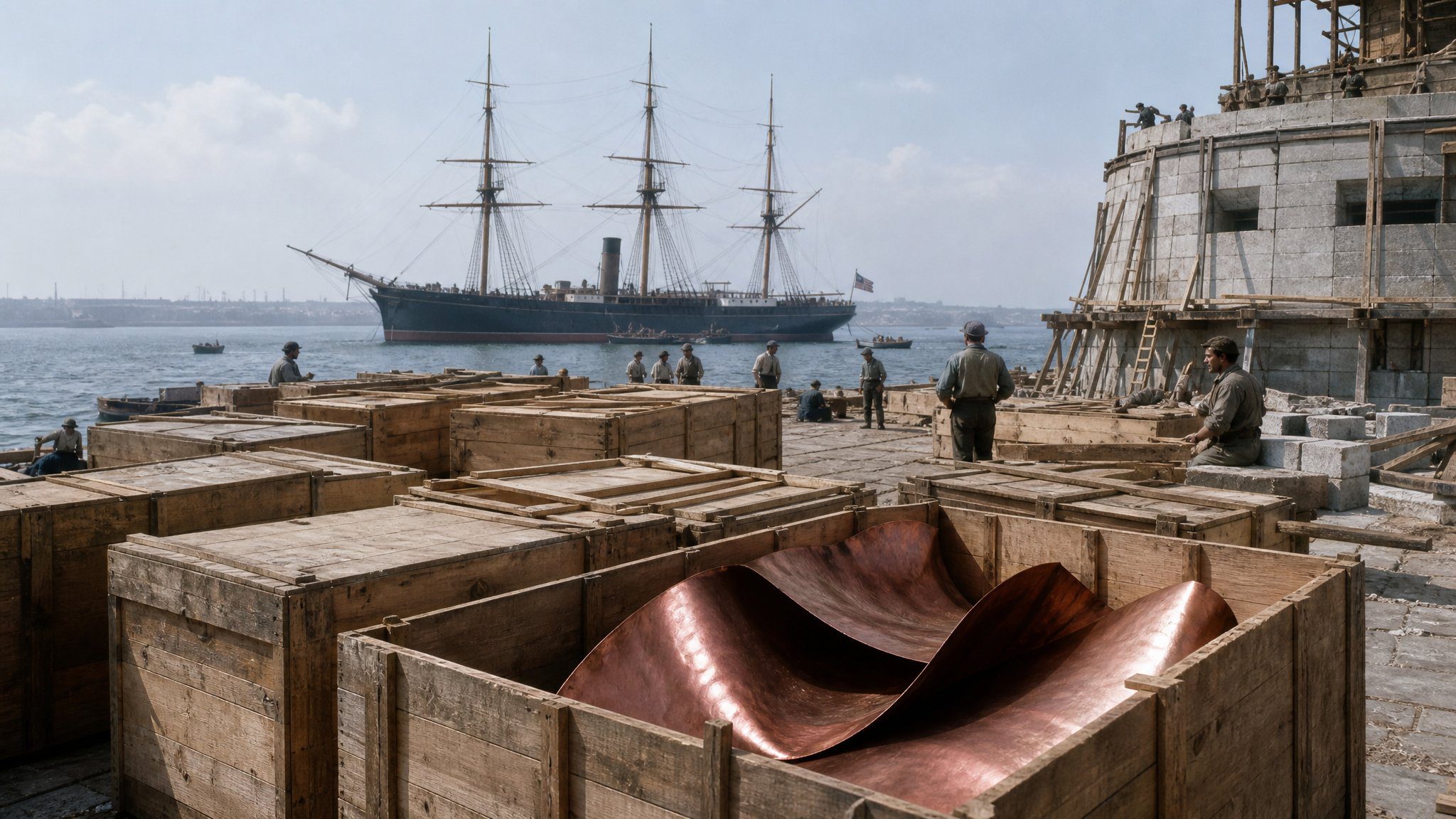
On June 17, 1885, the Statue of Liberty reached New York Harbor in 350 pieces packed into 214 crates, and the pedestal that was supposed to hold it was still unfinished.
The statue was a gift from the people of France, paid for by French subscribers, on the understanding that Americans would pay for the pedestal on Bedloe’s Island. That small federal island in New York Harbor is now called Liberty Island. France had delivered its part, a copper figure 151 feet tall that had already been assembled once in Paris and taken apart again for the voyage. The American fundraising had stalled so badly that work on the pedestal had stopped altogether the year before.
The crates waited on the island for almost a year while a newspaper campaign paid for the rest of the base, which was finally finished in April 1886. The statue was then reassembled on top of it. President Grover Cleveland dedicated Liberty Enlightening the World on October 28, 1886, more than fifteen years after a French law professor first suggested a monument of this kind.
Laboulaye, Napoleon III and a Monument for a Future Republic
The idea came from Édouard de Laboulaye, a Paris political thinker born in 1811 who was a leading French expert on the United States Constitution and the president of the French Anti-Slavery Society. In the years after the American Civil War, with the Union victorious and the Thirteenth Amendment abolishing slavery, he proposed a monument from France to the United States. He argued that honoring American democracy would strengthen the case for democracy in France. France was then ruled by the Emperor Napoleon III, and Laboulaye hoped the gift would inspire the French people to call for their own democracy in the face of a repressive monarchy.
The sculptor Frédéric Auguste Bartholdi took no immediate action on the idea, given the nature of the regime. The Franco-Prussian War of 1870 to 1871 delayed things further, since Bartholdi served in it as a militia major and his home province of Alsace was lost to Prussia. The war also ended the Second Empire, because Napoleon III was captured and deposed and a republic replaced him. In June 1871 Bartholdi sailed to New York with letters of introduction from Laboulaye and chose Bedloe’s Island because every arriving ship had to pass it. He met President Ulysses S. Grant, who told him the site would not be difficult to obtain.
Laboulaye waited until September 1875, when France was more politically stable, to announce the project and a fundraising body called the Franco-American Union, and the statue was given its formal name at the same time. French monarchists opposed it, partly because it came from Laboulaye, who had recently been made a senator for life. But the appeal drew money from schoolchildren and ordinary citizens as well as from 181 French municipalities. The Paris Opera staged a benefit on April 25, 1876, with a new cantata by Charles Gounod, the French government authorized a lottery, and by the end of 1879 about 250,000 francs had been raised. Laboulaye died in 1883, before the statue he had proposed was finished.
An Arm in Philadelphia and a Head in Paris
Bartholdi began with the pieces he could show the public, having the right arm and torch and the head built at the Gaget, Gauthier & Co. workshop in Paris. The copper skin was made by repoussé, a method in which sheets were heated and struck with wooden hammers. The sheets needed to be only 3/32 of an inch thick, which kept the statue light for its size. His mentor, the architect Eugène Viollet-le-Duc, chose the copper and the method and designed the folds of the robe.
The arm and torch were meant for the Centennial Exhibition in Philadelphia in 1876. They did not arrive until August, too late to be listed in the catalog, so some visitors knew the piece as the “Colossal Arm” or the “Bartholdi Electric Light.” In the exhibition’s last weeks fairgoers climbed up to the balcony around the torch to look out over the grounds. After the exhibition closed the arm went to New York, where it stood in Madison Square Park until 1882 as a way of drumming up money for the pedestal. It was then shipped back to France to be joined to the rest of the figure.
The head went on show at the 1878 Paris World’s Fair, and the Franco-American Union sold models of the statue and tickets to watch the workers in the Gaget, Gauthier & Co. workshop. On March 3, 1877, his last full day in office, President Grant signed a joint resolution authorizing the president to accept the statue, and his successor, Rutherford B. Hayes, selected Bedloe’s Island as the site. On the American side, a New York committee took charge of raising the pedestal money, and one of its members was a 19-year-old Theodore Roosevelt.
Read next
How the Cullinan Diamond Reached London by Parcel Post
Gustave Eiffel’s Iron Skeleton
Viollet-le-Duc had planned to support the skin on a brick pier filled with sand, but he fell ill in 1879 and died without leaving any plan for joining the copper to the masonry. In 1880 Bartholdi brought in Gustave Eiffel, the engineer who would later build the Paris tower that carries his name. Eiffel and his structural engineer Maurice Koechlin replaced the pier with an iron truss tower, or pylon. A secondary iron skeleton was attached to that pylon and connected loosely to the skin through flat iron bars ending in a mesh of straps called saddles, each made individually and riveted to the copper. That way the statue could flex in harbor winds and expand on hot days without cracking.
Eiffel insulated the copper from the iron with asbestos soaked in shellac to prevent galvanic corrosion between the two metals. His design made the statue one of the earliest examples of curtain wall construction, in which the outer surface carries no load. He also fitted two spiral staircases up to the crown and a single 40-foot ladder inside the narrow arm. The pylon’s parts were made at Eiffel’s factory in Levallois-Perret, outside Paris. Switching from masonry to iron meant the statue could be built in France and taken apart for shipping, where the earlier plan had been to assemble the skin on-site.
The United States ambassador to France, Levi P. Morton, drove the first rivet, fixing a copper plate to the statue’s big toe. By 1882 the figure was complete up to the waist, a stage Bartholdi marked by giving reporters lunch on a platform inside it. The finished statue was formally presented to Morton in Paris on July 4, 1884, and Ferdinand de Lesseps, who had succeeded Laboulaye as chairman, announced that the French government would pay to ship it. It stood in Paris until January 1885 and was then dismantled and crated, a total load of about 450,000 pounds that included 60,000 pounds of copper.
Pulitzer’s Readers and the Crates on Bedloe’s Island
The New York committee hired Richard Morris Hunt in 1881 to design the pedestal. Money problems forced him to cut his proposed height of 114 feet to 89 feet and to swap solid granite for poured concrete walls up to 20 feet thick, faced with granite from Branford, Connecticut. Work started on the foundation inside the star-shaped walls of the old Fort Wood in 1883, but critics objected to paying for the base of someone else’s gift. The New York Times wrote that no true patriot could approve such spending “for bronze females in the present state of our finances.” In 1884 Grover Cleveland, then governor of New York, vetoed a bill giving $50,000 to the project, and a proposal for $100,000 from Congress failed the next year. With only $3,000 left in the bank the committee stopped work while Boston and Philadelphia offered to pay for the statue if it were moved to them.
On March 16, 1885, Joseph Pulitzer’s New York World urged its readers, “Let us not wait for the millionaires to give us this money.” It promised to print the name of every donor, however small the gift. The paper published their notes as well, including a kindergarten class in Davenport, Iowa, that mailed in $1.35 and a group of children who sent a dollar they had saved to go to the circus. Meanwhile the Isère, a French Navy transport, left Rouen with the crates on May 21, 1885, and when it arrived about 200,000 people lined the docks, with hundreds of boats going out to meet it.
On August 11, 1885, the World announced that $102,000 had been raised from 120,000 donors, with 80 percent of the total given in sums of less than a dollar. Workers then anchored Eiffel’s framework to steel beams in the concrete and then fixed the copper sections in place while hanging from ropes, because the pedestal was too wide for scaffolding. Francis Longo, a 39-year-old Italian laborer, was killed during the construction when an old wall fell on him, although the general in charge, Charles Pomeroy Stone, said on dedication day that no one had died.
When the statue was dedicated it was the shiny reddish-brown of new copper, and by 1906 a green patina had covered it completely. Congress set aside money to paint it, but after public protest the Army Corps of Engineers studied the patina, concluded that it protected the skin, and painted the statue only on the inside.
More from Terribly Interesting
Sources
- Statue of Liberty-Ellis Island Foundation
- NPS, Édouard de Laboulaye
- NPS, Joseph Pulitzer
- National Park Service, “Creating the Statue of Liberty”
- National Park Service, “Pulitzer: In Depth”
- National Park Service, “Liberty Island Chronology”
- National Park Service, Statue of Liberty Historical Handbook 11
- Library of Congress Blogs, “This Day in History: Statue of Liberty”
- Smithsonian Magazine, “The Statue of Liberty Arrived in 350 Pieces”
- Encyclopaedia Britannica, “Statue of Liberty”