In December 2005, four divers spent about an hour in the open Pacific beside a 50-ton humpback whale, cutting away the crab-pot ropes that were dragging her under.
On Sunday, December 11, 2005, a crab fisherman spotted a female humpback whale caught in crab trap lines in open water east of the Farallon Islands, about 18 miles off San Francisco. By the afternoon a rescue team had reached her, and four divers went into the water with curved knives and cut her free by hand. When the last rope came away she swam to each diver in turn and nuzzled him before heading back out to sea.
Shelbi Stoudt, stranding manager at the Marine Mammal Center in Marin County, called it the first successful attempt on the West Coast to free an entangled humpback. She also pointed out how dangerous it had been, since a single flip of a humpback’s tail can kill a person. The divers came away convinced the whale had been thanking them, while whale experts said at the time that nobody could really know what was on her mind.
Entanglements like hers grew far more common off the West Coast in the decade that followed, and California’s Dungeness crab fishery now delays or shortens its season when humpbacks gather near the traps.
Twenty Crab-Pot Ropes Wrapped Around One Whale
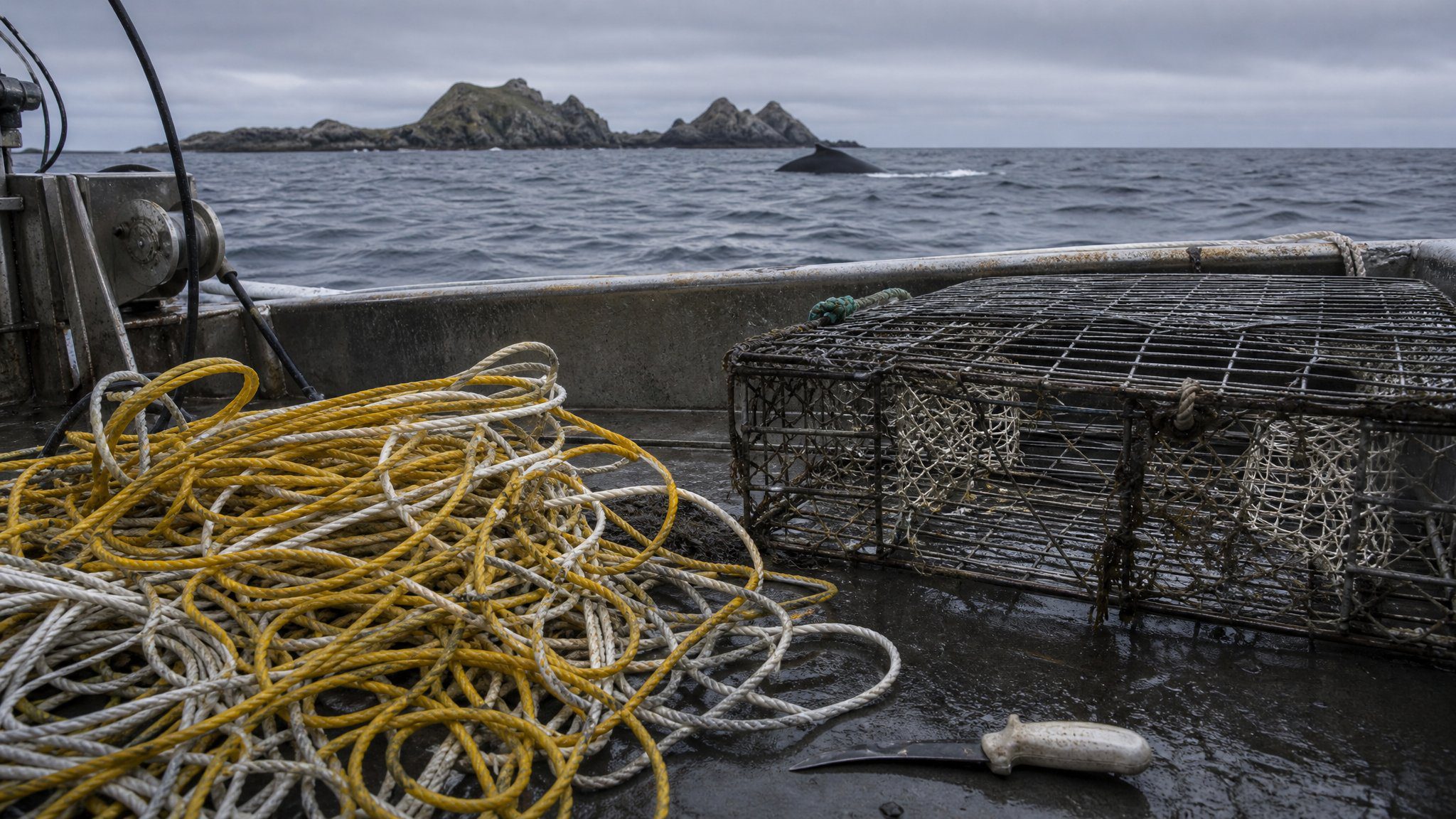
The whale was 45 to 50 feet long and was estimated to weigh 50 tons. She was traveling the route humpbacks use between the Northern California coast and Baja California when she swam into the nylon ropes that link crab pots together. Each of those ropes ran 240 feet, with a weight fixed to it every 60 feet along its length.
The call for help went to Mick Menigoz of Novato, who ran whale watching and shark diving trips to the Farallones on his boat, the New Superfish. He alerted the Marine Mammal Center on Sunday morning and gathered a team of divers, and by 2:30 p.m. the rescuers had reached the whale and looked over the situation. They concluded that the only way to save her was for divers to get into the water and cut the ropes themselves.
James Moskito, a 40-year-old diver from Pleasanton who worked for Great White Adventures, a cage-diving outfit that contracted with Menigoz, went in first. “I was the first diver in the water, and my heart sank when I saw all the lines wrapped around it,” he said afterward. “I really didn’t think we were going to be able to save it.”
About 20 crab-pot ropes were wrapped around her, looped at least four times around the tail, the back and the left front flipper, with another line running through her mouth. The lines had been pulled so tight that they were digging into her blubber and leaving visible cuts. At least 12 crab traps, each weighing 90 pounds, hung off her body, and the weight was dragging her down so that she had to struggle to keep her blowhole above the surface.
Read next
The Man Who Refused $50 Million for His Island
An Hour Beside the Eye of a Humpback
Moskito and the three other divers worked for about an hour, cutting through the ropes with special curved knives while the whale floated passively beside them. Moskito later said the animal gave off a strange kind of vibration the whole time they were working on her.
The most delicate part of the job was the line running through her mouth, which put Moskito’s face close to hers. “When I was cutting the line going through the mouth, its eye was there winking at me, watching me,” he said. “It was an epic moment of my life.”
Once the last rope was gone and the whale realized she was free, she began swimming in circles around the rescuers. She then swam to each diver, nuzzled him and moved on to the next one, a sequence the men in the water described in almost the same terms. “It felt to me like it was thanking us, knowing that it was free and that we had helped it,” Moskito said. “It stopped about a foot away from me, pushed me around a little bit and had some fun.”
“It seemed kind of affectionate, like a dog that’s happy to see you,” Moskito added, saying he never felt threatened during any of it. Menigoz, watching from the boat, was more cautious in how he put it. “You hate to anthropomorphize too much, but the whale was doing little dives and the guys were rubbing shoulders with it,” he said, adding that he couldn’t know for sure what the whale was thinking.
Whale experts were careful about the gratitude reading from the start. Stoudt noted that people do hear of friendly humpbacks approaching boats, especially off Baja California, but she added that for the most part the animals don’t like being interacted with.
Why Whale Rescuers Now Stay Out of the Water
The method used off the Farallones in 2005 is one that trained teams in the United States no longer use. NOAA Fisheries runs a national Large Whale Entanglement Response Network made up of biologists, veterinarians, fishermen, Coast Guard personnel and state staff. Its responders train heavily before they’re authorized under permit to approach an entangled whale, and its safety standards prohibit entering the water at all.
Responders instead work from boats, using grapples and knives with hooked blades mounted on long poles so that they spend as little time as possible near the animal. They often attach large floats to the trailing gear first, a technique NOAA describes as an adaptation of an old whaling method. The added drag and buoyancy stop the whale from diving deep and hold it near the surface. Satellite transmitters fixed to the gear let teams follow a whale for days or months until conditions allow a safe attempt.
NOAA warns that people, including trained and authorized responders, have died trying to free entangled whales.
Crab Pots and Humpbacks Off California
NOAA Fisheries has kept records of whale entanglements on the West Coast since 1982, and for years the numbers stayed low. Confirmed cases reached 50 in 2015 and 48 in 2016, a year in which 71 separate entanglements were reported off Washington, Oregon and California, the highest annual total since record keeping began. Humpbacks have been the species most often found entangled, followed by gray whales.
Fishermen and scientists linked the spike to a marine heat wave that pushed whales closer to shore while crab gear was concentrated in the same waters. “With warm water, no krill, high concentrations of crab gear, it was the perfect storm,” crab boat captain Dick Ogg told KQED. California set up a working group of fishermen, scientists and regulators in September 2015 to assess the risk and recommend ways to reduce it.
In October 2023 California postponed its commercial Dungeness crab season, due to open on November 15, along the coast from the Sonoma and Mendocino county line to Lopez Point in Monterey County. The state’s wildlife director said large groups of humpback whales were still feeding between Bodega Bay and Monterey, where the Farallones whale had been cut free of crab-pot rope eighteen years earlier.
More from Terribly Interesting
Sources
- San Francisco Chronicle, Peter Fimrite, “Daring rescue of whale off Farallones”, Dec 14, 2005
- San Francisco Chronicle, Peter Fimrite, “Daring rescue of whale off Farallones”, Dec 14, 2005
- NOAA Fisheries, West Coast Large Whale Entanglement Response Program
- NOAA Fisheries, 2016 West Coast Whale Entanglement Summary
- NOAA Fisheries, Large Whale Entanglement Response
- NOAA Fisheries, “Let Qualified Experts Respond to Entangled Whales” (Aug 12, 2022)
- KQED, March 2019
- Center for Biological Diversity
- Mongabay
- California Ocean Protection Council, RAMP Working Group statement
- CBS San Francisco, Oct 27, 2023
- KRON4