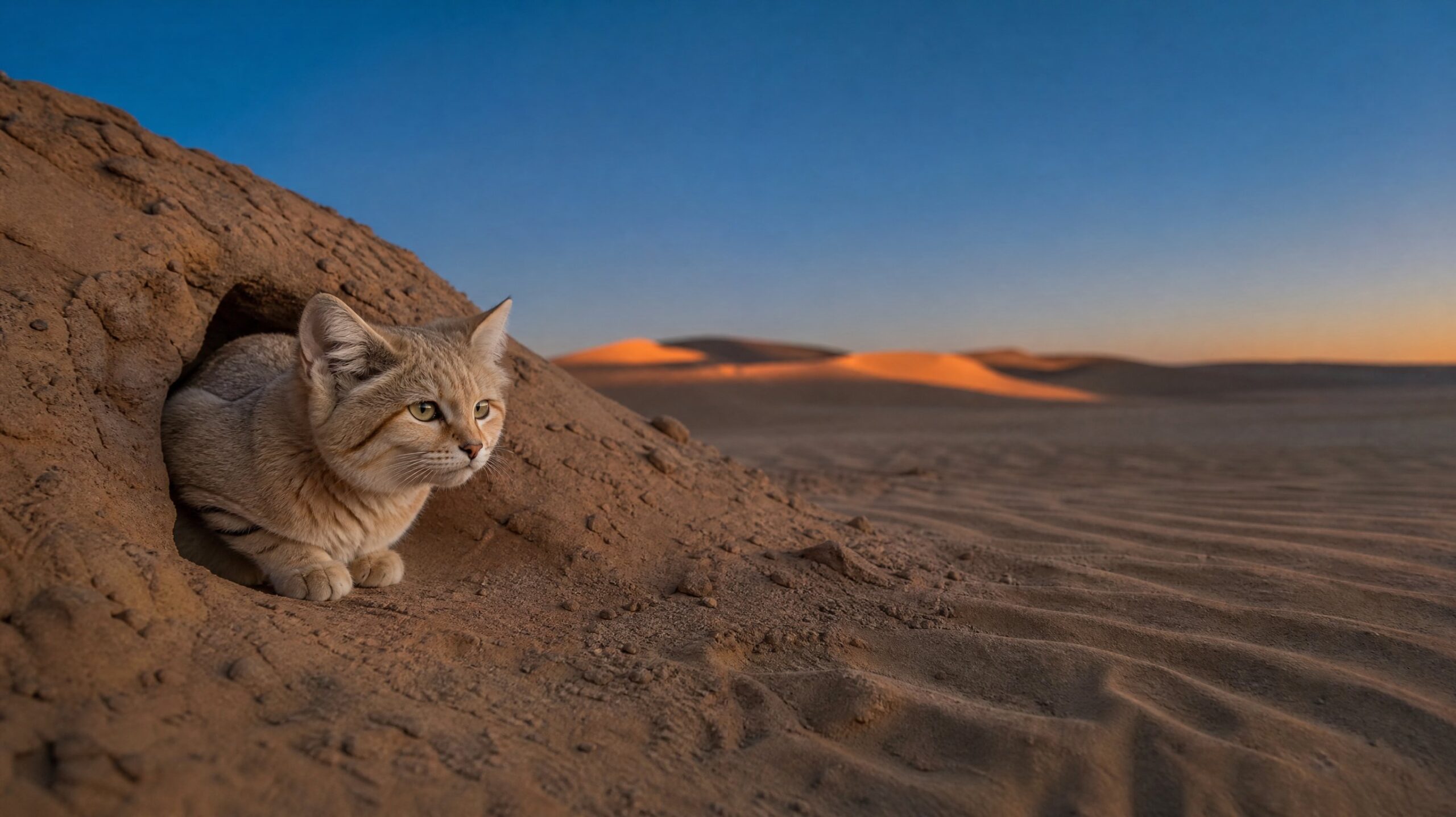
The sand cat lives in deserts where the ground can pass 50 degrees Celsius by day and fall below freezing at night, and it can go without drinking at all, taking the water it needs from the animals it eats.
The sand cat, Felis margarita, is the only wild cat found almost entirely in true desert. Its range is patchy and spread across three regions: the Sahara in North Africa, the Arabian Peninsula, and the deserts of Central Asia east of the Caspian Sea. It lives in places that get less than 20 millimeters of rain a year, where there is often no standing water for long periods. It will drink when water is available, but the rodents, reptiles, birds and insects it catches supply enough moisture for it to live without.
It is also one of the least understood cats in the world. It spends the day in burrows, hunts at night, leaves almost no footprints and crouches with its eyes shut when a light is shone on it. For most of the time since scientists described it in 1858, it was known mainly from scattered records and captive animals. Field studies in Morocco and the United Arab Emirates since the 2010s have begun to show how wild sand cats live.
Built for Heat, Cold and Moving Sand
After the black-footed cat of southern Africa, the sand cat is the second smallest member of the genus Felis. Adults weigh about 1.4 to 3.4 kilograms, and the head and body measure roughly 39 to 52 centimeters, with a long tail on top. Its coat is a pale sandy color that blends into dunes and gravel. It has faint bars on the legs, a black tip to the tail and a reddish streak running back from each eye across the cheek.
The temperatures it lives with are extreme in both directions, even in the shade. Summer shade temperatures in the Sahara can reach 58 degrees Celsius by day and drop to minus 0.5 degrees at night. In the northern part of its range, winter temperatures can fall to minus 25 degrees. In those northern areas the winter coat can grow up to 6 centimeters long, with soft woolly underfur that makes the cat look much larger than it is.
Dense dark fur grows between its toes and over the soles of its feet, completely covering the pads. It insulates the paws against hot and cold ground and keeps the cat from sinking into soft sand, and it also makes its tracks almost impossible to follow. The inside of each ear is lined with thick white hair, which probably keeps out sand during storms. Its claws do not fully retract and are blunt, because there is little in the desert to sharpen them on and they wear down from digging.
The cat spends the hottest hours in a shallow burrow dug into a dune or under a shrub, either digging its own or enlarging one made by another species. Several cats may use the same den, but not at the same time. At nightfall a sand cat sits at the entrance and watches the surrounding area for about 15 minutes before it leaves, and it takes up the same lookout position before going underground at dawn. It has occasionally been seen lying on its back outside the burrow in daylight, a posture that helps it shed body heat.
Hearing Prey Under the Sand
The sand cat’s ears are very large, set wide apart and low on a broad, flat head, which lets it stalk across open ground with little of its outline showing. The ear canals and the bony chambers of the middle ear are much larger than in other small cats. A 2002 study found that the sand cat’s ear canal and middle ear air space were about twice the size of a domestic cat’s. The researchers estimated that its hearing is about 8 decibels more sensitive.
The study also found that the sand cat’s outer ear is more efficient than a domestic cat’s at frequencies below 2 kilohertz. The dry desert air absorbs sound, and prey is scattered thinly and often underground, so a cat that can pick up faint low sounds can find rodents moving beneath the surface. When it locates one, it digs it out quickly.
Its diet includes gerbils, jerboas, sand voles, young hares, lizards, birds, spiders and insects. Among Saharan nomads the sand cat has a reputation as a snake hunter, particularly of horned vipers and sand vipers. It stuns them with rapid blows to the head before killing them with a bite to the neck. It covers larger kills with sand and comes back to finish them later.
Read next
Four Divers, One Knife Each and a 50-Ton Humpback Off the Farallones
Why Scientists Could Barely Find It
The French army officer Victor Loche described the species in 1858 from a specimen found in the northern Algerian Sahara. He named it after Jean Auguste Margueritte, the general who had led the expedition, and historical records of the cat after that are rare. The first study to track sand cats with radio collars took place in Israel in 1993, and the biologists found them extremely difficult to follow.
The cats’ furred feet left almost no tracks, and when a light was trained on one it crouched and closed its eyes so that no reflection showed. They also buried their droppings, which made it impossible to study their diet. Across its range, the sand cat’s known distribution is still pieced together from scattered sightings and camera trap records, and it is not clear whether the gaps on the map reflect missing cats or missing surveys.
In the United Arab Emirates, no sand cat had been photographed in the wild for about a decade by 2015. That March the Environment Agency Abu Dhabi set five camera traps in the Baynouna protected area, about 150 kilometers west of the city of Abu Dhabi. The researchers baited them with open cans of chicken and fish cat food, and the first sand cat appeared within a month. By December the cameras had recorded 46 images of three sand cats, one male and two females, most of them between midnight and 6 a.m. and about 40 percent during a full moon.
The last estimate for the emirate, made in 2005, was fewer than 250 sand cats. The species is listed as Least Concern on the global IUCN Red List, but it is classed as Endangered in the United Arab Emirates and Critically Endangered in Israel.
What the Moroccan Radio Collars Revealed
In 2012, reports of regular sand cat sightings began coming out of the Moroccan Sahara, and two cat specialists decided to look for themselves. Gregory Breton, who later became director of the conservation group Panthera France, and Alexander Sliwa, a curator at the Cologne Zoo in Germany, traveled to Morocco in their own time in 2013. Nine days into the trip they had seen nothing, and at the end of it they found three sand cats.
With the Rabat zoo and a permit from the Moroccan government, they began catching and collaring the cats, forming what became the Sand Cat Sahara Team. Between December 2015 and December 2019 the team observed 47 sand cats, caught 41 and fitted 22 with VHF radio collars. Seventeen of the collared cats repeatedly vanished from range, sometimes reappearing days or months later.
The explanation came when the team followed one collared male beyond its study area and found that it had traveled more than 13 miles in a straight line overnight. The team now estimates that home ranges can cover at least 120 square miles for males and about 100 for females, which would make them the largest known for any small cat. The Moroccan sand cats did not appear to be territorial and tolerated one another. The researchers suspect they are partly nomadic, leaving areas where there has been no rain and the prey has disappeared.
At about 2 a.m. on April 26, 2017, near the end of the team’s fifth expedition, Sliwa was shining a spotlight from the roof of their vehicle when three pairs of eyes reflected back. They belonged to sand cat kittens, about 4 kilometers from the team’s camp, and from experience with captive litters the researchers judged them six to eight weeks old, too small to collar. The team spent an hour photographing and filming them and set up camera traps nearby before leaving. Breton wrote that it was the first time researchers had documented wild sand cat kittens in the species’ African range. As the team left, it caught and radio-collared an adult female that had been roaming nervously nearby, which the researchers thought could be the kittens’ mother.
What is known of sand cat breeding comes mostly from captivity and a handful of wild records. In the Sahara, kittens are born between January and April after a pregnancy of about 60 to 67 days, usually in litters of three or four, each weighing 50 to 60 grams at birth. They become independent at three to four months. Adults are solitary and find mates with a loud call that sounds like the bark of a small dog.
More from Terribly Interesting
Sources
- Animal Diversity Web (University of Michigan)
- IUCN SSC Cat Specialist Group
- International Society for Endangered Cats Canada
- Mongabay
- Smithsonian Magazine
- Huang, Rosowski and Peake, Journal of Comparative Physiology A (2002), PubMed
- Springer
- Mammalian Species (Oxford Academic, Sliwa 2015)
- The National
- Panthera
- Smithsonian Magazine (video story dated October 12, 2017)