An elephant’s trunk has no bones, and the most detailed count so far puts the number of muscle bundles inside it at about 90,000, more than twice the 40,000 figure that is usually quoted.
The trunk is a fusion of the nose and upper lip. It is made of muscle, blood and lymph vessels, nerves, connective tissue, skin, hair and bristles, with cartilage only at its base between the nostrils. An elephant uses it to breathe, smell, drink, feed, touch other elephants, lift, push and dig.
The figure of 40,000 goes back to the 19th-century French anatomist Georges Cuvier, and other estimates have run as high as 150,000. In 2023 researchers in Berlin traced the trunk’s muscle bundles in a detailed scan and estimated about 90,000. The smallest of them, packed into the tip, help explain how the same trunk that pulls down branches can pick a single blade of grass off the ground.
Counting the Muscles in a Trunk
The trunk belongs to a class of organs called muscular hydrostats, which also includes the human tongue and the arms of an octopus. None of these organs has a skeleton, so their muscles use one another for leverage, pulling against each other and against the surrounding tissue. That arrangement lets the trunk bend, stretch, shorten and twist at almost any point along its length.
Older counts of trunk muscles were based on dissection and extrapolation from cross-sections. Cuvier estimated 30,000 to 40,000 muscle fascicles, the bundles of muscle fibers that act as working units, and the elephant biologist Jeheskel Shoshani later put the number at about 150,000. The Smithsonian’s National Zoo describes the trunk as having about 150,000 muscle units and tendons.
In 2023 a team led by the neuroscientist Michael Brecht of Humboldt University of Berlin scanned the trunk of a six-day-old Asian elephant calf born at the Leipzig Zoo. The work was carried out with Luke Longren and Lennart Eigen. They used micro-computed tomography to trace thousands of individual fascicles in parts of the trunk and extrapolated to an estimate of about 90,000 for the whole organ. The finger and the lip at the tip alone contained about 8,000 extremely fine fascicles. The study was published in the journal Current Biology in September 2023.
Three Kinds of Muscle in One Organ
The trunk’s fascicles fall into three types, each with its own job. Longitudinal fascicles form the outer layer and run the length of the trunk, and they are the longest in the organ. When they contract, the trunk shortens and bends up, down or sideways.
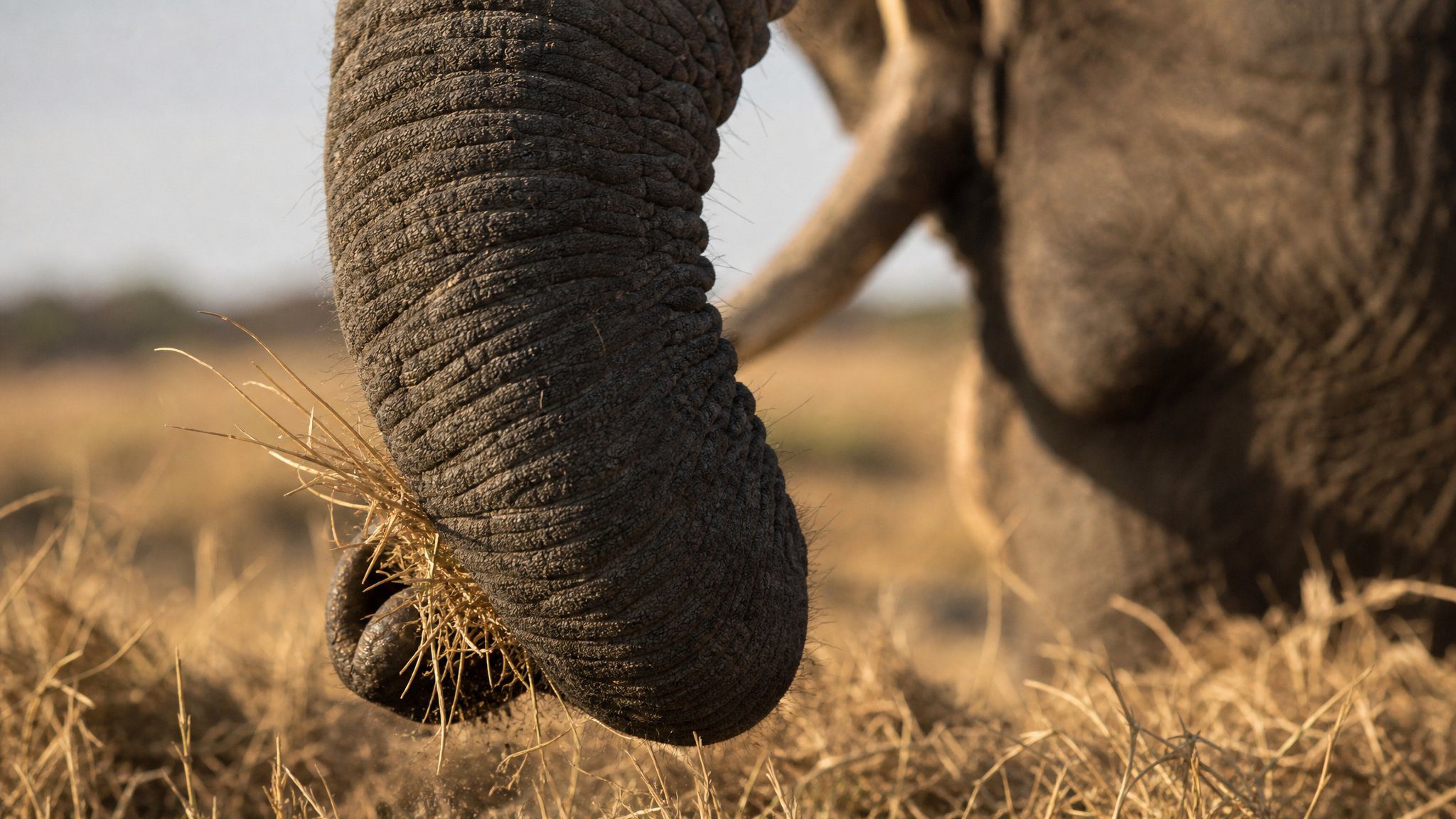
The radial fascicles are short and point outward from the nostrils toward the skin. They make up most of the trunk’s muscle bundles, and they are at their smallest in the tip of the finger, which the researchers linked to fine motor control. Transverse fascicles run across the trunk between the two nostrils and widen or narrow them. Radial and transverse fascicles together lengthen the trunk and let it enlarge the nasal passages.
The tip is shaped differently in the two main groups of elephants, and so is the way they grasp. African savanna elephants have two finger-like projections at the tip, one above and one below, and pinch food between them. Asian elephants have one finger on the upper side and a thickened bulb below. They wrap the trunk around objects, and they can flip the bulb backward to clamp something behind the tip.
A 2025 study in the journal Communications Biology scanned the trunk tips of three adult African and three adult Asian elephants. In the African tips, about a third of the fascicles were longitudinal and two-thirds radial or transverse, suited to pinching. The Asian tips had the reverse proportions, which suits wrapping and clamping.
Read next
The Sacred Golden Langur of India and Bhutan
A Hose, a Vacuum and a Nose
In 2021 researchers at the Georgia Institute of Technology, led by the mechanical engineering doctoral student Andrew Schulz, measured how elephants at Zoo Atlanta use their trunks to move air and water. An elephant sucked up 3.7 liters of water in 1.5 seconds, a rate of about 3 liters a second. The researchers estimated the air speed inside the trunk at about 150 meters per second, some 30 times faster than a human sneeze.
Ultrasound images of the trunk wall showed how it can hold so much water. By contracting its muscles, an elephant can widen its nostrils by up to 30 percent, thinning the trunk walls and increasing the volume of the nasal passages by 64 percent. “It turns out their trunks act like suitcases, capable of expanding when necessary,” Schulz said. The team calculated that an elephant can store up to 5.5 liters of water in its trunk before spraying it into its mouth.
The Zoo Atlanta elephants also used suction to pick up food as well as water. They vacuumed up small cubes of rutabaga, and when given a tortilla chip, an elephant sometimes pressed down and breathed in, holding the chip against the tip of its trunk without breaking it. The researchers found that elephants are the only animals known to use suction both on land and underwater. An elephant eats about 400 pounds of food a day and spends up to 18 hours a day gathering it with its trunk. “An elephant uses its trunk like a Swiss Army Knife,” said David Hu, Schulz’s adviser. “It can detect scents and grab things. Other times it blows objects away like a leaf blower or sniffs them in like a vacuum.”
The trunk is also the elephant’s organ of smell, and that sense is highly developed. A 2014 genome study by Yoshihito Niimura of the University of Tokyo found that African elephants carry about 2,000 olfactory receptor genes. That was the largest number found in any animal studied, more than twice as many as dogs and five times as many as humans. Elephants can tell another elephant’s identity, sex and reproductive state by smelling its mouth, temporal gland, genitals, urine or dung. They also touch one another with their trunks constantly in greeting, reassurance and play.
A Thousand Whiskers
Much of the trunk’s fine sense of touch comes from hair rather than skin. About 1,000 whiskers cover an elephant’s trunk, compensating for thick skin and poor eyesight, and a study published in the journal Science in 2026 found that they are built differently from the whiskers of rats and mice. The research was led by Andrew Schulz, now at the Max Planck Institute for Intelligent Systems in Germany, with Katherine Kuchenbecker, and it examined whiskers about 5 centimeters long from elephants and domestic cats.
Micro-CT scans showed that elephant whiskers are thick and blade-like, flattened in cross-section, with a hollow base and long internal channels like those in sheep horn and horse hoof. Their stiffness changes gradually from a stiff, porous base to a soft, rubbery tip, as in cats. The researchers think this gradient tells the elephant where along a whisker contact is happening, which helps it pick up a tortilla chip without breaking it or grab a single peanut. The whiskers never grow back, and the porous structure helps them survive the hundreds of kilograms of food an elephant eats every day.
Digging Wells in Dry Riverbeds
In the dry season, elephants in arid parts of southern Africa dig wells in the sandy beds of seasonal rivers to reach the water beneath. They use their feet and trunks to dig, and their tusks to loosen hard ground. In the Kunene region of northwestern Namibia, where desert-dwelling elephants live along rivers that carry surface water only part of the year, the wells can reach about a meter deep.
The wells are used by many other animals once the elephants have finished, including springbok, jackals and baboons. The elephants in Kunene also damage the pipes and pumps of community boreholes to get at the water, even when an artificial drinking pool is right beside them.
The Namibian elephants often dig wells right next to flowing surface water or pools, which puzzled researchers. In 2013 Eva Ramey, Rob Ramey and colleagues tested water from freshly dug elephant wells and from the nearest surface water across two field seasons. In 13 paired comparisons, the wells had significantly fewer fecal coliform bacteria than the surface water beside them, and they were no less salty. The researchers concluded that the elephants dig to reach cleaner drinking water. The two boreholes the elephants periodically damaged also had far lower coliform counts than the nearby pools, which the researchers took as the same preference at work.
More from Terribly Interesting
Sources
- Smithsonian’s National Zoo
- HERD (Hoedspruit Elephant Rehabilitation and Development)
- Communications Biology (2025)
- Current Biology (Longren et al. 2023)
- Cleveland Zoological Society
- Science (AAAS news)
- Georgia Tech College of Engineering
- ScienceDaily
- University of Tokyo
- PMC
- Pachyderm No. 53 (2013)
- Max Planck Society
- Science
- Phys.org (February 2026)