Brendon Grimshaw turned down $50 million for Moyenne, the tiny Seychelles island he had bought for £8,000 and spent most of his life replanting, because he did not want it turned into a holiday island for millionaires.
Grimshaw, a newspaper editor from Dewsbury in Yorkshire, bought Moyenne in 1962, when it had been abandoned for almost half a century and was so overgrown it could not be walked across. The island lies about 4.5 kilometers off the north coast of Mahé, the main island of the Seychelles, and measures about 400 meters by 300 meters. Over the next four decades Grimshaw and a Seychellois helper, René Antoine Lafortune, planted about 16,000 trees by hand, cut roughly 4.8 kilometers of paths, and brought in giant tortoises.
In June 2008, after years of effort to keep the island out of private hands, Moyenne was declared a national park. It is often described as the smallest national park in the world. Grimshaw died on July 3, 2012, and was buried on the island.
An Editor Looking for an Island
Grimshaw was born in Dewsbury, in West Yorkshire, on July 27, 1925. By the early 1960s he was working as a newspaper editor in Nairobi, Kenya. Tanganyika, now part of Tanzania, had just become independent and Kenya was about to follow, and Grimshaw, then in his late 30s, expected his job to pass to a local journalist. He wanted a life closer to nature and had begun to think about owning land in the Seychelles.
He went to the islands on holiday to see whether the idea was possible and found that the few islands for sale were expensive. Shortly before he was due to leave, a young man stopped him in the street and asked whether he wanted to buy an island. They went out to Moyenne the same day. “It was totally different,” Grimshaw said many years later. “It was a special feeling. This is the place I’d been looking for.”
The island had been left empty since 1915, when its last resident, an eccentric Englishwoman named Emma Best, moved away. By the time Grimshaw arrived, weeds had choked the native plants, the undergrowth was so thick that falling coconuts did not reach the ground, and rats were almost the only wildlife.
Sixteen Thousand Trees
Grimshaw moved to Moyenne permanently in the early 1970s and hired Lafortune, a local man, to help him. The two cut paths through the forest, cleared scrub and began planting. For the first 18 months after he settled there, with no water supply of his own, they rowed to Mahé every day to bring back a barrel of water. Over time the island gained water, electricity and a telephone line.
The planting eventually reached about 16,000 trees, including around 700 mahogany trees that grew 60 to 70 feet tall. The island’s trees now include mango as well as mahogany and palms, and by 2012 Moyenne held more than two-thirds of the plant species endemic to the Seychelles. The paths they cut, about 4.8 kilometers in all, were lined with displays naming the trees.
Bringing birds back to Moyenne proved much harder than planting trees. Grimshaw once carried 10 birds over from a neighboring island, and they promptly flew home. He tried again, and this time a few returned and stayed. He and Lafortune fed them, and as the new trees began to bear fruit more birds settled, until about 2,000 were living on the island.
Read next
Why Female Sloths Call Through the Rainforest to Mate
Tortoises in the Bedroom
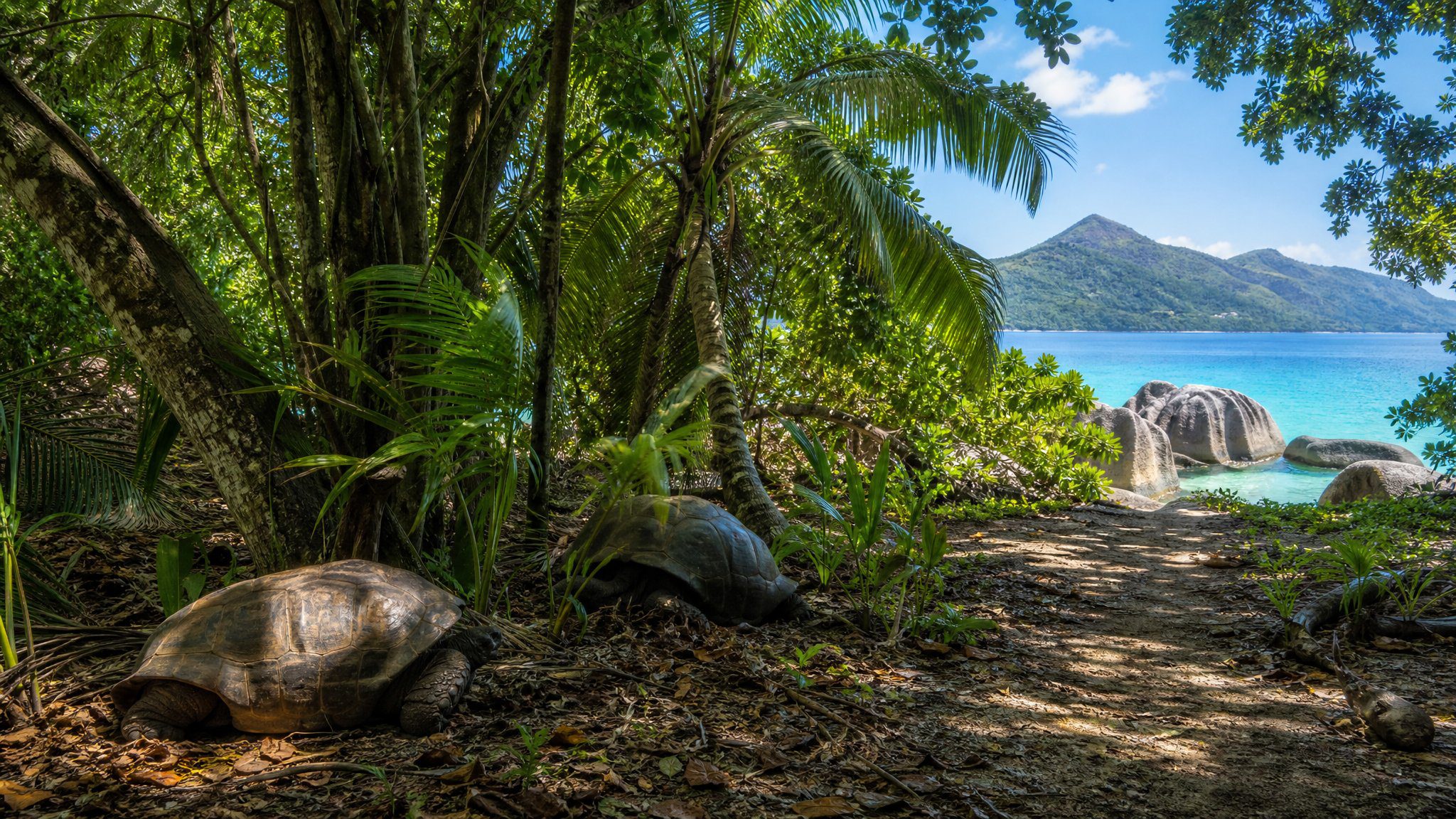
The animal most associated with Moyenne is the Aldabra giant tortoise, a species native to the Seychelles that had disappeared from many of its islands. Grimshaw brought tortoises to Moyenne, painted numbers on their shells so that he could tell them apart, and started a breeding program. “The babies are kept in my bedroom,” he told the Financial Times in 2008. “If you let them go, you’ll never see them again.”
By the time of his death Grimshaw was caring for about 120 tortoises. The tortoises roam the island freely, and some visitors’ guides describe the oldest as more than a century old.
Grimshaw did not spend all those years on the island alone. When his mother died in 1981, he invited his father, then 88, to come and live with him, and was surprised when he agreed. “We had a wonderful time together and became the best of friends,” Grimshaw said. His father died five years later and was buried on the island, next to a grave Grimshaw had already dug for himself.
The Offer and the National Park
As the island grew greener, it also grew more valuable to developers. Grimshaw turned down several offers to buy it, the largest of them $50 million, saying he wanted Moyenne to become a national park for everyone to enjoy. Day-trippers were allowed to visit from Mahé for a small fee, and with no jetty they had to wade ashore, where Grimshaw often met them himself.
Lafortune died in 2007, leaving Grimshaw, then 81, without the partner who had worked beside him for decades. Unmarried and with no children, Grimshaw set up a trust and signed an agreement with the Seychelles Ministry of Environment, and in June 2008 Moyenne was declared a national park. It covers about 9.9 hectares and lies within Ste. Anne Marine National Park, just north of the capital, Victoria.
The environment ministry now oversees the island, and visitors arrive on day trips from Mahé to walk the trails past Grimshaw’s house and the graves, look for white-tailed tropicbirds in the trees and snorkel on the coral reefs around the shore.
Grimshaw published the story of his life on the island in 1996 as a book, A Grain of Sand. He appeared in many documentaries, the last of them filmed by the British presenter Simon Reeve shortly before his death.
Pirates, Graves and Buried Treasure
Moyenne’s other attraction for visitors was a legend of pirate gold. The waters around the Seychelles were a hunting ground for pirates in the 18th century, among them the Frenchman Olivier Levasseur, known as La Buse. He was hanged in 1730, and the story goes that on the scaffold he threw a sheet of coded clues into the crowd. Searchers have been digging on Mahé and other islands ever since, with the most attention at Bel Ombre in northern Mahé. While clearing the overgrown northwest corner of Moyenne, Grimshaw found two graves whose stones read “Unhappily Unknown.”
Local legend held that pirates killed men and buried them beside their loot so that their spirits would guard it. Grimshaw believed that treasure lay on the island and that a ghost guarded it, and he took the stories seriously enough to dig twice near the graves. In his book he described stopping his first attempt when two coconuts fell beside him just as his spade struck a slab of coral concrete. His second excavation went down about 16 feet, and he found nothing. After the first attempt he noticed charcoal beside the graves, left by someone who had dug there secretly. A local told him the legend that only the person who dreams of a treasure can find it, and that anyone else digs up nothing but charcoal.
At his request, Grimshaw’s tombstone on Moyenne reads, “Moyenne taught him to open his eyes to the beauty around him and say thank you to God.”