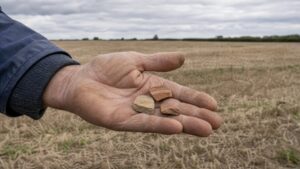
A charred lump of papyrus about eight centimeters tall, sealed since Mount Vesuvius erupted in AD 79, has been read from its first column to its last by digitally unwrapping it inside an X-ray scan, without anyone peeling back another layer.
On June 25, 2026, the Vesuvius Challenge announced that the Herculaneum scroll catalogued as PHerc 1667 had been digitally unwrapped and read in full. The prize competition, co-founded by University of Kentucky computer scientist Brent Seales, recovered nearly a meter and a half of continuous Greek text in about twenty columns. The roll belongs to the National Library of Naples Vittorio Emanuele III, and it is the first Herculaneum papyrus to be digitally unwrapped and read from end to end.
The text is a philosophical treatise on ethics that deals with human nature, impulse and moral progress. A reference to Aristocreon, the nephew and pupil of the Stoic philosopher Chrysippus, places it among the Stoics, and papyrologists date the handwriting to the second century BC, possibly as early as the late third. That dating would make it one of the oldest rolls in the collection.
The scroll was scanned with high-resolution X-rays on the BM18 beamline of the European Synchrotron Radiation Facility in Grenoble, France. Machine learning models trained to recognize ink on carbonized papyrus then picked out the writing inside the three-dimensional scan. A team of papyrologists led by Federica Nicolardi of the University of Naples Federico II read and transcribed the columns the software had made visible.
Caesar’s Father-in-Law and the Library Under Herculaneum
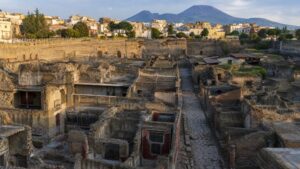
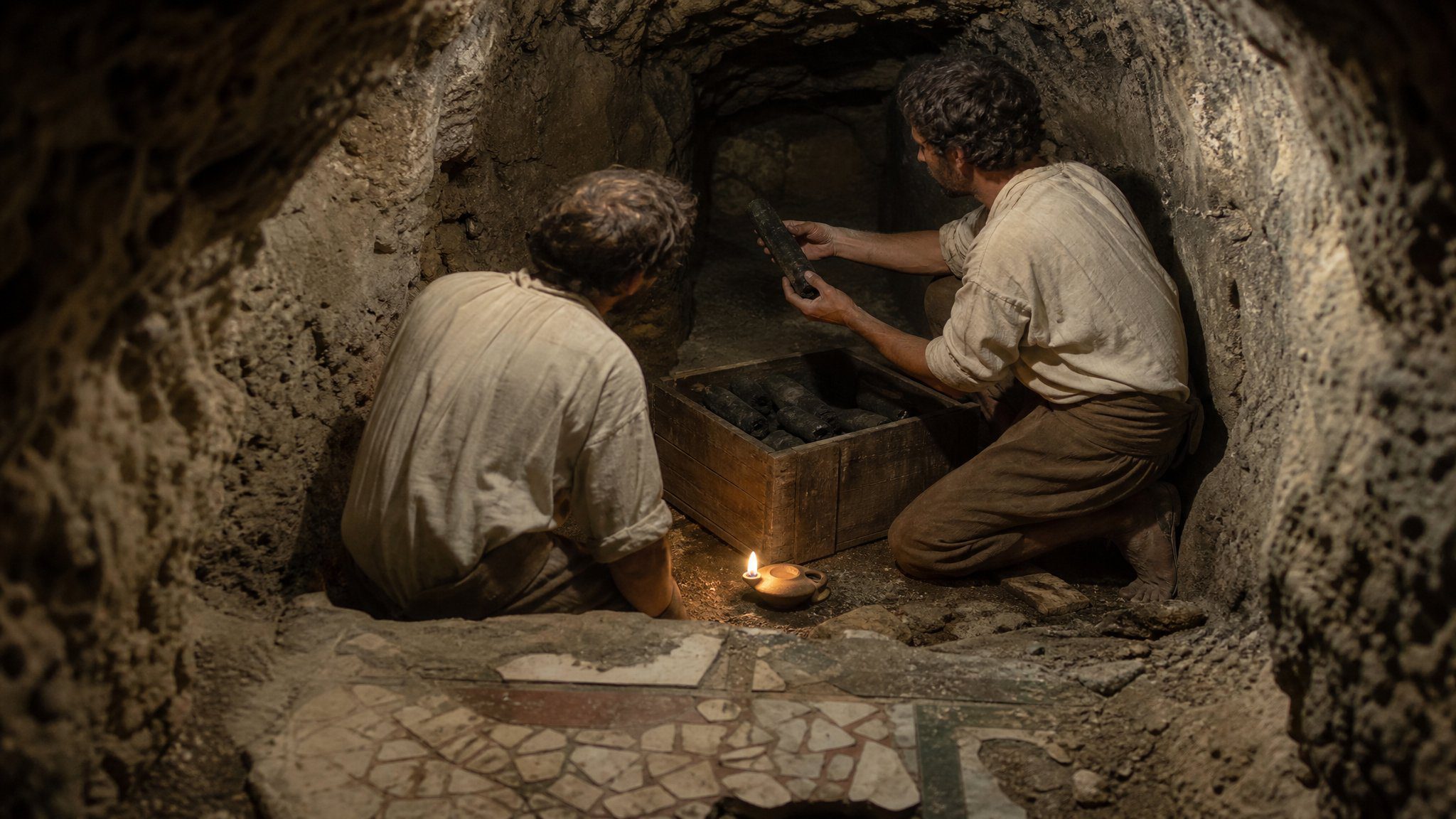
In 1750 well diggers working near the royal palace at Portici struck a polychrome marble floor, and the Swiss military engineer Karl Weber was put in charge of exploring the building beneath it. His workers followed the buried villa through tunnels and shafts, struggling with poor light, bad air and noxious fumes, until dangerous gases forced the work to stop in 1761.
Between 1752 and 1754 they brought out the carbonized papyri that gave the building its modern name, the Villa of the Papyri. Estimates of the haul vary with how the pieces are counted, from about 1,100 scrolls to some 1,800 fragments that may represent around 800 original rolls. Together they make up the only library known to have survived from classical antiquity.
The villa is generally attributed to Lucius Calpurnius Piso Caesoninus, consul in 58 BC and the father of Calpurnia, the wife of Julius Caesar. Piso was the patron of Philodemus of Gadara, an Epicurean philosopher who had studied at Epicurus’s school in Athens. Most of the texts identified so far are Greek works of Epicurean philosophy, and many of them were written by Philodemus himself.
The heat of the pyroclastic flows that buried Herculaneum carbonized the rolls, and the mud that followed sealed them away from oxygen, which is why they survived at all. The same process left them as brittle black cylinders that crumble when handled, with writing in carbon-based ink lying on papyrus that had itself been turned to carbon.
Two Centuries of Opening Scrolls by Hand
The first people to tackle the rolls after the excavation cut them apart and scraped away their layers to reach the writing, and those methods destroyed much of what they exposed. In June 1753 King Charles of Bourbon asked the director of the Vatican Library to send Antonio Piaggio, a priest from Genoa who looked after manuscripts in the Vatican, to Portici to help.
Piaggio built a machine that lifted the edge of a roll with silk threads attached to the papyrus and drew it slowly upward, separating the fused layers a little at a time. The work took months for a single roll, and it still damaged the papyrus, yet machines based on his design opened almost all of the Herculaneum texts that can be read today.
Later scholars kept experimenting with chemistry and imaging over the following two centuries. In the 1980s a Norwegian team led by Knut Kleve, working with the National Library in Naples, developed a method of loosening the layers with acetic acid, gelatin and water. A team from Brigham Young University later adapted multispectral imaging to photograph the fragments that had already been opened.
PHerc 1667 went through much of this history itself, as attempts to open it by hand in the nineteenth century, again in 1969 and once more in the 1980s destroyed its outer layers. What remained was a compact inner core about 8 centimeters tall, from a roll that originally stood 19 to 24 centimeters high. When it was partly opened in the 1980s it was given a readability score of zero, because its overlapping layers hid the writing.
Read next
Scientists Found Human Brain Tissue Turned To Glass At Herculaneum
Finding Carbon Ink Inside a Sealed Roll
The ink was the central obstacle for any X-ray method, because carbon-based ink and carbonized papyrus absorb X-rays in almost the same way. A conventional scan therefore shows the shape of the roll with almost no contrast where the letters sit. In 2016 a published study used X-ray phase-contrast tomography, which picks up subtler differences in how a material affects the beam, to read letters inside Herculaneum papyri without opening them.
Seales had been working toward the same goal at the University of Kentucky for years. His team built software called Volume Cartographer, which traces each wrap of papyrus through a 3D scan and flattens it into a readable 2D surface. By the time of the 2026 announcement the Kentucky team had scanned 45 scrolls.
Seales launched the Vesuvius Challenge on March 15, 2023, with backing from Nat Friedman, the former chief executive of GitHub, and the investor Daniel Gross. The contest released its scan data openly and offered cash prizes for each stage of progress. Later that year Luke Farritor, a 21-year-old college student and SpaceX intern from Nebraska, recovered porphyras, the Greek for purple, as the first word read from inside a sealed Herculaneum roll. The word won him the $40,000 First Letters prize.
On February 5, 2024, the $700,000 Grand Prize went to Farritor and two other young researchers working as a team. He shared it with Youssef Nader, an Egyptian PhD student in Berlin, and Julian Schilliger, a Swiss robotics student at ETH Zurich, for recovering 15 columns of PHerc Paris 4. That was about 5 percent of the scroll, and the text, probably by Philodemus, discussed pleasure, music and food.
A Stoic Text in an Epicurean Library
For PHerc 1667 the machine learning models acted as visibility amplifiers for the experts, marking where ink was likely to be so that papyrologists could read and check every line by eye. The transcribed columns discuss ethics, the arts and human behavior across the whole surviving length of the roll. One passage, in the team’s translation, reads “we will inquire into something, but we will not grasp it, if in some way we depart from ourselves and from our own nature.”
The author is still unknown, but a column naming Aristocreon, Chrysippus’s nephew and student, helped the team place the work in the Stoic school. It was found in a library whose identified texts are largely Epicurean, the school to which Philodemus belonged.
Hundreds of Rolls and an Unfinished Villa
Hundreds of Herculaneum scrolls remain unopened in Naples and other collections. The team released its methods and data so that the same sequence of scanning, virtual unwrapping and ink detection can be applied to the rest of them.
The villa itself has never been fully excavated, and digs in the 1990s and 2000s found previously unknown lower levels, rooms with mosaics and frescoes, and a seaside pavilion with sculptures and furnishings. Those finds dated the villa’s construction to about 40 BC. Scholars including Richard Janko have argued that a Latin library may lie in the parts that are still buried, since the collection found so far is overwhelmingly Greek.
A record from 1782 describes PHerc 1667 as a compressed but largely intact object, the same height as today but more than twice as wide. The Stoic treatise read in 2026 survives on the inner part of the roll that the later attempts to open it by hand had left behind.
More from Terribly Interesting
Sources
- Vesuvius Challenge
- University of Kentucky
- Gizmodo
- Discover Magazine
- arXiv 2606.29085
- Archaeology Magazine
- J. Paul Getty Museum
- University of Oxford Herculaneum papyri project
- CISPE Marcello Gigante
- Richard Janko, University of Michigan
- Bukreeva et al. 2016, PMC
- Scientific American
- Vesuvius Challenge
- University of Nebraska-Lincoln
- World History Encyclopedia