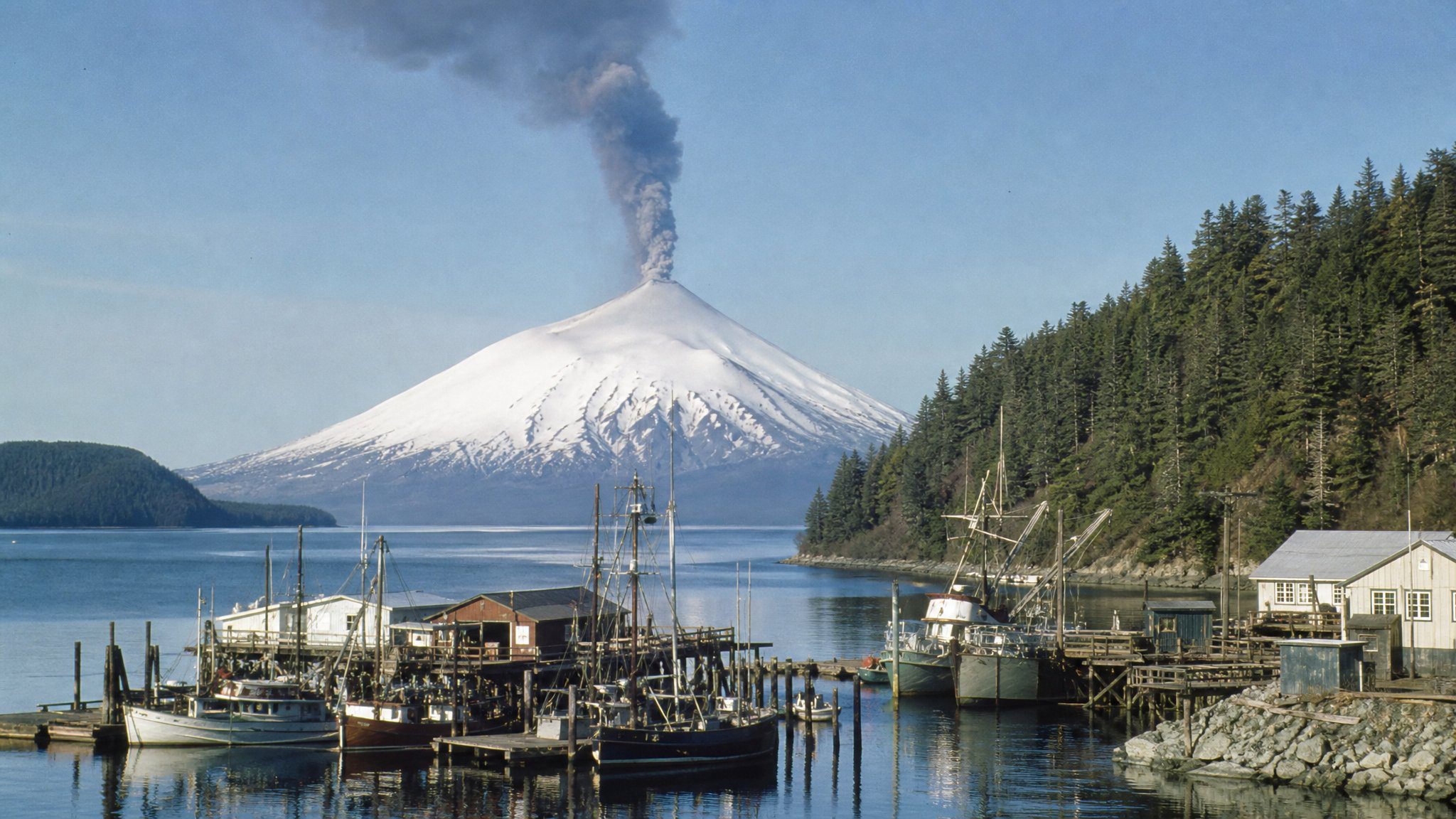
On the morning of April 1, 1974, black smoke began pouring out of the crater of Mount Edgecumbe, the long-dormant volcano across the water from Sitka, Alaska, and the town’s phones started ringing.
The smoke came from about 70 old tires soaked in kerosene and diesel. A local logging equipment dealer named Oliver “Porky” Bickar had flown them into the crater by helicopter and set them on fire. He had been planning the stunt since 1971 and had warned the police, the fire department and the air traffic controllers in advance. He forgot to tell the Coast Guard, which sent a helicopter to investigate and found a ring of burning tires and the words APRIL FOOL spray-painted in the snow in 50-foot letters.
Geologists date the volcano’s last eruption to about 4,000 years before the prank. The prank became national news through the Associated Press and still appears on lists of the best April Fools’ jokes ever played. Forty-eight years later, in April 2022, the volcano began producing earthquakes for real, and scientists found that magma was moving beneath it.
Porky Bickar and the Plan
Bickar was born in 1923 and enlisted in the US Army in 1942. He served in a unit that waterproofed tanks and trucks for the D-Day landings and arrived in Normandy three days after the invasion. He then served with General George Patton’s Third Army across France, Belgium and the Rhine. In 1984 he told the Daily Sitka Sentinel how he and another American prisoner had overpowered and killed a German soldier who was marching them to a prison camp. In 2002 he received the Jubilee of Liberty Medal, created by the French government for veterans of the Normandy campaign. “It was all a dream,” he said at the ceremony. “A big dream. I was seasick and so scared and mixed up.”
By 1974 he was 50 and had lived in Sitka for 15 years, working in the logging equipment business. He was known around town as a showman. His favorite stunt was to fell a tree so precisely that it landed on a target on the ground, usually a hard hat. He also sat on Sitka’s police commission and met most mornings for coffee at Revard’s Restaurant with a group of friends who called themselves the Dirty Dozen.
Mount Edgecumbe rises about 3,200 feet on Kruzof Island, on the west side of Sitka Sound, and dominates the view from town, and snow covers it for about eight months of the year. Bickar got the idea of making it appear to erupt in 1971. The plan needed a clear day so that the smoke would be visible across the sound, and for three years in a row April 1 brought the wrong weather. He spent that time collecting old tires and storing them.
April 1, 1974
That morning dawned clear, and Bickar looked out at the mountain and told his wife, Patty, “I have to do it today.” Her reply has become part of the story: “Don’t make an ass of yourself.” He called several helicopter charter companies, and more than one turned him down. With the help of his friend Harry Sulser, owner of Sitka’s Pioneer Bar, he reached Earl Walker, a pilot with the charter company Temsco in Petersburg. Walker’s helicopter was fogbound, but he liked the idea and said he would set off as soon as he could see one more telephone pole.
Bickar and his friends Larry Nelson and Ken Stedman tied the tires into two rope slings about 150 feet long. They loaded the helicopter with oily rags, a gallon of Sterno, diesel oil, smoke bombs and cans of black spray paint. Walker flew Bickar and the first sling of tires to the crater and set down. He then went back for the second load while Bickar stacked the tires, poured on the fuel and painted his message in the snow.
When Walker returned, the two men set the pile alight and flew back to Sitka. As they approached, the air traffic controller, Homer Sutter, told them he would bring them in as low and inconspicuously as possible. “The son of a gun looks fantastic,” he added.
In town, residents came out into the streets to look at the plume, and calls flooded the police station, the fire station and the radio station. Harold Wahlman was walking across the footbridge to Alice Island when he saw the smoke, and he ran home to get his camera.
Read next
A Newark Principal Put Washing Machines in a Football Locker Room
What happened after Porky Bickar’s volcano prank?
Bickar had forgotten to warn the Coast Guard, so its response was genuine, but the admiral in charge of the Coast Guard in Alaska later told him the prank was brilliant. The Coast Guard commander in Sitka had sent a helicopter and a whaleboat to investigate. The pilot radioed back that all he could see was a pile of smoldering tires and a large April Fool sign in the snow.
Jimmy Johnson, a vice president of Alaska Airlines, heard about the eruption and told the airline’s departing flight from Sitka to fly over the mountain so that passengers could see it. Once the joke was explained, most residents loved it. The Associated Press carried the story, and it ran in newspapers far beyond Alaska.
Bickar had a jacket made to commemorate the day, showing a plume of smoke rising from Mount Edgecumbe with the label “Porky’s rising.” In 1975 Alaska Airlines held an Alaska Brag Contest, and he entered. “On April Fools’ Day, I hired a chopper and flew 70 old, kerosene-soaked tires on top of the dormant volcano, Mt. Edgecumbe, that looms over Sitka,” he wrote. “I set the tires on fire, and the billowing black smoke created one hell of a commotion in Sitka. I dare you to top that April Fools’ joke.” He lost to a man who had survived a bear attack.
The Volcano Wakes Up in 2022
On April 11, 2022, the Alaska Volcano Observatory detected a swarm of hundreds of small earthquakes beneath Kruzof Island. A look back through the records showed that a few small earthquakes had begun occurring under the volcano in 2020, none larger than magnitude 3.0. Scientists then went back through radar satellite images of the island. Since August 2018 an area about 10.5 miles across, centered near the summit of Mount Edgecumbe, had been rising by up to 2.9 inches a year. By early 2023 the ground at the center had risen about 11.8 inches in total.
The University of Alaska Fairbanks geophysicist Ronni Grapenthin and colleagues modeled the uplift. It was consistent with magma moving from about 12 miles down through a thin conduit to about 6 miles below sea level. The observatory stressed that intrusions of magma often end without an eruption, and that if magma rose closer to the surface there would very likely be further warning signs. By February 2023 the observatory described the unrest as low-level, with the uplift continuing at a steady rate and only 11 earthquakes large enough to locate since the previous June, none above magnitude 1.3. In the fall of 2022, some Sitka residents reported bubbling water near the eastern shore of Kruzof Island, which may or may not have been related.
The observatory treats the whole Mount Edgecumbe volcanic field as the source of the unrest, since Edgecumbe is only its best-known peak and Crater Ridge rises just to the north. It installed seismic and satellite positioning stations on the volcano in September 2023.
Rocks from Edgecumbe’s last eruption, about 4,000 years ago, show that it was highly explosive, driven by magma meeting an outside source of water. In June 2023 an international team of scientists was at work on the summit of Mount Edgecumbe, 49 years after Porky Bickar stood there painting APRIL FOOL in the snow.