A walk through a Rutland wheat field during the 2020 lockdown led Jim Irvine to an 11-meter Roman floor showing Achilles dragging the body of Hector.
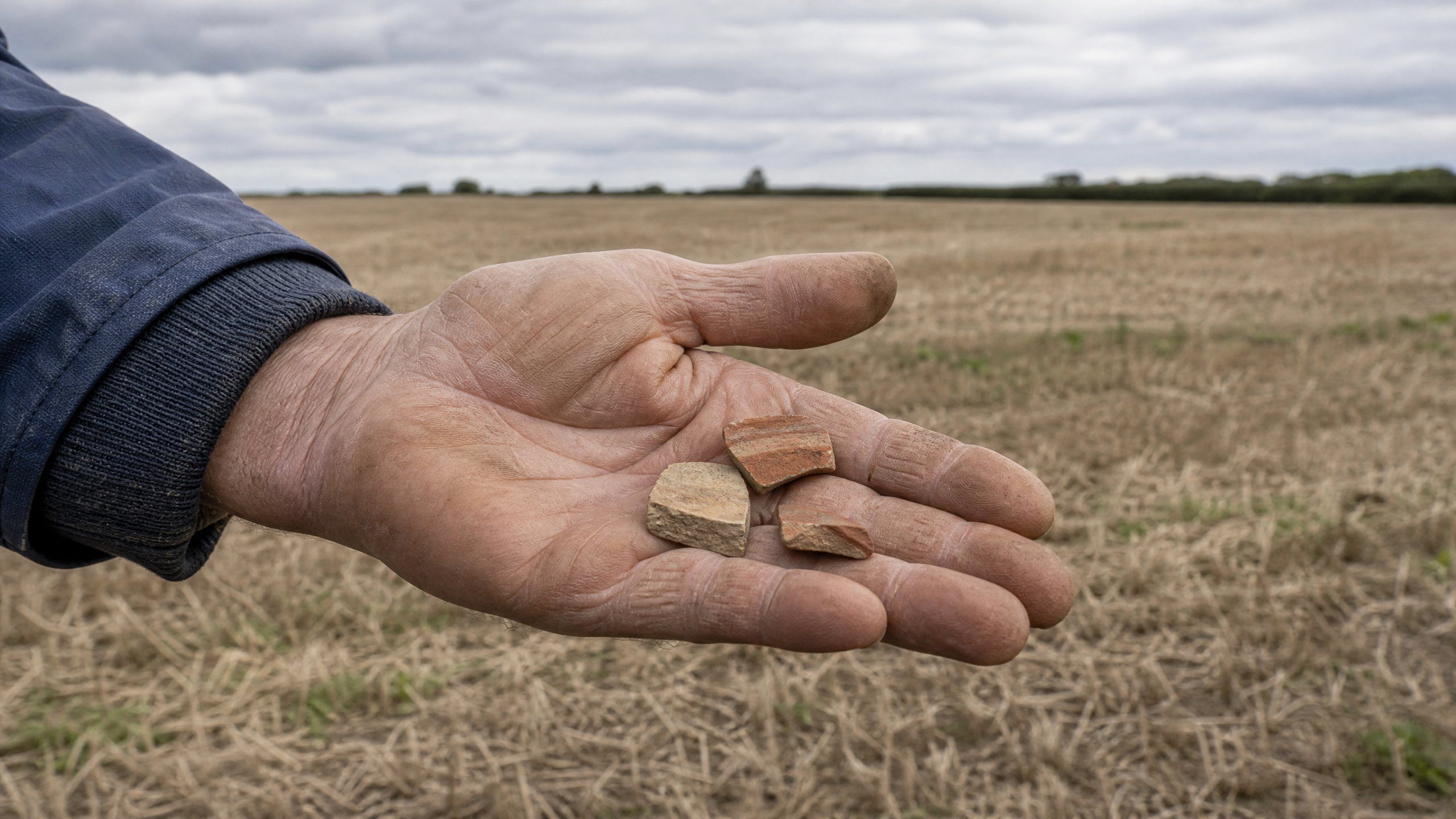
In the summer of 2020, Jim Irvine was walking the fields of his father’s farm in Rutland, in the East Midlands of England, when some unusual pottery among the wheat stubble caught his attention. He followed it to a crop mark and then to a small trench, which struck a decorated Roman floor. The complete mosaic measures 11 meters by almost 7 meters and tells the end of the Trojan War in three panels, the first depiction of these stories ever found in Britain.
John Thomas, deputy director of University of Leicester Archaeological Services and the manager of the project, called it “the most exciting Roman mosaic discovery in the UK in the last century.” The floor belonged to a large villa complex of the 3rd and 4th centuries AD, on land owned by Irvine’s father, Brian Naylor. It was uncovered, recorded and then covered over again, and it lies today on private land that the public can’t visit.
A Crop Mark Like Chalk on a Computer Screen
Irvine collected some of the pottery fragments and then looked up the field on satellite images in Google Maps. “I spotted a very clear crop mark, as if someone had drawn on my computer screen with a piece of chalk,” he said later. The moment, he added, “really was the ‘oh wow’ moment, and the beginning of the story.”
Further research showed that the mark traced the outline of a building. A small investigation of the mark exposed part of a mosaic floor, and Irvine reported it to the Historic Environment team at Leicestershire County Council, which advises Rutland on its archaeology. Richard Clark, the council’s lead planning archaeologist, went out to the field with Peter Liddle, a former county archaeologist, and they confirmed that the floor was well preserved and showed figures, horses and chariots.
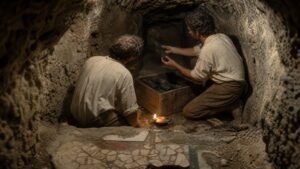
Historic England, the government’s heritage body, paid for urgent work by the Leicester team in August 2020, starting with the cleaning of the mosaic and the soil and rubble above it. The archaeologists later described the appearance of the first figures as “a spine-tingling experience.” They recognized the scenes as the end of the Trojan War, the fight between the Greek hero Achilles and Hector of Troy.
Radar, Test Pits and the Risk From the Plow
Surveys with magnetometry and ground-penetrating radar then mapped what lay around the floor. Several buildings stood inside an angular enclosure of multiple ditches, among them possible aisled barns, circular structures and a possible bath house. The mosaic itself lay in an apse-ended room only 30 to 40 centimeters beneath the rubble.
Trenches and test pits showed how shallow the remains were across the site, which left them exposed to damage from plowing. Historic England began the process of protecting the villa as a Scheduled Monument, and the landowners agreed to stop cultivating the field and return it to grassland.
Lockdown had also kept archaeology students at the University of Leicester out of the field, and in September 2021 a team of staff and second-year students returned to dig three areas, including the mosaic room. Alice Roberts, the archaeologist and television presenter, helped uncover some of the figures while her program “Digging for Britain” filmed at the site. By the end of the season the whole floor lay exposed.
Read next
Harry Houdini Taught WWI Soldiers to Escape German Handcuffs
Three Panels From the End of the Trojan War
The floor tells its story in three panels like a comic strip, and it probably covered a large dining or entertaining room. In the bottom panel, Achilles and Hector duel from chariots, with Achilles drawn larger than his opponent and lines under the horses’ front feet to suggest movement. The middle panel shows Achilles dragging Hector’s body behind his chariot while Hector’s father, King Priam of Troy, stands by in a striped robe and pleads for his son.
The top panel shows Hector’s body being exchanged for its weight in gold, with a figure holding giant scales. Homer’s “Iliad” has no such weighing, and its two heroes fight on foot. The scene comes from “Phrygians,” a lost play by the 5th-century BC tragedian Aeschylus, and Thomas said that “Aeschylus added that scene for dramatic effect because it would have been shown on stage.”
The choice of subject points to the person who paid for it. Jane Masseglia of the University of Leicester’s School of Archaeology and Ancient History suggested that highly skilled mosaicists may have copied the scenes from an illuminated manuscript in the owner’s possession, and that the owner wanted guests to see a knowledge of the classics. Thomas described the owner in the same terms, as someone with “a knowledge of the classics,” and he said of the floor, “There’s nothing like it from the UK.”
Fires on the Floor and Skeletons in the Rubble
The excavation also showed what happened to the room after the villa’s wealthy days were over. Layers directly above the mosaic revealed that fires had been lit on the floor, and the top panel is so heavily burnt that its images are discolored. Rubble from the collapse or demolition of the building then covered everything.
Two human skeletons had been buried in that rubble inside the room, after the building had gone out of use. The archaeologists could say only that the burials were later than the mosaic and might date to the very end of the Roman period or the early medieval centuries that followed.
On November 25, 2021, the government protected the mosaic and villa complex as a Scheduled Monument on the advice of Historic England, which gives the site legal protection from unauthorized work and illegal metal detecting. By then the excavated areas had been backfilled to protect them, and talks with Rutland County Council had begun about a display away from the site.
Irvine and his family stayed involved throughout the work, and more excavation was planned for 2022. Under an agreement with Historic England, the fields where he picked up the pottery are being turned from arable land into pasture, so the only crop above Achilles and Hector is grass.