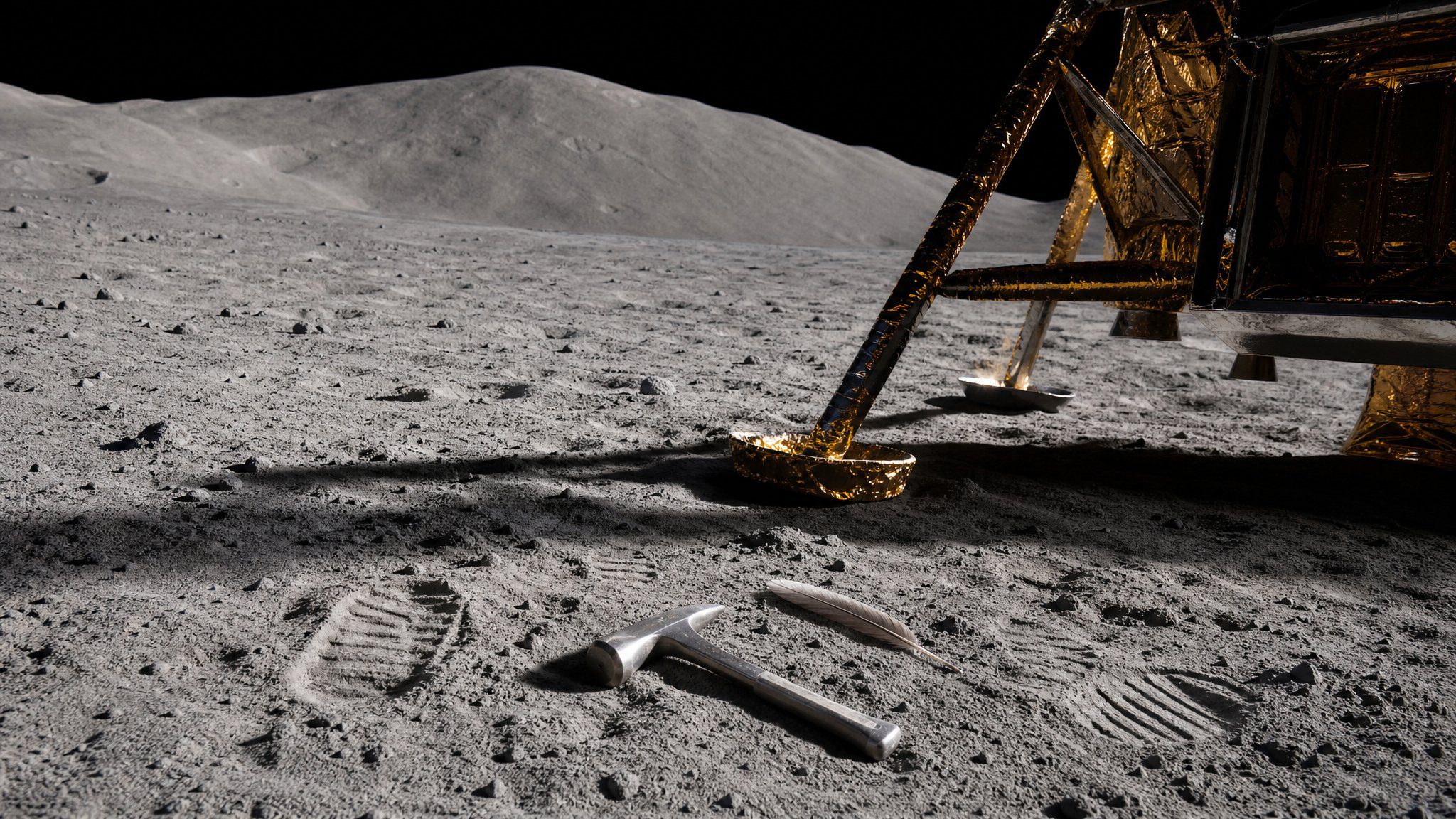
On August 2, 1971, Apollo 15 commander David Scott held a geology hammer in one hand and a falcon feather in the other and let both fall on the Moon.
With no air to slow the feather, the two objects fell side by side and struck the gray dust of the Hadley-Apennine landing site together. A controller in Houston was steering the television camera that recorded it, near the end of the mission’s third and final moonwalk. The aluminum hammer weighed 1.32 kilograms, and Scott released both objects from about 1.6 meters above the ground.
The drop was meant to confirm a principle that Galileo Galilei had worked out in Italy around 1600: without air resistance, all bodies fall at the same rate. Scott told viewers on Earth that the crew owed their trip partly to “a gentleman named Galileo, a long time ago, who made a rather significant discovery about falling objects in gravity fields.” When the hammer and feather landed together, he added, “Which proves that Mr. Galileo was correct in his findings.”
Mission Control in Houston answered with applause, and capsule communicator Joe Allen, who had suggested the demonstration, called it “Superb.” The feather was picked to match the name of the lunar module, Falcon, and both objects stayed on the Moon when the crew left.
Apollo 15 and Three Days at Hadley Rille
Apollo 15 launched from Kennedy Space Center at 9:34 a.m. EDT on July 26, 1971, with a crew of three. Scott was commander, James Irwin was lunar module pilot and Alfred Worden was command module pilot. It was the first Apollo mission to carry the Lunar Roving Vehicle, a battery-powered car that let the astronauts drive several kilometers from their lander.
Falcon touched down on July 30 at Hadley-Apennine, between the Apennine mountain front and the winding channel of Hadley Rille. Scott and Irwin stayed on the surface for about 67 hours, beginning with a 33-minute survey that Scott made standing in the top hatch. Their three moonwalks then lasted 6 hours 34 minutes, 7 hours 12 minutes and 4 hours 50 minutes.
Scott became the seventh person to walk on the Moon and the first to drive on it, reaching about 12 kilometers per hour in the rover. The crew brought home about 170 pounds of rock and soil, including a white crystalline rock from Spur Crater that became known as the Genesis Rock. Worden, meanwhile, orbited alone in the command module Endeavour, at times 2,235 miles from his crewmates.
The hammer and feather drop came near the end of the third and shortest moonwalk, with Scott standing in front of the rover’s camera. He later explained that he had carried two feathers so that he could try the drop first. He worried that static charge might make a feather cling to his glove, but there was no time for a rehearsal, so the broadcast drop was his only attempt.
Read next
That Pool Smell Is Chloramines
Galileo, the Leaning Tower and the Test in Delft
The idea Scott tested ran against the teaching of Aristotle, who had held that heavier bodies fall faster in proportion to their weight. That view matched everyday experience, since a stone dropped beside a leaf reaches the ground first. Galileo’s most famous challenge to it is probably a test he never carried out at all.
His pupil and biographer Vincenzo Viviani wrote in 1654 that Galileo had dropped unequal weights from the Leaning Tower of Pisa. The demonstration would have taken place while Galileo taught at Pisa between 1589 and 1592. Viviani’s account stayed unpublished until 1717, and most historians now treat the tower story as a legend or a thought experiment.
A real tower experiment did take place a few years before the Pisa story is set, in the Dutch city of Delft. The Flemish engineer Simon Stevin worked with Jan Cornets de Groot, a local nobleman who later became the father of the legal scholar Hugo Grotius. They dropped two lead balls, one ten times heavier than the other, from about 30 feet up the Nieuwe Kerk.
Stevin reported the result in his 1586 book De Beghinselen der Weeghconst, writing that the light ball took no longer to fall than the heavy one. Galileo’s own evidence came later, from experiments that slowed the fall down until it could be measured with the tools of his time.
Beginning around 1603, he rolled bronze balls down a long wooden board with a polished channel cut into it. He tilted the board to make the motion slow, and he timed each run by weighing the water that flowed out of a vessel through a thin pipe. From those runs he found that the distance a body covers from rest grows with the square of the time.
Galileo published that law in Two New Sciences, which the Elzevier house printed in Leiden in 1638.
From Galileo’s Ramps to Einstein’s Falling Man
Physicists now call the behavior Scott demonstrated the universality of free fall, or the weak equivalence principle. It holds that a body’s inertial mass, which resists being pushed, exactly equals its gravitational mass, which gravity pulls on. If the two differed between materials, a hammer and a feather made of different substances would fall at different rates in a vacuum.
In 1907, while working at the patent office in Bern, Albert Einstein realized that a person falling from a roof would feel no gravity at all. He later called the realization the “happiest thought” of his life. Because everything falls at the same rate, an observer in a closed box can’t tell whether the weight they feel comes from gravity or from acceleration.
Einstein made that equivalence a foundation of his general theory of relativity, which he developed over the following eight years. In general relativity, gravity is the curvature of spacetime itself, so every body follows the same path through it whatever the body is made of.
Physicists have kept testing the principle with finer and finer instruments in the decades since Apollo. The French-led MICROSCOPE satellite compared the free fall of titanium and platinum test masses in orbit and published its final results in September 2022. Their accelerations differed by no more than about one part in a million billion, the most stringent test of the principle so far.
The Camera in Houston and the Feather Left Behind
The pictures reached Earth through a camera mounted on the rover and steered from a console in Houston. Its operator was Ed Fendell, a 39-year-old NASA engineer whom Time magazine called NASA’s own Captain Video. Radio signals needed more than a second to reach the Moon, and the full loop from button press to returning picture took several seconds.
Fendell rehearsed with electronic delays built into the system’s circuitry to simulate the distance to the Moon, so he could compensate for the lag. The drop itself had been Joe Allen’s idea, while the feather came through a friend of Scott’s who taught at the US Air Force Academy. The Academy’s mascot is the falcon, and the feather came from one of its birds.
After the drop, Scott kicked the hammer and the feather under the lunar module’s equipment storage bay so that he and Irwin wouldn’t step on them. Both were left at Hadley when the crew lifted off.
In NASA’s preliminary science report, Joe Allen wrote that well-established theory had predicted the result, but that it was reassuring all the same. A great many people had watched it, he noted, and the crew’s journey home depended critically on that same theory being right.
More from Terribly Interesting
Sources
- NASA NSSDC, “Apollo 15 Hammer-Feather Drop”
- Apollo Lunar Surface Journal
- NASA, “50 Years Ago: Apollo 15 on the Moon at Hadley-Apennine”
- Smithsonian NASM collection
- NASA Apollo 15 mission page
- NASA biography of David R. Scott
- NSSDC Apollo 15 info
- UA Magazine, “Galileo’s legendary tower of Pisa experiment was actually done by a Dutch scientist in Delft”
- Amusing Planet, “The Delft Tower Experiment”
- Paolo Palmieri, “Galileo’s Construction of Idealized Fall in the Void” (University of Pittsburgh)
- University of Notre Dame, “The Pendulum Swings Again”
- CNES, MICROSCOPE project page
- Stanford, Gravity Probe B, “Einstein’s Spacetime”
- Paul Worden, “Einstein’s Happiest Moment”
- Physical Review Letters 129, 121102 (French-led CNES/ONERA mission)
- Imperial College London
- Time, “The Moon: NASA’s Captain Video”