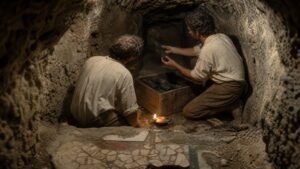
Inside the skull of a young man killed at Herculaneum by the eruption of Mount Vesuvius in 79 AD, researchers found shiny black fragments of glass that they identified as his brain.
The man was about 20 years old and died lying face down on a wooden bed in the Collegium Augustalium, a building on Herculaneum’s main street. His charred skeleton was excavated in the 1960s. In January 2020 a team led by the forensic anthropologist Pier Paolo Petrone of the University of Naples Federico II published its findings in the New England Journal of Medicine. The glassy material in his skull contained proteins found in human brain tissue and fatty acids found in human hair.
Later studies found intact neurons in the glass and in fragments from his spinal cord. In 2025 a team of volcanologists and physicists argued that the glass had formed at more than 510 degrees Celsius. No other case of human tissue preserved as glass is known. Some specialists outside the team remain unconvinced that it is brain tissue at all.
The Guardian of the Collegium Augustalium
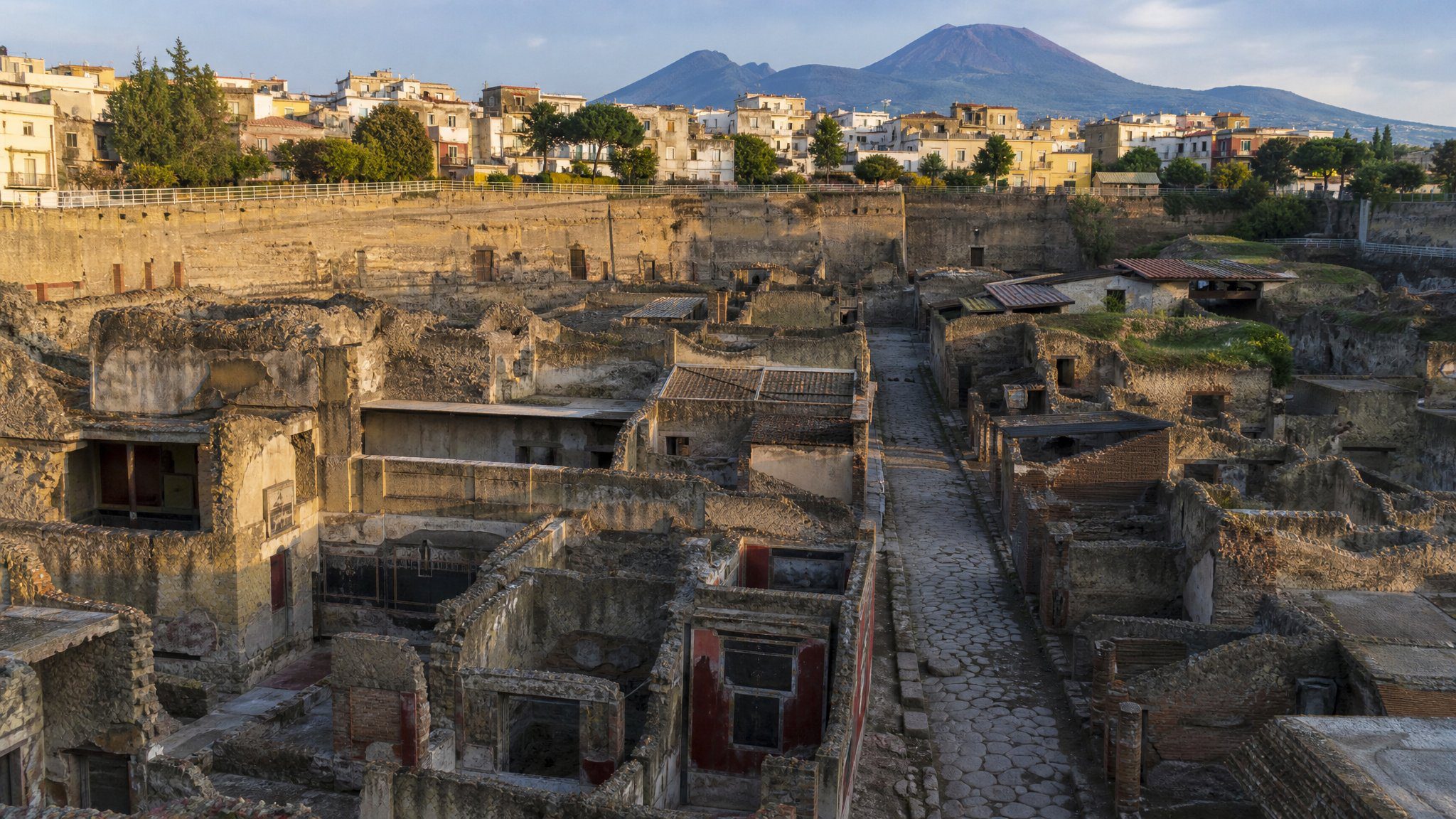
Herculaneum was a seaside resort town on the Bay of Naples, about 11 miles from Pompeii and closer to the volcano. When Vesuvius erupted, it first threw ash and pumice high into the air for hours, and many people fled or sheltered in solid buildings. Then pyroclastic currents of hot gas, ash and rock swept down the slopes in a series of pulses, and Herculaneum was eventually buried under about 20 meters of volcanic deposits. The eruption killed several thousand people across the towns around the volcano.
The Collegium Augustalium was the meeting place of an imperial cult that worshiped the emperor Augustus. The man found inside it is believed to have been the building’s guardian, and he appears to have been in bed when the eruption reached the town. Estimates of his age vary between about 20 and 25. His body lay under volcanic ash, and his bones were charred and in places shattered by the heat.
The black material was found only inside his skull, in angular fragments between half a millimeter and 5 millimeters across. It had the shiny, glassy look of obsidian, the volcanic glass that forms when lava cools very quickly.
Brain Proteins, Hair Fat and Neurons
Petrone’s team analyzed the fragments with proteomics and mass spectrometry, the standard methods for identifying proteins. In the 2020 paper they reported seven proteins whose genes are expressed in the human brain, and fatty acids typical of human brain fat and of the natural fat in human hair. The researchers wrote that these findings indicated “the thermally induced preservation of vitrified human brain tissue.” They measured how charred wood from the site reflected light and estimated that it had been heated to about 520 degrees Celsius.
In October 2020 the team published a second study in the journal PLOS ONE, using scanning electron microscopy and image-processing software to examine the glass and similar material from the victim’s spinal cord. They reported well-preserved nerve cells and axons from different parts of the central nervous system, including the regular layered structure of the myelin sheath that insulates brain axons. Brains recovered by archaeologists are usually preserved, when they survive at all, by saponification, a process that turns fat into a soap-like substance and destroys fine structure.
Petrone told the arts site Hyperallergic that, as with the discovery of the vitrified brain, the neurons were “something never before seen at such a level of detail.” He added that only a small part of the possible analysis has been done and that samples remain available for further study.
Read next
Ruth Lee’s Chinese Flag on a Miami Beach in December 1941
How a Brain Becomes Glass
The problem the 2025 study set out to solve was that glass forms from fast cooling, not from heating. Organic tissue is mostly water, so ordinarily it can be turned into a stable glass only by plunging it into liquid nitrogen, the method used to cryopreserve organs. A glass made that way turns back into soft tissue once it warms up again, which is why no natural organic glass had been found on Earth.
A team led by the volcanologist Guido Giordano of Roma Tre University heated and cooled fragments from the skull and spine. Under an electron microscope the fragments broke with curved, step-like fractures like those of glass, and 3D scans showed a very even material with only about 1.4 percent pore space. The material had a density of about 1,000 kilograms per cubic meter, close to that of water, and was made mostly of carbon and oxygen, with small amounts of sodium, chlorine, potassium, magnesium, aluminum and silicon. They measured the temperature at which the material began to relax, the point at which a glass starts to flow. Using fast heating rates, they found that the glass had formed at about 510 degrees Celsius. “The process of transformation of anything liquid into glass is the fast cooling, not the fast heating,” Giordano told CNN.
The pyroclastic deposits that buried Herculaneum had been measured at 315 to 465 degrees Celsius, too cool to form this glass and slow to cool once they settled. Giordano’s team concluded that the brain must have turned to glass before the body was buried. They proposed that the first thing to reach the Collegium was a thin, fast-moving ash cloud with an internal temperature well above 510 degrees. It killed the guardian and heated his brain without destroying all of it.
“What is an ash cloud? It’s a dilute part of the pyroclastic flow,” Giordano told CNN, explaining that it forms at the edges and above the main avalanche of material, where the particles are finer. “These clouds can be hot enough to kill you.” He pointed to a layer of fine ash at the very bottom of the deposits that buried Herculaneum as a possible trace of that first cloud.
The thick bones of his skull and spine may have shielded part of the brain from complete breakdown. When the ash cloud passed, probably within minutes, it left only a few centimeters of ash, and the air temperature dropped back quickly enough to turn what remained of the brain into glass. The bodies of the guardian and hundreds of other victims lay almost in the open air until the next surges arrived. The heavier and cooler pyroclastic flows that buried the town came later and never grew hot enough to soften the glass again.
The Scientists Who Doubt It
Several researchers outside Petrone and Giordano’s group do not accept the conclusion. Alexandra Morton-Hayward, a forensic anthropologist at the University of Oxford who has compiled records of 4,405 brains recovered by archaeologists, told CNN that vitrification of soft tissue was “incredibly unlikely.” In a 2020 paper she had argued that the eruption at Herculaneum was neither hot enough nor fast-cooling enough to vitrify a brain. She also pointed out that proteins break down at temperatures far lower than the proposed ash cloud.
“I’m not convinced this (artifact) is the one and only exception to this rule,” she said. Tim Thompson, a forensic anthropologist at Teesside University in Britain, has suggested that the Herculaneum victims may instead have been baked by lower heat. Other specialists told National Geographic that identifying the material as brain tissue would be stronger if researchers outside the team confirmed it independently.
Giordano has said there is no doubt that the glass is organic, pointing to the proteins and neurons found in earlier work. His co-author Alessandra Pensa, a geologist, has said the team was “incredulous that such delicate structures could have been preserved in a ‘glassy form'” at first. She has also argued that the findings could help in planning shelters near active volcanoes that can withstand a sudden flash of intense heat.