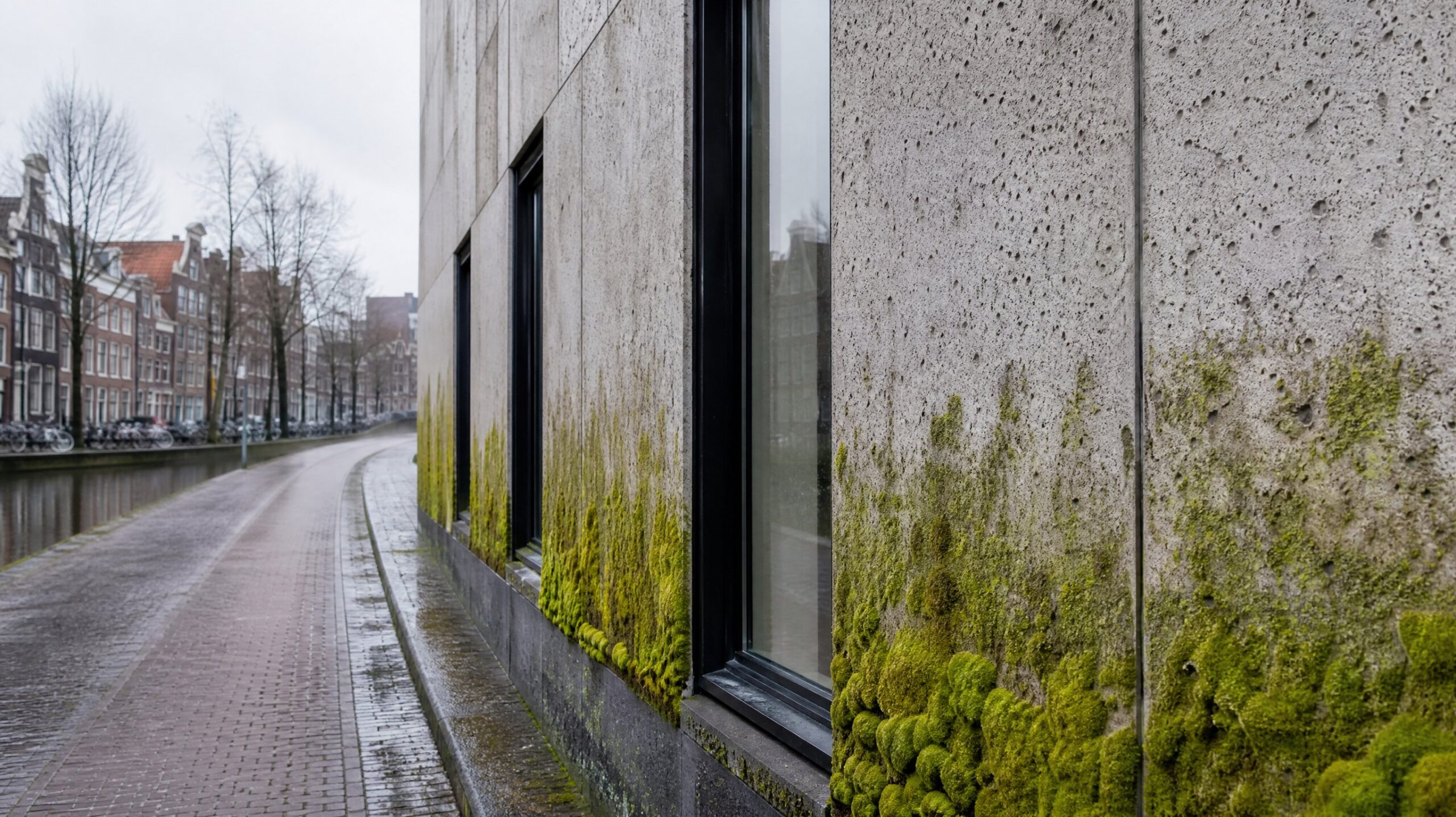
A startup from Delft University of Technology in the Netherlands has developed a concrete coating on which moss grows over building walls using nothing but rainwater and the humidity in the air.
The company, Respyre, calls its material Mosscrete and describes it as bioreceptive concrete, meaning concrete built to be colonized by living organisms. It is a layer applied over ordinary structural concrete, and its porosity, pore texture, acidity and added nutrients are adjusted so that native moss species can take hold without soil, planters or irrigation. Respyre’s chief executive, Auke Bleij, has said the coating is 70 percent recycled concrete.
Moss on a wall cools the surface as water evaporates from it, traps fine particulate matter from the air and gives small insects somewhere to live. Respyre has been testing the material on buildings in Amsterdam and other Dutch cities. Its aim is to turn bare concrete facades green for far less than the living walls and climbing plants that cities use now.
Patents From Delft and a Chance Introduction
The company started from a set of university patents for bioreceptive concrete. Mark de Kruijff, a Delft graduate, saw commercial potential in them and founded Respyre to develop them.
Bleij came to the company by a separate route, after researching the urban heat island effect, in which cities become much hotter than the countryside around them and suffer more during heat waves. His research looked at how moisture evaporating from building facades draws heat out of the street. A friend told him about a startup working on the same problem, and it turned out to be de Kruijff’s, so Bleij joined in 2021 and became chief executive.
Early funding came through a Dutch technology transfer program, the TTT Circular Technology program, which gave Respyre a proof of concept grant. De Kruijff said the grant let the company take major steps toward a usable concrete product on which moss could easily lodge.
How Bioreceptive Concrete Holds Moss
Standard concrete is dense and alkaline, which makes it a poor home for plants. Respyre’s layer is porous enough to hold a large amount of water, rough at a very small scale and closer to neutral in pH. Moss spores and fragments can settle on it and stay damp. The company plants a wall by spraying on a bio-gel made of finely processed moss fragments and spores suspended in a medium that sticks to the concrete. The gel keeps the fragments moist and attached while they establish, and the moss is largely self-sustaining after about 12 weeks.
Mosses suit a bare wall because of how they handle water. Most land plants die if they dry out, while mosses can dry out completely, shut down their metabolism and revive when they are wetted again, an ability called poikilohydry. They have only a thin waxy cuticle, so they take in water and nutrients directly through their leaves and stems. They anchor themselves with rhizoids, thread-like structures that grip a surface without boring into it, and reproduce from spores or from broken fragments.
That is why Respyre chose moss over climbing plants and vertical gardens, which need containers or attach themselves to walls in ways that can damage them. Of the more than 500 species of moss that occur in the Netherlands, about 40 grow on stone and similar materials, including concrete. Respyre selects native or locally adapted species that can cope with drought, frost and wind at each site, and Bleij has said the coating is strong enough to last 30 years.
Read next
China’s EV Shift Prevented 262,000 Pollution Deaths
What the Moss Does on a Wall
Ordinary concrete absorbs the sun’s heat and radiates it back into the street, which adds to the heat island effect in dense cities. A moss layer that has soaked up rain releases that water by evaporation, which cools the wall, and the moss also shades the concrete underneath.
The measured effect so far is modest and depends on the weather. In early experiments reviewed by the Delft researchers in 2023, dry moss cut the temperature of a concrete panel by 0 to 5 degrees Celsius. When the panels were wet, bare and moss-covered concrete both cooled by 5 to 10 degrees, with the moss panel still 2 to 5 degrees cooler. The moss also kept the cooling going for longer because it held the water. The surface of the moss itself was 2 to 3 degrees warmer than bare concrete, because it is darker and holds less heat.
The second benefit Respyre claims is cleaner air, because moss absorbs nitrogen oxides and carbon dioxide and traps fine dust in its dense mat of leaves, and Bleij has said that nothing absorbs fine particulates better than moss. In urban areas, he has said, fine particulate levels run three times higher than the maximum values the World Health Organization recommends. The moss also holds rainwater during storms and gives small insects a habitat, which in turn feeds birds.
The AMS Institute in Amsterdam, working with Wageningen University and Research and TU Delft, set up a research program to put numbers on these benefits. Its position was that the services had to be measured before firm claims could be made. Respyre’s own estimate for carbon dioxide uptake is about 500 to 1,200 grams per square meter of facade each year.
Pilots From Amsterdam to Purmerend
The first test walls went up at the Marineterrein Amsterdam Living Lab, an experimental site in the city set aside for testing sustainable urban technology. Demonstration projects were also planned at the tower of the former Bijlmerbajes prison in Amsterdam and at Wageningen University and Research. In Amsterdam’s Rivierenbuurt district, moss concrete has been applied to the balconies of social housing.
In Purmerend, north of Amsterdam, Respyre worked with the company Hemubo on a pilot at the apartment building D’Groene Citer to see how well moss survives at heights of up to 20 meters. A storage building covered with 450 square meters of moss concrete has been described as the company’s largest project to date. Respyre has developed three product types: a plaster for existing walls sold as VertiScape, a version that can be sprayed on, and prefabricated cladding panels.
Bleij’s main argument for moss over other green facades is cost, and he has said that a living wall can easily cost 500 euros per square meter and that living walls and climbing plants both need pruning several times a year. A moss facade needs no pruning and no container, and he has said one square meter of moss can be used to grow 80 square meters of new cover.
The hardest part is the living layer rather than the concrete. The 2023 Delft review found that moss colonizes concrete outdoors very slowly on its own. Moss grown quickly indoors under stable temperature, high humidity and controlled light often dies when moved outside, because it has not developed the defenses it needs for harsher conditions.
Barcelona and London Tried It First
Other research groups had designed concrete for plants years before Respyre was founded. In late 2012 researchers in the Structural Technology Group at the Universitat Politecnica de Catalunya in Barcelona, led by Antonio Aguado, announced a biological concrete for building facades in Mediterranean climates. It used magnesium phosphate cement, which is slightly acidic, because mosses can grow at a pH as low as 5 and carbonated Portland cement concrete sits at around 8.
The Barcelona design, the subject of Sandra Manso’s doctoral thesis, stacked four layers. A waterproofing layer and a structural layer sat behind a bioreceptive layer for the organisms, with a reverse waterproofing layer that held water for the plants. In a later outdoor experiment, the magnesium phosphate mix proved less receptive to growth than ordinary cement, the opposite of what the team had found indoors.
In London, the BiotA Lab at the Bartlett School of Architecture, University College London, led by Professor Marcos Cruz, developed concrete facade panels between 2015 and 2017 to support mosses, lichens and algae. The panels were milled with grooves and hollows that trap moisture, and 32 of them were installed on the outside of St Anne’s Catholic Primary School in south London. Another 20 went onto East Putney station on the London Underground. Like the Barcelona design, the panels used magnesium phosphate concrete in place of Portland cement.
Moss on the old quay walls of Dutch canals is usually a sign that the mortar has been damaged and water is getting in. Bleij has described Respyre’s material as a controlled version of that process, porous enough for moss to grow and still sound enough to protect the concrete beneath it for decades.
More from Terribly Interesting
Sources
- TU Delft
- Thematische Technologie Transfer
- Respyre
- Climate Solutions News
- Parametric Architecture
- MaterialDistrict
- Respyre homepage
- Tocco.Earth interview with Respyre
- AMS Institute
- The Concrete Centre
- Critical Playground
- Phys.org
- ArchDaily
- Cooper Hewitt, Smithsonian Design Museum
- Veeger, Nabbe, Jonkers and Ottele, “Bioreceptive concrete: State of the art and potential benefits,” Heron 68(1), 2023