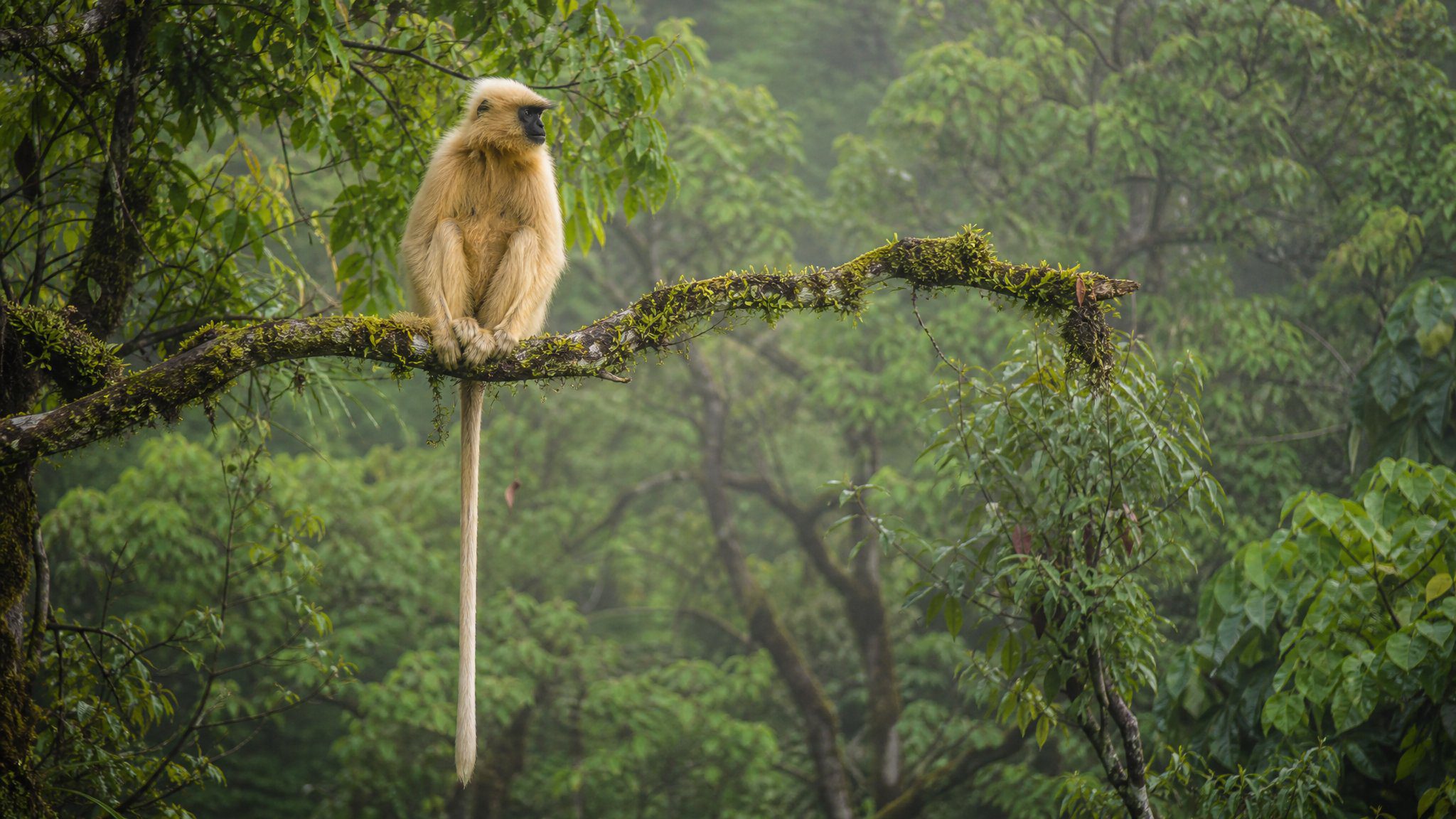
The golden langur, a monkey revered in Bhutan as a sacred animal, lives only in the forests of western Assam in India and southern Bhutan and nowhere else on Earth.
Gee’s golden langur, Trachypithecus geei, is found only in southern Bhutan and in western Assam in northeastern India. Its range is bounded by the Himalayan foothills to the north, the Brahmaputra River to the south, and the Sankosh and Manas rivers to the west and east. It lives in lowland evergreen, semi-evergreen, riparian and moist deciduous forests, including sal forest. In Assam its main stronghold is the Manas Biosphere Reserve along the Bhutan border, with smaller populations in isolated reserve forests to the south.
The species is listed as Endangered by the IUCN, and it is protected by law in both countries. A survey completed in 2024 counted a minimum of 7,396 golden langurs in India, living in 707 groups, and a 2019 study estimated about 2,516 in Bhutan. In the 1990s the Indian population had fallen to about 1,500, after years of armed conflict in western Assam in which about half the reserve forests were cut down.
A Monkey Science Found Late
The golden langur’s orange-gold coat attracted attention as early as 1907. The species was formally brought to scientific notice only in 1953, by the British naturalist Edward Pritchard Gee, whose name it carries, and was described by Khajuria in 1956. In Assamese it is called Sunali Bandar, and some Hindus identify it with Sugriva, the monkey king of the Ramayana. In Bhutan it is known as a sacred monkey and holds a place in the country’s folklore.
The coat can look deep cream in dull light and bright gold when sunlight strikes it. The face, hands and feet are black, the face is framed by long hair on the cheeks and brow, and a whorl of longer hair crowns the head. The light brown whites of the eyes make them stand out and give the face an expression that many observers describe as almost human. The tail, longer than the body, ends in a tuft that is usually larger in males.
Infants are born with pale, creamy-white fur that turns golden by the age of about 9 to 15 months. Researchers think the pale coat may encourage other members of the troop to care for them.
A Life Spent in the Canopy
Golden langurs spend about 99 percent of their time in trees and come down to the ground only occasionally, and a troop typically travels 200 to 700 meters a day through the canopy. They are colobines, a group of leaf-eating Old World monkeys. Leaves make up about 60 percent of their feeding time, fruit about 24 percent and flowers about 11 percent, and they eat from more than 200 plant species.
They live in groups of about 5 to 19, usually with one or two adult males and several females with their young, and all-male groups and lone males also occur. Females generally stay in the troop where they were born, while young males leave to join or take over another troop. That movement of males between troops is how genes pass from one group to the next.
Adults groom one another, and the young chase, wrestle and hang upside down from branches. The adult males keep watch while the troop feeds or rests, and when one spots a threat, he gives a loud, whooping alarm call and may repeat it, holding a stiff posture and staring at the danger. The dominant male may stay behind while the rest of the troop retreats, then follow them or confront the threat with calls and aggressive gestures.
Read next
The Elephants Who Walked to Lawrence Anthony’s Home
War, Logging and Broken Forest
The langur’s worst decline in modern times came from human conflict rather than hunting. The Bodo autonomy movement that grew in western Assam from the 1980s brought armed groups into the forests, and some of them financed themselves by selling timber. Forest officials were threatened, kidnapped and killed, illegal logging went unchecked, and ethnic clashes in 1996 and 1998 drove villagers into relief camps on the edges of the reserve forests. By the late 1990s almost half of the reserve forests in western Assam had been cleared, and the golden langur was considered India’s most endangered primate.
What forest remains is badly fragmented, and more than 70 percent of the patches where golden langurs now live in Assam cover less than 20 square kilometers, with an average of fewer than 50 langurs each. About 80 percent of the Indian population lives outside protected areas, and many fragments have almost no primary forest left, which pushes troops into villages during the dry season in search of food.
The primatologist Jihosuo Biswas of the Primate Research Centre North East India has warned that such small, isolated populations risk inbreeding and extinction. Langurs are killed crossing highways, electrocuted on low-slung live wires and attacked by dogs. In April 2020 a mother and her baby were killed by a speeding car when a group of 13 crossed National Highway 17 beside the Kakoijana reserve forest.
How Villagers Brought the Langurs Back
The Golden Langur Conservation Project began in 1998, started by the non-governmental groups Community Conservation, Nature’s Foster and Green Forest Conservation. It worked with more than 140 communities to form forest protection committees and self-help groups, and eventually 18 community groups patrolled almost the whole of the Manas Biosphere Reserve. After the conflict was resolved in 2003 and the Bodoland Territorial Council was formed, the council adopted the golden langur as its mascot.
The effect of the community patrols showed in the population counts. The Indian population rose from about 1,500 in 1997 to about 5,600 by the period 2007 to 2012. UNESCO removed Manas from its list of World Heritage in Danger in 2011. The survey, with fieldwork in 2020 and 2021 and results published in 2024, was led by Biswas and the scientist H. N. Kumara of the Salim Ali Centre for Ornithology and Natural History. It found 5,566 langurs in the northern population around Manas and 1,830 in the fragmented forests farther south, and average group size had risen from 9.24 to 10.69 since the previous survey.
At Kakoijana, a 17-square-kilometer reserve forest near Abhayapuri in Bongaigaon district, the naturalist Arnab Bose of Nature’s Foster first recorded golden langurs in 1995. Working with 34 villages of seven ethnic groups, his organization helped restore the forest canopy to 75 percent cover, and dried-up springs began flowing again. A local conservationist, Harmohan Rabha, estimated in 2025 that about 400 golden langurs now live there.
Rope Bridges Over the Highway
Roads remained the most visible danger for the langurs living in and around Kakoijana. Vehicles on National Highway 17, which cuts through Kakoijana, killed nine langurs in 2023 and nine more in 2024. After another langur died on January 4, 2025, residents blocked the highway in protest, and the district commissioner, Nabadeep Pathak, backed an experiment. The first hanging canopy bridge, made of plastic-coated wire, went up that month, and within a week langurs were seen crossing on it, so three more were built.
Across the border, Bhutan’s Nature Conservation Division has adopted a 10-year Golden Langur Conservation Strategy and Action Plan for 2025 to 2035, with a budget of 120.8 million ngultrum. In Bhutan the species lives in six districts of the south-central foothills, and electrocution on uninsulated power lines has become the leading cause of unnatural deaths, followed by road kills. Between 2013 and 2020 more than 100 langurs there died from human causes, nearly half of them electrocuted.
The plan calls for insulating power lines, building canopy crossings, sterilizing stray dogs and studying hybridization with the closely related capped langur. Hybrids become a risk where floods, landslides or bridges break down the rivers that normally keep the two species apart. It aims to halve deaths from electrocution and road accidents by 2030.