Nearly every vanilla pod sold today grows from a flower pollinated by hand, using a method worked out in 1841 by Edmond Albius, a 12-year-old enslaved boy on the Indian Ocean island now called Réunion.
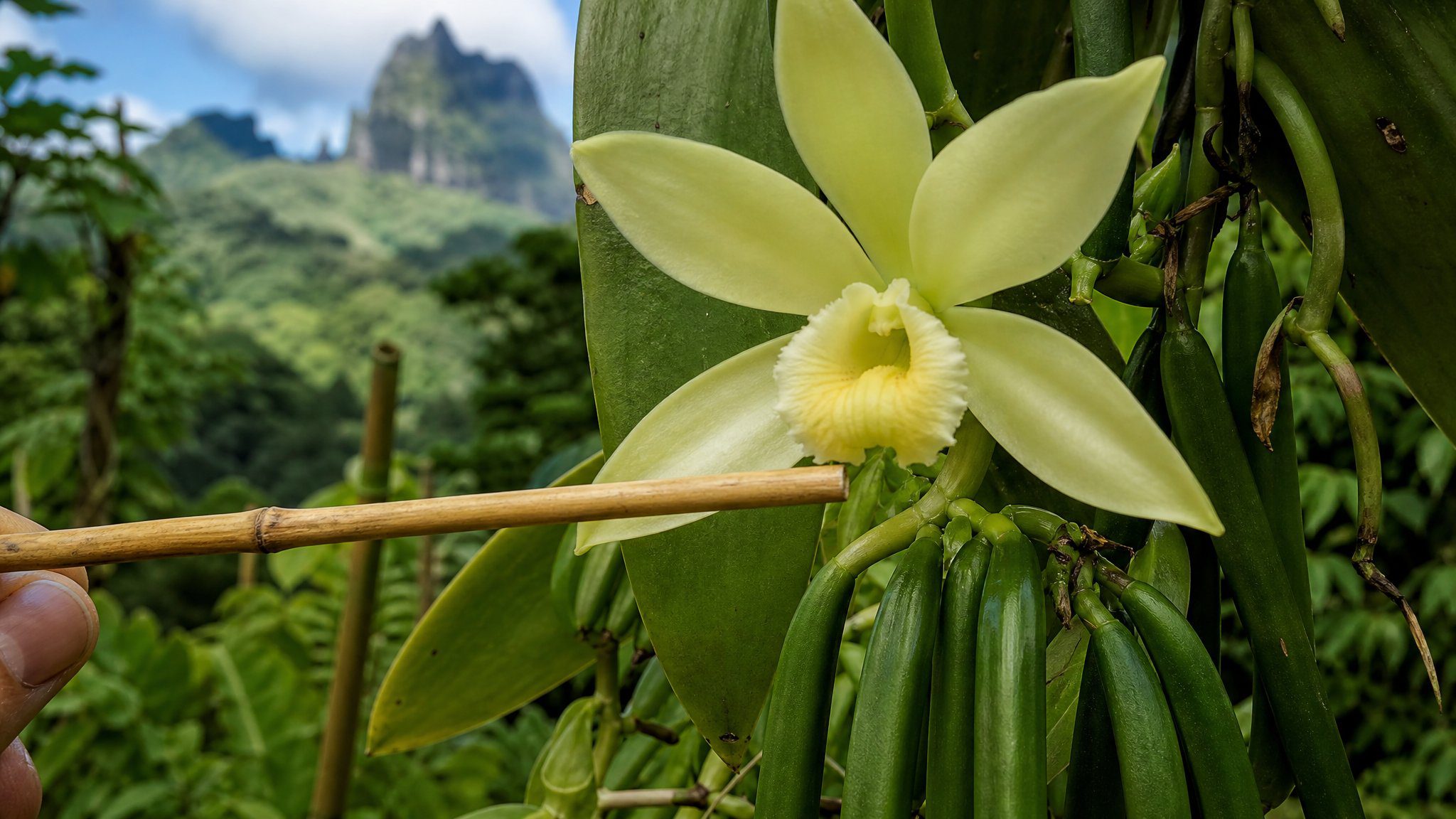
Vanilla is the seed pod of an orchid, Vanilla planifolia, which is native to Mexico and Central America, and for centuries the vines refused to set fruit anywhere else. European botanists and colonial planters carried cuttings to greenhouses and plantations around the world, where the plants grew and flowered normally and then dropped their blossoms without producing a single pod. Albius found that a flower could be fertilized in a few seconds by lifting a flap inside it with a thin stick and pressing its male and female parts together with his thumb.
His technique turned Réunion, then a French colony called Bourbon, into a major vanilla exporter within a few decades, and French planters took it to Madagascar, which is now the world’s largest producer. Albius was freed when France abolished slavery in its colonies in 1848, but he never received a payment or pension for the discovery. The crop his method made possible grew into Madagascar’s largest export.
Why Vanilla Would Not Fruit Outside Mexico
The Totonac people of what is now the Mexican state of Veracruz grew vanilla on farms from at least 1185. The Aztecs, who conquered them in 1427, used the pods to flavor a cocoa drink called xocolatl. Hernán Cortés is credited with bringing vanilla to Europe in the 16th century, and for the next three hundred years Mexico remained the chief source of the spice. The first vanilla orchid known to flower in Europe did so in the London collection of Charles Greville in 1806. Cuttings from it went to the Netherlands and Paris, from where the French sent vines to their overseas colonies.
The Totonac had used vanilla as a fragrance in their temples and in good-luck amulets as well as to flavor food and drink. Veracruz stayed at the center of the trade long after the crop spread abroad. The town of Papantla became one of Mexico’s main vanilla centers, and by 1889 Mexican vanilla exports exceeded 70,000 kilograms.
The problem lay in the flower itself, because each blossom holds both the pollen-bearing anther and the receptive stigma. It keeps them apart with a thin membrane called the rostellum, which prevents the plant from pollinating itself. In the wild the only creatures seen carrying vanilla pollen are orchid bees of the genus Eulaema, and a long-repeated claim that stingless Melipona bees do the job has never been substantiated. Even where those bees live, a wild vanilla flower has only about a 1 percent chance of being pollinated, and on plantations each bloom has to be hand-pollinated within about 12 hours of opening.
In 1836 the Belgian botanist Charles Morren studied how vanilla was pollinated and in 1837 published a method of pollinating it by hand. But his technique was slow and fiddly, suited to greenhouses, and too costly for plantations. On Bourbon, a planter named Féréol Bellier-Beaumont had received vanilla cuttings in the late 1810s from Pierre-Henri Philibert, a French naval captain, and he managed to keep only one vine alive. By 1841 that vine was about twenty years old and had never produced a pod.
Who was Edmond Albius?
Edmond was born into slavery in 1829 in Sainte-Suzanne, in the northeast of Bourbon, and his mother, Mélise, died giving birth to him, while he never knew his father, Pamphile. As a young child he was sent to work for Bellier-Beaumont on his Belle-Vue estate. There the planter taught him the basics of botany and showed him how to hand-pollinate watermelons, whose male and female flowers grow on different plants. In 1841, while walking through the garden with Edmond, Bellier-Beaumont found two pods on his old vanilla vine, and the boy told him he had fertilized the flowers himself.
Bellier-Beaumont did not believe him until more pods appeared a few days later, and he then asked Edmond to show him how he did it. Using a thin sliver of bamboo or a blade of grass, the boy lifted the rostellum out of the way and pressed the anther against the stigma with his thumb. It is the same basic movement workers on vanilla farms use today. Bellier-Beaumont later wrote that this clever boy had realized the vanilla flower also had male and female elements and had worked out for himself how to join them together.
Other planters came to Belle-Vue within days to see the method, and Edmond was taken around the island to teach it to enslaved workers on other estates. Réunion shipped 2 tonnes of vanilla beans to France in 1858, 20 tonnes in 1867 and 200 tonnes in 1898, and by the late 19th century the island was producing more vanilla than Mexico.
From Réunion the orchids were sent on to the Comoros, the Seychelles and Madagascar together with instructions for pollinating them by hand. Vanilla from these Indian Ocean islands is still sold as Bourbon vanilla, after Réunion’s old name. In 2023 Madagascar produced 42 percent of the world’s 7,433 tonnes of raw vanilla, with Indonesia second at 25 percent.
Read next
The Real Rain Man Read Two Pages at Once, One With Each Eye
Freedom, Prison and a Rival Claim
France had first abolished slavery in 1794, Napoleon restored it in 1802, and in April 1848 the French Republic abolished it again throughout its colonies. Edmond was freed and given the surname Albius, which came from the Latin word for white, the color of the vanilla flower. At about 19 he moved to the capital, Saint-Denis, with a small amount of money from Bellier-Beaumont, and after laboring jobs he found work as a kitchen hand in the house of an army officer.
A robbery at that house left a white woman injured, and although several men took part, Albius was convicted and sentenced to hard labor. Bellier-Beaumont and a local justice of the peace, Mézières Lépervanche, appealed to the governor on the grounds of his service to the island, and he was released early. He returned to Belle-Vue and stayed there until he married.
Meanwhile the French botanist Jean Michel Claude Richard claimed that he had developed the same method three or four years before Edmond and had demonstrated it on the island, where the boy must have seen it. In a letter to the island historian Eugène Volsy-Focard, Bellier-Beaumont asked how Richard could have taught the technique in 1838 to a child then only eight or nine years old. He also asked why a botanist would have shared it with that child and with none of the planters. The orchid scientist Joseph Arditti and his co-authors reviewed the evidence in 2009, relying on the archival research of the writer Tim Ecott. They concluded there was very little doubt that Albius had discovered the process on his own.
Around 1980 a town on Réunion put up a statue of Albius beside a bus stop named after him on the island’s Vanilla Line. When the writer Tim Ecott went to see it he found Albius shown barefoot, because enslaved people were not allowed shoes, and dressed in a jacket and a narrow bow tie. A street and a school on the island also carry his name.
Madagascar’s Vanilla Boom and the Guards in the Fields
In Madagascar the crop is grown mainly by small farmers in the northeastern SAVA region. After harvest the green beans have to be cured, a process of killing, sweating and slow-drying followed by five to six months of conditioning in closed boxes. That is one reason vanilla is the world’s second most expensive spice by weight after saffron. Earlier generations of Malagasy farmers marked each of their beans with their own pattern, pressed in with a small wooden tool fitted with tiny nails.
A cartel controlled vanilla prices and distribution from its creation in 1930 until it broke up in the mid-1980s, after which prices fell by 70 percent over a few years to nearly $20 a kilogram. Prices then climbed to $500 a kilogram in 2004 and fell back to about $20 by 2010.
In 2016 world prices reached about $400 a kilogram, while three out of four vanilla farmers in the SAVA region lived on less than a dollar a day. Vanilla prices peaked at $635 a kilogram in 2018. That year police and vigilante groups in SAVA caught more than a thousand vanilla thieves, and one grower told reporters that he had moved into his vanilla field to guard the harvest.
Fear of theft led many growers to pick their beans early, which cut the vanillin content of Madagascar’s vanilla from a typical 1.8 percent to about 1 percent, and some foreign buyers sent shipments back. Even so, in 2017 Madagascar exported 1,600 tons of processed beans worth $680 million, making vanilla the country’s largest export, ahead of nickel and textiles.
Albius died in the public hospital at Sainte-Suzanne on August 9, 1880, at the age of 51. Two weeks later the Moniteur newspaper reported that the man who had discovered how to pollinate vanilla, at great profit to the colony, had come to “a destitute and miserable end.”
More from Terribly Interesting
Sources
- Linnean Society
- The World (PRX)
- National Geographic (Robert Krulwich)
- Al Jazeera
- Linnean Society, “Edmond Albius: the boy who revolutionised the vanilla industry”
- Europeana, “Edmond Albius”
- Lapham’s Quarterly, “Edmond Albius”
- Nautilus, “The Boy Who Was King of Vanilla”
- European Commission, “Vanille de l’ile de la Reunion PGI”