
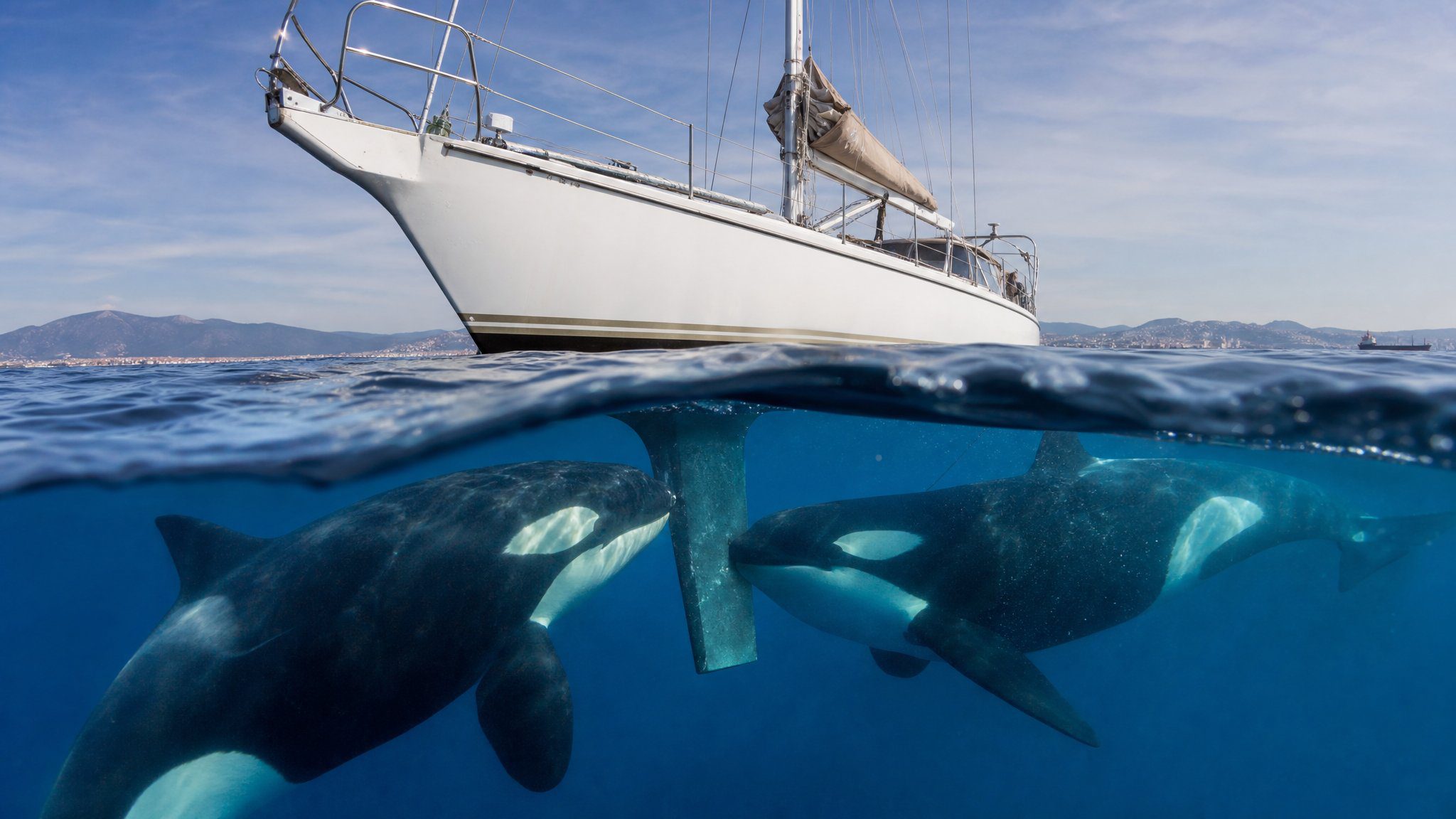
Since May 2020, a population of about 37 orcas living off Spain, Portugal and Morocco has repeatedly rammed and bitten the rudders of sailing boats, and by September 2025 at least seven vessels had sunk.
By May 2024 researchers had logged nearly 700 interactions between these Iberian orcas and boats, and by September 2025 the total had passed 750. About half ended with some damage to the boat, usually to the rudder, and many left crews without steering and waiting for the coast guard. The orcas approach from behind, go for the rudder, and often lose interest once the boat has stopped.
One early explanation centered on a female known as White Gladis, whom some researchers believe began the behavior after a traumatic encounter with a boat or fishing gear. A 2024 international workshop of orca scientists concluded that the behavior looks more like play or a passing fad, possibly encouraged by the recovery of the orcas’ main prey, and warned against calling the incidents attacks.
A Pattern Aimed at the Rudder
The first interactions were reported in May 2020, off Galicia in northwestern Spain and in the Strait of Gibraltar. The Atlantic Orca Working Group, known by its Spanish initials GTOA, recorded 52 that year, and the number climbed in each of the following years. Interactions peaked at about 207 in a single year, then fell to 136 in 2024.
In most encounters the orcas come up from the stern, push, bite or ram the rudder until it bends, breaks or tears away, and then usually move off once the boat is dead in the water. Most of the damaged vessels have been sailboats, while motorboats and rigid inflatables were approached in the same way but were usually unharmed, since they have different rudders, or none, and can speed away.
Researchers have identified 15 individual orcas from photographs taken during interactions, normally traveling in four separate groups. The behavior is concentrated in the Strait of Gibraltar and the Gulf of Cádiz, although the same orcas follow their prey along the coasts of Portugal and Galicia. In the Strait, fewer than 1 percent of sailboats that pass through experience an interaction.
The GTOA has said the orcas know exactly what they are dealing with. “Orcas don’t confuse the rudder with anything, they know what it is, how it moves and what effect it has when touching it,” the group wrote, adding that the boat’s speed and the resistance of the rudder make them persist.
The same population has swum alongside small fishing boats in Moroccan waters for decades without damaging them. Researchers at the 2024 workshop suggested that the rudders on those boats may simply not interest the orcas.
The Boats That Went Down
For the first two years the interactions left boats stranded and in need of expensive repairs, but none sank. That changed late one night in July 2022, when a family’s sailboat sank after an encounter with orcas off the port of Sines, Portugal, and the five people aboard escaped in a dinghy after radioing for help. On November 1, 2022, a French-flagged yacht sank about 25 kilometers off Viana do Castelo in northern Portugal after meeting a pod of orcas, and another sailboat that heard its distress call picked up the four crew.
On the night of May 4, 2023, three orcas struck a yacht in the Strait of Gibraltar and pierced its rudder. The skipper, Werner Schaufelberger, told the German magazine Yacht that two smaller orcas shook the rudder while a larger one rammed the boat from the side. “The two little orcas observed the bigger one’s technique and, with a slight run-up, they too slammed into the boat,” he said. The Spanish coast guard rescued the crew, and the boat sank at the entrance to the port of Barbate.
By the time of the international workshop in February 2024, the interactions had sunk six vessels, four sailboats and two fishing boats. On May 12, 2024, orcas rammed the 15-meter yacht Alboran Cognac in Moroccan waters of the Strait until it took on water. A passing oil tanker picked up the two people aboard and carried them to Gibraltar, and the yacht sank.
On September 13, 2025, orcas rammed a rental sailboat several times off Costa da Caparica, near Lisbon, and it sank bow first. Portugal’s maritime authority rescued the five people aboard, none of them injured. The same day, tourists on another sailboat in Cascais Bay reported orcas knocking against their hull.
Read next
The Male Betta Who Guards a Nest Made of Bubbles
Why did White Gladis start ramming boats?
Alfredo López Fernández and his colleagues suspected that White Gladis began ramming boats after what he described as “a critical moment of agony,” such as a collision with a boat or being caught during illegal fishing. López Fernández, a biologist at the University of Aveiro in Portugal and a member of the GTOA, gave Live Science that explanation in 2023, and it made White Gladis famous. “That traumatized orca is the one that started this behavior of physical contact with the boat,” he said. The behavior has since been seen in more than a dozen other orcas in the population.
The name came from Gladis Blanca, a nickname taken from Orcinus gladiator, a former scientific name for the orca. Mónica González, a marine biologist with the Galician marine mammal group CEMMA, said in a webinar that White Gladis was probably pregnant when the interactions began. She gave birth in 2021, and orca pregnancies last 15 to 18 months. González noted that she took her calf with her to the boats.
López Fernández said he did not think the adults were teaching the young. In his view the behavior spread by imitation, first from mothers to their calves and then sideways among the young animals. Some sailors who watched the orcas at close range described what they saw differently. A crew member on a boat approached by six orcas in May 2023 told an Australian news program that a mother appeared to be teaching her calf to charge the rudder.
Play, Fads and the Return of the Tuna
In February 2024 orca scientists and officials from Spain, Portugal and Morocco met in Madrid for a workshop sponsored by the Spanish and Portuguese governments and reported to the International Whaling Commission. They discussed the trauma idea but did not adopt it. They noted that the number of juveniles, typically the most curious members of an orca population, had risen before the rudder interactions began. They also noted that playful contact with boats may have started around 2017, without damage, and escalated as the young animals grew.
The workshop also looked at changes in what the orcas eat and how easily they find it. The Iberian orcas feed mainly on Atlantic bluefin tuna, which was scarce between 2005 and 2011 but has since recovered, and the tuna now stay in the Gulf of Cádiz year-round. With food easier to find, researchers suggested, the orcas and especially the juveniles may have more spare time for new behaviors. The workshop report described the behavior as closer to the fads recorded in other orca populations, in which a habit spreads quickly and then disappears.
“The use of words such as ‘aggression’ or ‘attack’ to describe such interactions is thus inappropriate,” the workshop report stated. Deborah Giles, an orca researcher at the University of Washington, told Live Science that orcas are “incredibly curious and playful animals.” Bruno Díaz López of the Bottlenose Dolphin Research Institute in Spain told The New York Times in 2024 that he had seen adults teaching the behavior to juveniles. “This is like a training toy,” he said.
A Population of 37
The Iberian orcas were listed as Critically Endangered on the IUCN Red List in 2019, because of their small numbers, high calf mortality and the state of their prey. A study presented at the Madrid workshop estimated that the population held steady from 2011 to 2023 at an estimated 37 animals in 2023. Females give birth only about once every 8.3 years on average, and adult survival, especially among females, has fallen.
Eleven Iberian orcas, four of them juveniles, stranded between 2011 and 2023, and in most cases the cause of death could not be determined. The orcas take tuna from fishing lines, and they face entanglement, hostile reactions from fishers and a newer risk from electric “tuna stunners” used on longlines. Some sailors have used firecrackers, flares and even attempts at electrocution to drive them off, measures the workshop called ineffective, dangerous and illegal under European law for a protected species.
Earlier official advice told crews to stop the engine, drop the sails and let go of the wheel, which the GTOA said usually made the orcas lose interest. The workshop said that advice may need revisiting in some areas. It advised crews who meet the orcas to move at least 2 to 3 kilometers away, toward the coast or toward help, and to alert the authorities at once. Portugal’s navy set up a working group with the maritime authority and the national conservation institute to issue navigational warnings when orcas are nearby. The country also banned whale-watching boats from approaching the Iberian orcas in 2023.