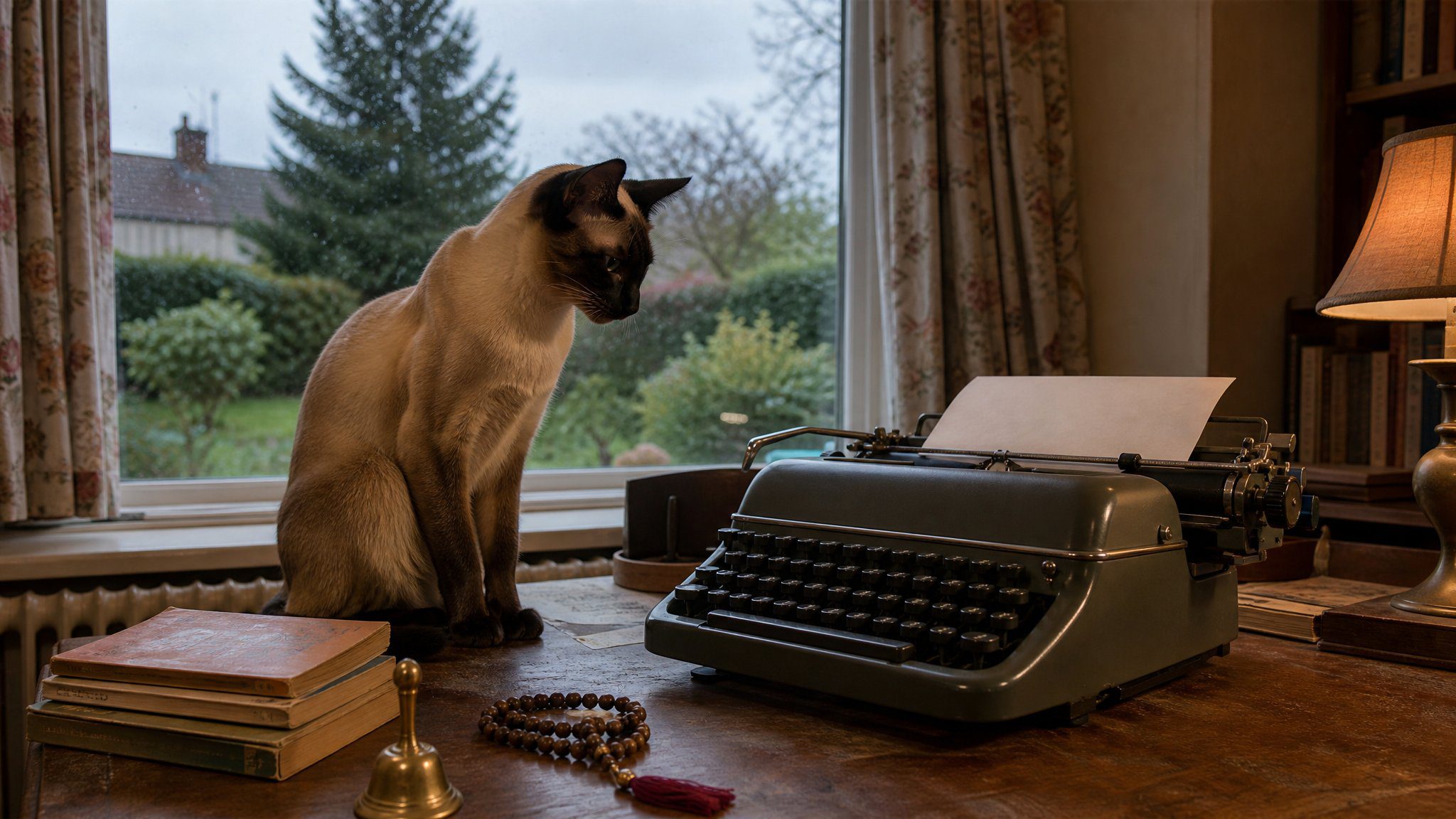
In 1964 a writer who called himself Tuesday Lobsang Rampa published a book called Living with the Lama and credited it to his Siamese cat, Mrs. Fifi Greywhiskers, who he said had dictated it to him telepathically.
Rampa had become famous eight years earlier with The Third Eye, which he presented as the autobiography of a Tibetan lama trained in Lhasa. It included an operation in which a hole was drilled into his forehead to open a third eye for seeing auras. The book sold hundreds of thousands of copies in Britain and Europe at a time when Tibet had fallen under Chinese Communist rule and almost no Western reader could check what it said.
The author was Cyril Henry Hoskin, born on April 8, 1910, in Plympton, Devon, the son of the local plumber. A private detective established in 1958 that there was no evidence he had ever left the British Isles before moving to Ireland. He went on writing as Rampa for more than twenty years, and his books have sold more than four million copies.
The Third Eye and the Doubts at Secker & Warburg
The London publisher Fredric Warburg first met the author at his firm’s offices, where a shaven-headed, bearded man calling himself Dr. Kuan-Suo introduced himself in fluent English and read Warburg’s palm. He correctly told him his age and assured him that Secker & Warburg was the karmically appropriate publisher for his book. Warburg still had doubts, so he sent copies of the manuscript to almost twenty experts on Tibet, several of whom had lived in Lhasa during the years the book described. None of them had heard of Lobsang Rampa or his teacher, a lama named Mingyar Dondup. One reader, the Austrian-born Hindu monk and anthropologist Agehananda Bharati, later wrote that the first two pages convinced him the author was not Tibetan. The next ten, he wrote, convinced him he had never been to Tibet or India.
Bharati noticed that the narrator said “for we know there is a God,” a statement he regarded as impossible for any Buddhist. Other readers, including Hugh Richardson, the last British representative in Lhasa, the scholar Marco Pallis and the explorer Heinrich Harrer, author of Seven Years in Tibet, sent similarly negative reports. On a later visit Warburg greeted the author with a Tibetan phrase asking whether he had enjoyed a pleasant journey. Rampa gave him a blank look and then collapsed to the floor. He explained that during the war he had hypnotically blocked his knowledge of Eastern languages to avoid giving away secrets to the Japanese, so that hearing his own language brought back the pain of torture.
Rampa refused an offer to publish the book as fiction, and Secker & Warburg released it in November 1956 with a preface admitting that its authenticity was difficult to establish. The scholar David Snellgrove opened his review with the line “This is a shameless book.” Harrer’s review was so hostile that the book’s German publisher threatened to sue him for libel. Richardson wrote in the Daily Telegraph that its errors about Tibetan life gave “the impression of Western suburbia playing charades.” None of it slowed sales, because The Third Eye sold 300,000 copies in its first eighteen months and went through nine hardback printings in Britain alone in two years.
A Liverpool Detective and a Plumber’s Son From Plympton
In January 1957 Scotland Yard asked Rampa to produce a Tibetan passport or a residence permit, and he moved to Ireland. A year later a group of scholars hired Clifford Burgess, a private detective from Liverpool. After a month of inquiries Burgess reported that the lama was Cyril Henry Hoskin, a plumber’s son from Plympton who had left school early. Hoskin had moved to London in 1940 and found work with a manufacturer of surgical fittings before becoming a clerk at a correspondence school. There, in Burgess’s words, he took his cat out for walks on a lead and shaved off all his hair.
At the correspondence school Hoskin began calling himself Kuan-Suo, and he wrote his supervisor a rhyme asking him to remember that he was now Kuan Suo, after which he was fired. Burgess could account for the years 1950 to 1953 only through one acquaintance, to whom Hoskin had described himself as a criminal and accident photographer. In 1954 he reappeared in the London district of Bayswater as Dr. Kuan-Suo. He later took two manuscripts to a literary agent, one about surgical fittings and one about Tibet, which became The Third Eye.
The findings led the British papers in the first week of February 1958, and the Daily Express ran the headline “The FULL truth about the Bogus Lama.” Reporters traced Hoskin to Ireland, where he at first declined to see them on doctor’s orders, citing a weak heart. He sent word through his wife that he had written the book for a real Tibetan, Dr. Kuan, whose family was in hiding from the Chinese Communists. Booksellers were warned about the book, and the Dutch publisher and bookseller E.J. Brill kept selling it with a note in small print saying it was no genuine study of Buddhism or Tibet.
Read next
China’s Underwater Data Centers Use the Ocean as Cooling
A Fall From a Tree and a Lama in a Borrowed Body
A fuller explanation soon arrived in a statement printed in reissues of The Third Eye, which began, “In the East it is commonly acknowledged that the stronger mind can take possession of another body.” In his third book, The Rampa Story, published in 1960, Hoskin wrote that in June 1949 he had fallen out of a fir tree in his garden at Thames Ditton, in Surrey. He had been trying to photograph an owl. When he came around from the concussion he saw a Buddhist monk in saffron robes walking toward him. He agreed to let the lama’s spirit take over his body because he was unhappy with his life in England.
The sequel to The Third Eye, Doctor from Lhasa, supplied the lama’s side of the story, in which Rampa trained as a doctor in China and flew air ambulances against the Japanese. He was held in a prison camp near Hiroshima and escaped in a stolen fishing boat on the day the atomic bomb fell. In The Rampa Story his exhausted spirit met the Thirteenth Dalai Lama in a world beyond the astral plane. He was told that a suitable body had been found “in the land of England,” whose owner was anxious to leave it. Hoskin had in fact legally changed his name to Carl Kuon Suo in 1948, a year before the fall. In the foreword to a 1964 edition of The Third Eye he wrote that Tuesday Lobsang Rampa was now his legal name and that he answered to no other.
Living with the Lama was one of nineteen books he published on auras, astral travel, extraterrestrials and the lost years of Jesus, the last of them published in 1980. His wife, who wrote as Mama San Ra’ab Rampa, published three books of her own in the 1970s. He also donated the royalties from a book called My Visit to Venus to the Save a Cat League of New York. He later said that book had been compiled and expanded by an American publisher without his permission.
Third Eye Questions for Real Lamas
Bharati traced what he called “Rampaism” to a much older Western tradition of imagined Himalayan masters, going back to the Theosophical Society founded by Helena Blavatsky and Henry Olcott in the late 19th century. Some readers of The Third Eye tried to perform the operation on themselves, in one case in the Netherlands with a dental drill. The historian of Tibetan Buddhism Donald S. Lopez Jr. found that in the 1970s Tibetan lamas teaching in Europe and North America were invariably asked whether they knew Lobsang Rampa. They were also asked whether they had undergone surgery to open the third eye.
Lopez also learned that The Third Eye had been the first book on Tibet for many European scholars of the subject, and that some said Rampa’s world had led them into their careers. When he assigned it to first-year students at the University of Michigan without telling them its history, they praised it unanimously. They judged it more realistic than anything else they had read about Tibet, despite six weeks of lectures on Tibetan history and religion. In 1972 Rampa’s French agent asked the Dalai Lama’s office for its view. The deputy secretary, Lobsang Wangchuk, replied that it did not “place credence in the books” and called them “highly imaginative and fictional in nature.”
Faced with continuing accusations in the British press, Hoskin moved to Canada in the 1960s, and he, his wife and his secretary and companion Sheelagh Rouse became Canadian citizens in 1973. He died in Calgary on January 25, 1981, at the age of 70, still insisting that everything in his books was true. People who knew him in his later years invariably noted a depression in the center of his forehead.
More from Terribly Interesting
Sources
- Donald S. Lopez Jr., “Lobsang Rampa: The Mystery of the Three-Eyed Lama,” Tricycle
- Bharati, “Fictitious Tibet: The Origin and Persistence of Rampaism,” Tibet Society Bulletin (1974) (archived)
- University of Chicago Press, Prisoners of Shangri-La by Donald S. Lopez Jr.
- Museum of Hoaxes, “The Third Eye of T. Lobsang Rampa (1956)”
- The Skeptic’s Dictionary, “T. Lobsang Rampa”
- Explorersweb, “Lobsang Rampa: The British Plumber Who Claimed to be a Tibetan Monk”