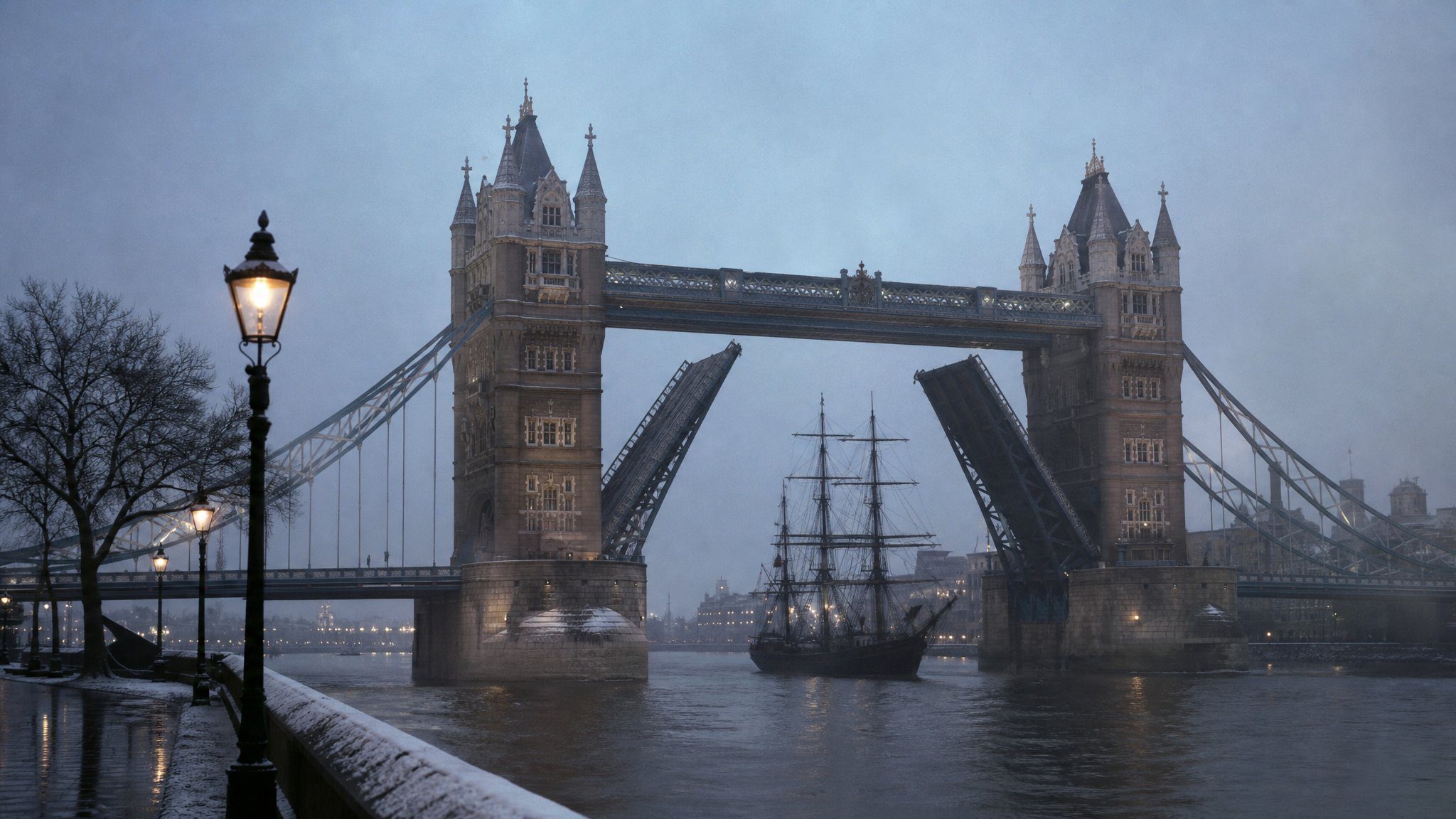
On a winter evening in 1952, a London double-decker with 20 passengers aboard drove off the end of Tower Bridge’s rising roadway and landed on the far half of the span.
The driver was Albert Gunter, a London Transport busman taking the number 78 across the Thames at about 9:30 p.m. on December 30, 1952. As he crossed, the leaf of road beneath his bus began to lift to let a vessel through. Gunter accelerated up the climbing slope instead of braking, and the bus cleared the gap opening between the two halves of the bridge. It came down on the southern leaf, which had not yet started to move, and London Transport later rewarded the driver with £10 and a day off work.
In 1952 Tower Bridge cleared its road before every lift using signal lights, warning bells and gates across the carriageway. That evening the routine failed while the bus was already on the span. The story made the front page of the Daily Telegraph and Morning Post the next morning, and TIME magazine ran it in January 1953 under the headline “Foreign News: The Jumping Bus.”
How Tower Bridge Raises Its Road
Tower Bridge was built between 1886 and 1894 to carry road traffic across the Thames without closing off the Pool of London. That stretch of river was the busiest port in Victorian London, where cargo ships from around the world unloaded cotton, sugar and tea. A fixed low bridge would have cut those ships off from the wharves and warehouses upstream.
More than 50 designs were entered in the competition for the crossing. The one Parliament accepted came from Sir Horace Jones, the City Architect, working with the engineer Sir John Wolfe Barry. The Corporation of London (Tower Bridge) Act 1885 received Royal Assent on August 14, 1885, and work began on April 22, 1886. Jones died in 1887, early in construction, and Barry saw the project through with roughly 432 men on site each day.
The finished bridge used about 31 million bricks, and its steel frame was clad in Cornish granite and Portland stone. The central span between the two towers is 200 feet long and divides into two leaves called bascules. Each one weighs more than 1,000 tons and is balanced by a counterweight, so comparatively little force was needed to raise it, and the Victorian machinery could lift the leaves in about five minutes.
The original machinery was built by Sir W. G. Armstrong Mitchell and Company of Newcastle upon Tyne. Two stationary steam engines pumped water at 750 pounds per square inch into hydraulic accumulators, which held the pressure that drove the leaves upward. Those steam engines powered every lift until the bridge switched to electricity in the 1970s, and they now stand on display in its Victorian engine rooms.
The bridge was opened by the Prince of Wales on June 30, 1894, at an official cost of £1,184,000. When pedestrians were let onto it on July 9, 141,760 people walked across in a single day. In its first year it lifted more than 6,000 times, and its busiest single day came in 1910, with 64 lifts. Each of those lifts depended on the road being emptied of people and vehicles before the bascules began to move.
Read next
The Jenny Lind Wreck and the Doctor Who Distilled the Coral Sea
Twenty Passengers on a Rising Leaf
Albert Gunter was a 46-year-old from Theberton Street in Islington who had driven tanks for the British Army during the Second World War. On December 30 he was at the wheel of an AEC Regent III RT, the standard London double-decker of the period, working route 78 from Shoreditch. The route ran from Shoreditch, north of the river, over Tower Bridge and into south London, and Gunter had driven across the bridge hundreds of times before that night.
The approach light was green as the bus came onto the bridge at about 12 mph. The warning bell was silent and the gates stood open, so Gunter had no reason to expect a lift. He later told TIME that “it seemed as though the roadway in front of me was falling away,” and he realized within moments that the leaf under the bus was the one rising.
Peter Dunn, a passenger on the bus, later described the choice Gunter faced in those few seconds. He could stop and risk the heavy vehicle sliding backward toward the river, or he could drive on and try to clear the gap. Gunter, with his wartime years in tanks behind him, chose to drive on, and he told TIME, “I felt we had to keep on or we might be flung into the river.”
The height of the drop onto the southern leaf was never settled. TIME put it at six feet, while the bridge’s superintendent engineer told the Daily Telegraph that the bus had fallen about three. Gunter feared that the southern half might start rising as well, and he explained afterward, “I thought that might start going up too, so I just kept right on till I got to the other bank.”
A Broken Leg, a Broken Spring and a Forgotten Bell
The landing broke one of the bus’s springs and threw passengers to the floor. The most serious injury fell to the conductor, Alfred Barton, who broke his leg. TIME counted minor injuries among twelve of the passengers, while the Telegraph’s front page on December 31 listed ten people hurt. Injured passengers were taken to hospital, and nobody was killed.
A watchman at the bridge was supposed to ring the warning bell and close the gates before the bascules moved. On that evening he did neither, which left the approach signal showing green to a bus that was about to be lifted into the air.
London Transport officially commended Gunter for his quick thinking, and the £10 that came with the day off was worth about $28 at the time. Converted to present-day money, the reward comes to somewhere between £250 and £300, depending on the calculation used.
Long after the newspapers had moved on, the story kept turning up in films and children’s entertainment. A double-decker leaps the opening bridge in the 1997 Spice Girls film Spice World. Versions of the jump have also appeared in an episode of Peppa Pig and in the children’s book The Tower Bridge Cat.
Gunter went back to driving the number 78 after his day off, and when a reporter asked how he planned to spend his reward, he answered, “Five for me, and five for the missus.”
More from Terribly Interesting
Sources
- TIME magazine, “Foreign News: The Jumping Bus”
- Tower Bridge (official)
- Hagerty UK
- Tower Bridge (official)
- Tower Bridge (official)
- Tower Bridge (official timeline)
- Tower Bridge, Sir John Wolfe Barry
- Tower Bridge, Sir Horace Jones
- PBS Building Big
- Tower Bridge (official)
- Tower Bridge, Sir William Armstrong
- Forces News
- This Day in Aviation
- This Day in Aviation
- Tower Bridge, Engine Rooms
- Hagerty (US)