For 37 days in 1850, the 28 people wrecked with the barque Jenny Lind drank seawater that a passenger had turned fresh using the ship’s copper cookware and a length of lead pipe.
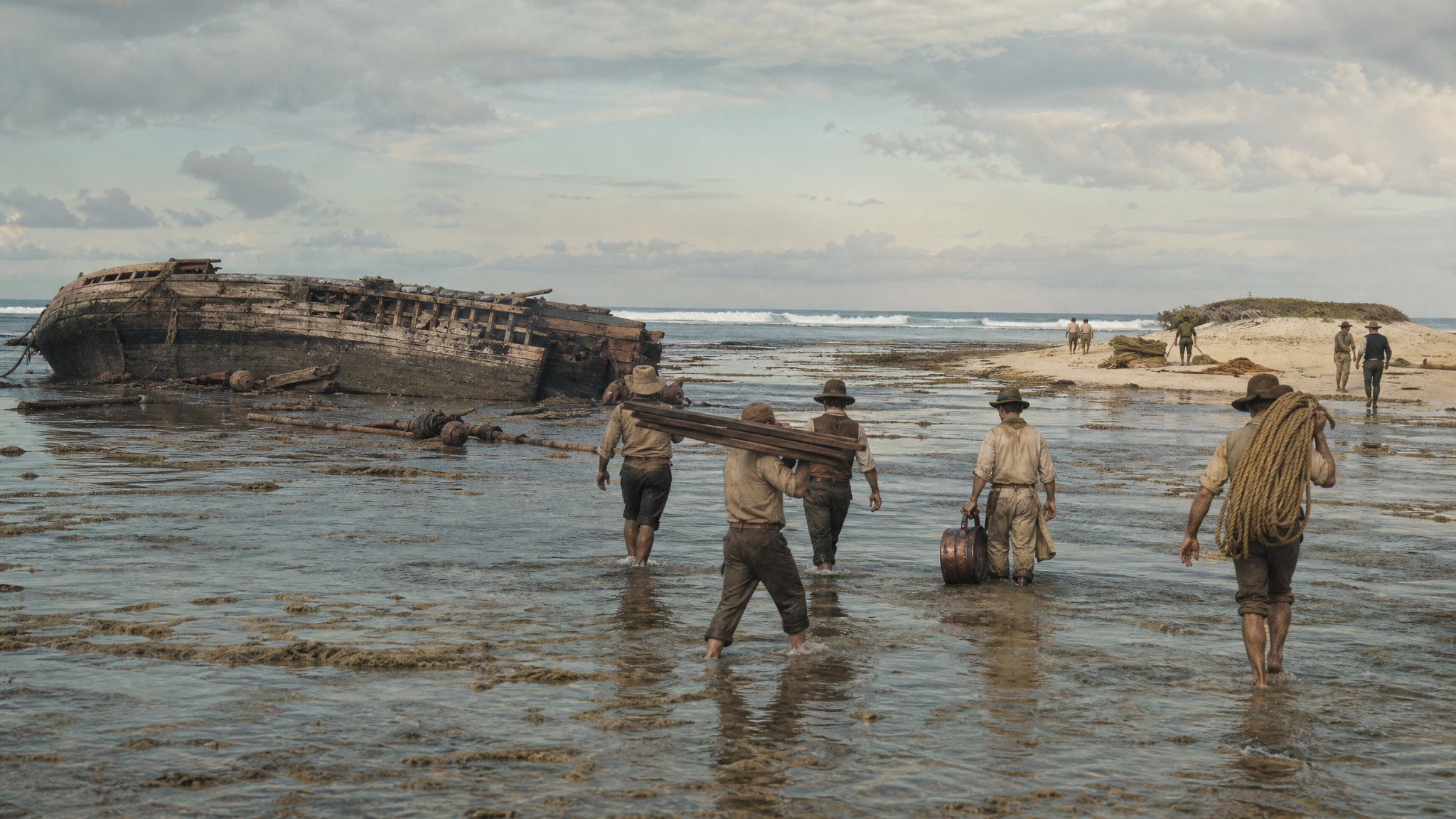
The British barque Jenny Lind struck Kenn Reef in the Coral Sea, far off the coast of Queensland, just after four in the morning on September 21, 1850. She was sailing from Melbourne to Singapore with 19 officers and crew and nine passengers, and every one of them reached a low sand cay about half a mile away. There a passenger named Philip Beal, a physician and former ship’s surgeon, built a working still from copper cookware and lead piping salvaged from the wreck. The crew built a schooner-rigged boat from the ship’s timber, rigging and sails, and all 28 people sailed it and a small cutter to Brisbane.
Three of the nine passengers were young children, and the cay offered the castaways sand, coral and very little else. Maritime archaeologists from the Australian National Maritime Museum studied the wreck in 2017. They credit Beal’s apparatus with turning about 25 gallons (114 liters) of seawater into drinking water a day, and they call it critical to the group’s survival.
A Canadian Barque Named for the Swedish Nightingale
The Jenny Lind was built in Quebec, Canada, in 1847, with a hull of oak, pine and hackmatack. Hackmatack is a North American larch, and Canadian shipbuilders used it for the knees that braced a wooden ship’s frame. She was a single-decked barque 118 feet long, with a 26-foot beam and a 20-foot depth of hold, and she could carry 484 tons.
Her figurehead was carved as a likeness of her namesake, the Swedish soprano Jenny Lind, known to her public as the Swedish Nightingale. That carved figure is now on display at the Gladstone Maritime Museum in Central Queensland.
The shipping firm Brent & Co bought the barque, registered her at Plymouth, England, on February 26, 1848, and put her on the route between Liverpool and New York under Captain Stephen Cleverly. In February 1850 she sailed on her first voyage to Australia under a new master, Joseph Taylor, with 114 passengers and merchant goods aboard. She reached Port Adelaide in mid-June and, a little over a month later, carried 50 passengers on to Melbourne, arriving on August 2.
Her last voyage began when she cleared Melbourne on August 27, 1850, and left Port Phillip Bay two days later. Accounts of the wreck list her cargo as a small quantity of flour and beef. The archaeologists who examined the site in 2017, however, found a heap of wrought iron bars that may have been ballast or a cargo nobody recorded.
Four in the Morning on Kenn Reef
Kenn Reef sits on the summit of an extinct undersea volcano that rises more than 3,000 feet from the seafloor. Its reefs cover about 15 square miles and, seen from above, form the outline of a reversed letter L. Alexander Kenn, master of the ship William Shand, came upon the reef in April 1824 while sailing from Sydney to Batavia.
The reef lay close to the Outer Route, a course many northbound ships took to stay clear of the Great Barrier Reef. The sea breaks over the whole complex at high water.
The weather on the run north was variable, and on September 19 and 20 cloud hid the sun so completely that the officers could not fix the ship’s position. Just after four in the morning on September 21, lookouts saw something black in the water ahead, and although the crew tried to steer clear, the barque struck the reef and went over on her beam ends.
The crew cut away all three masts, with their sails and rigging, in an attempt to right the hull and keep it from breaking apart. Passenger Daniel Rowntree Somerset, traveling with his wife and three children, wrote in his diary that an hour after striking, the ship “presented a scene of perfect and complete ruin.”
Everyone reached the cay now known as Observatory Cay, which rises only about two meters above sea level at its highest point. By October 3, seaman Richard Holten recorded, nearly one entire side of the ship had washed onto the reef top, and the castaways had made it fast to a rock.
Read next
The Tobacco Scientist Who Broke His Silence Agreement
How Philip Beal Made Seawater Drinkable
Distillation works because boiling seawater gives off steam that leaves the salt behind, and the steam turns back into fresh water when it cools. Everything Beal needed for a still was lying in the wreck, from copper vessels that could serve as a boiler to lead piping that could carry the steam away to condense.
The ship lay on its side on a reef that flooded at every high tide, so the castaways could reach it only when the water dropped. Once Beal had assembled the salvaged copper cookware and lead pipe on the cay, the apparatus produced about 25 gallons of fresh water a day by the archaeologists’ estimate. That came to a little under a gallon for each of the 28 people.
The fullest record of the five weeks on the cay comes from Somerset’s diary and Holten’s written account of the wreck. Both are held in the Ian H Nicholson Collection at the John Oxley Library, part of the State Library of Queensland.
A Boat Built From the Wreck
While Beal kept the water coming, the crew went back to the wreck for timber, rigging and sails, and from them they built a schooner-rigged boat large enough to carry 22 people. The barque’s only surviving ship’s boat was a small cutter, so between the two craft there was room for everyone.
On October 29, 1850, after 37 days on the cay, both boats left Kenn Reef for the Australian mainland, more than 370 miles away. The Moreton Bay Courier of November 9 reported that the schooner-rigged boat and the cutter had come into the Brisbane River the previous Tuesday night. Aboard were the captain, officers, passengers and seamen of the barque.
All 28 had survived the wreck, the weeks on the cay and the passage to Brisbane, and newspapers across the colonies carried the story. Bell’s Life in Sydney and Sporting Reviewer ran its account on November 30, 1850, under a headline announcing the preservation of all hands.
A Reef Strewn With Wrecks
Most of the at least eight vessels lost on Kenn Reef between 1828 and 1884 went down in the 1850s, a decade of rising migration to Australia. Trade between Sydney, Melbourne and ports in Asia and Britain was growing fast at the same time. A chart from the late 1850s described the southern end of the reef as strewn with wrecks, almost all of them lost near Observatory Cay.
A Queensland Museum team first documented the Jenny Lind site in 1987, labeling it KR4, and the 11 archaeologists and divers of the 2017 expedition relocated it. Its centerpiece is a mound of stone ballast fused with concreted iron bars, about nine meters long, lying some 800 meters southwest of Observatory Cay. That distance matches the half mile the survivors recorded. Nearby lay anchor chain, parts of a windlass and a British Admiralty pattern anchor with a shank 2.9 meters long.
Satellite imagery analyzed after the survey suggested the site might cover about 157 by 60 meters, far more than the 1987 team had mapped. On the same trip the team located the remains of several previously unidentified sailing ships, with cannons, anchors and ballast stones among them.
The 2017 team listed a full survey of Observatory Cay as a goal for future fieldwork, in the hope of finding remnants of the survivors’ camp, where Beal’s copper and lead still once stood.
More from Terribly Interesting
Sources
- Hunter and Malliaros, “The wreck of the Jenny Lind”, Signals 119 (Australian National Maritime Museum), 2017
- Live Science
- Trove record title
- ABC News, January 20, 2017
- Gladstone Maritime Museum, Our Collections
- Wikimedia Commons file record
- WikiTree, Daniel Rowntree Somerset
- USGS Water Science School, Desalination
- Britannica, Desalination