
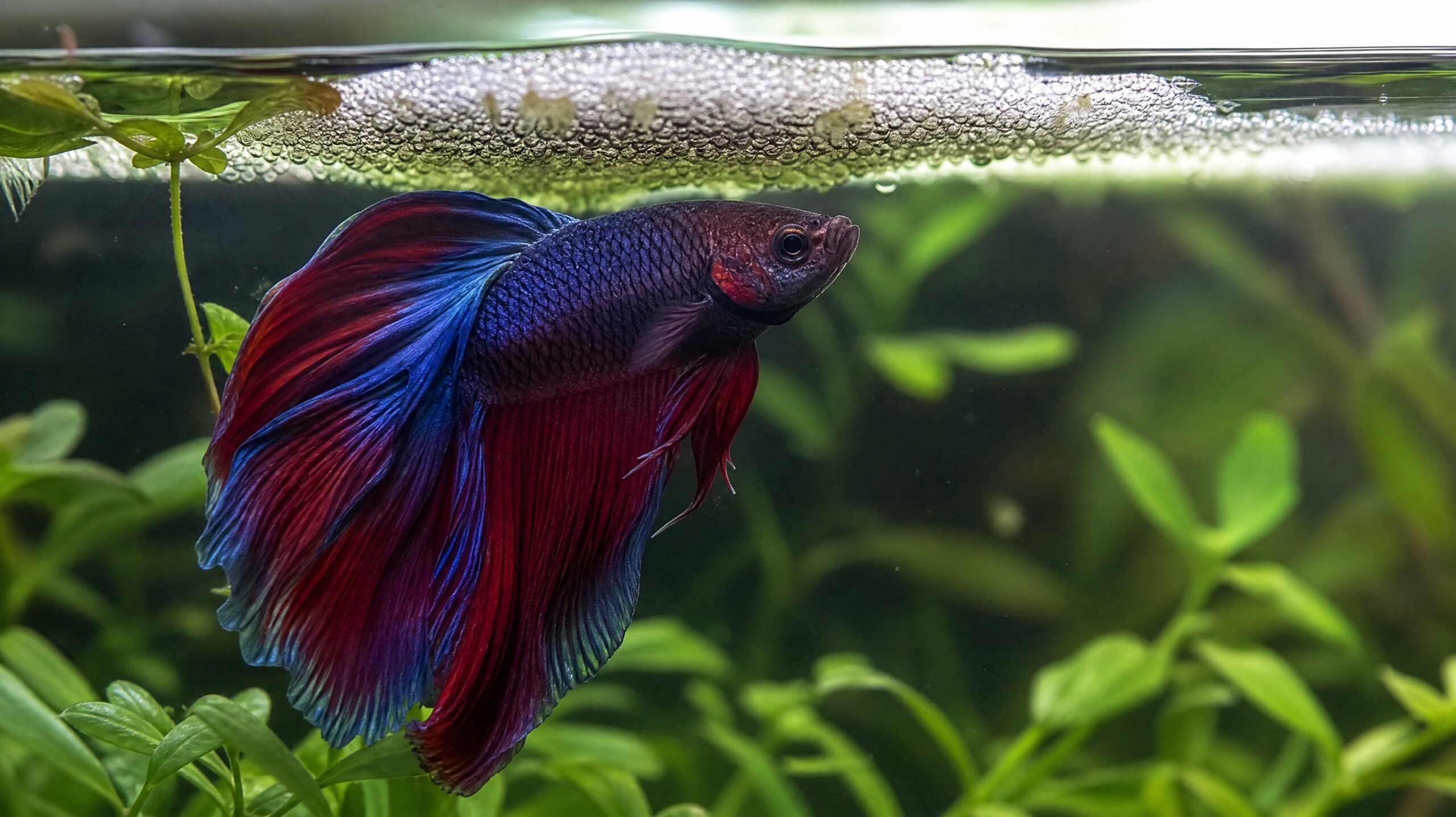
A male Siamese fighting fish builds a raft of bubbles on the surface of the water, catches his falling eggs in his mouth and spits them into it, then guards the nest alone until his young can swim.
The Siamese fighting fish, Betta splendens, is a small freshwater fish from the shallow, still waters of central Thailand, known worldwide as the betta. Males are famous for fighting each other, and for centuries people in Thailand bred them to fight for bets. The same male is also the only parent the young have. The female releases the eggs and takes no further part, while the male tends the nest, retrieves eggs and larvae that fall out of it, and stays until the fry are free-swimming.
The bubble nest is an adaptation to the water bettas live in, which is warm, acidic and often short of oxygen. Holding the eggs at the surface gives them more oxygen than they would get in the water below, keeps them from drying out and keeps them close to the male that defends them.
Air Breathers in Oxygen-Poor Water
Bettas belong to the labyrinth fishes, a group of about 137 species in Africa and southern Asia. Their gills are relatively small, and they rely on the labyrinth organ, a set of folded, bony chambers above the gills lined with tissue that absorbs oxygen from air gulped at the surface. Many labyrinth fishes must breathe air to survive, and the group is thought to have arisen about 60 million years ago in waters where oxygen was scarce.
Wild bettas live in rice paddies, swamps, roadside ditches and ponds, usually among dense vegetation. In one survey of a wild population in Thailand, the fish lived in water about 5 centimeters deep with an average temperature of 29.9 degrees Celsius and a pH of about 5.5. Dissolved oxygen there averaged about 3.8 milligrams per liter and swung between zero and 7.4 over the course of a day. The bettas were spread thinly, at about 1.7 fish per square meter.
Biologists at the University of Florida describe the bubble nest as one of the traits that evolved alongside air breathing. It lets the eggs develop at the warm, oxygen-rich surface of water that is otherwise poor in oxygen and relatively free of predators. In Thailand, bettas move to shallow water at the edges of their habitat to breed during April and May.
How does a male betta build a bubble nest?
A male betta builds the nest by taking air at the surface and releasing bubbles that stick together into a floating mat, often among floating plants or under a broad leaf. He builds it before there are any eggs to put in it, and he keeps adding to it. He does not usually tolerate the female near the nest until it is finished. When she is ready to spawn, the female turns paler and dark vertical bars appear on her flanks.
The size of the nest has been studied as a possible signal to females. A study of wild bettas in Thailand found that longer males built larger nests, but that females given a choice between two males did not prefer the one with the bigger nest. A 2006 study by Ethan Clotfelter and colleagues found that males that displayed to females more often also built larger nests, while larger males did not.
The pair spawn directly under the nest in an embrace typical of their family, with the male wrapping his body around the female. At each embrace she releases a few eggs, which he fertilizes, and they begin to sink. The male picks them up in his mouth as they fall and carries them up into the bubbles.
The female sometimes catches eggs between her pelvic fins and her body during the embrace, and she may gather up loose eggs as well. The pair repeat the embrace many times, until the female has released all her eggs, with about 300 eggs in a typical spawning.
From then on, the female has no role in caring for the eggs, and commercial breeders take her out of the container once spawning is over. The male takes sole charge of the nest, adding bubbles where it needs repair and guarding the area beneath it against other fish.
Read next
The Orca Called White Gladis and the 700 Boat Encounters
Days of Catching and Returning
The eggs hatch in 24 to 48 hours, depending on conditions. The newly hatched larvae cannot yet swim and stay in the nest for another three to four days while they absorb their yolk sacs. During that time eggs and larvae keep slipping out of the bubbles and sinking, and the male collects each one in his mouth and puts it back.
If the nest is threatened, the male may move the entire nest to another spot. Once the fry begin to swim freely, he loses interest in them, and in commercial hatcheries the larvae are moved to separate tanks at about three days after hatching. Adult bettas do not usually eat their own young.
The fry need a layer of warm, humid air above the water while their own labyrinth organs develop in their first weeks. Breeders keep their tanks tightly covered, sometimes with plastic wrap, because the organ can develop abnormally without that layer of air. The young are raised together for three to four months, until the males can be told apart from the females and have to be separated to stop them fighting.
A Cousin That Broods Its Eggs in Its Mouth
The genus Betta contains more than 73 species, and not all of them build bubble nests. The Penang betta, Betta pugnax, lives in shallow, clear hill streams in Peninsular Malaysia and Singapore, where flowing water would break up a floating nest. Its males are mouthbrooders that hold the fertilized eggs inside their mouths instead of in bubbles.
The pair spawn in the same wrapped embrace as the Siamese fighting fish, often after several practice embraces in which no eggs are released. The male then incubates the eggs in his mouth for 9 to 16 days before releasing free-swimming fry. A male that is stressed or inexperienced may swallow the eggs or spit them out too early, so aquarists usually leave the female and other fish in place rather than disturb him.
From Rice Paddies to National Symbol
Bettas have been bred for fighting in Southeast Asia for centuries, with reports from Thailand dating back as early as the 14th century. A genetic study published in Science Advances in 2022 sequenced 98 fish across five closely related species. It found that bettas were domesticated more than 1,000 years ago, which makes them one of the oldest domesticated fish.
A male betta meeting another male almost immediately spreads his fins and flares out his gill covers, and if neither backs down the two bite at each other’s fins and flanks. In the fighting tradition, two males were placed together in a small container and the first to retreat was declared the loser. From the early 20th century bettas were also bred for color and long fins for the ornamental trade, which is now the main market.
In Thailand the fish is known as pla kat, the Thai name for all members of the Betta splendens group, and the species name splendens is Latin for shining or glittering. Escapes from ornamental fish farms have established wild populations far outside Thailand, in Singapore, Malaysia, Indonesia, Brazil, Colombia and the Dominican Republic.
On February 5, 2019, Thailand’s cabinet named the Siamese fighting fish the country’s national aquatic animal, citing its history and cultural importance. Wild populations have declined as farming and development have altered the waterways, and the species is listed as Vulnerable by the IUCN. Sakda Sihapat, a caretaker at the Siamese Fighting Fish Gallery in Samut Prakan, told the news agency AFP that “you have to go to a really virgin swamp to find this fish, and there aren’t any anymore.”
Wild male bettas, which still build their nests among the weeds at the edges of rice paddies, are a dull brown or green. The vivid colors and long flowing fins of the pet-shop fish are the product of about a century of selective breeding.
More from Terribly Interesting
Sources
- University of Florida IFAS, “Evolution, Culture, and Care for Betta splendens” (FA212)
- Seriously Fish
- Jaroensutasinee and Jaroensutasinee, Journal of Fish Biology 2001
- “The effect of bubble nest size on sexual selection in wild Siamese fighting fish” (ResearchGate listing)
- Wiley Online Library
- PMC (Kwon et al., Science Advances 2022)
- PubMed
- The Jakarta Post (AFP)
- Bangkok Post
- Seriously Fish