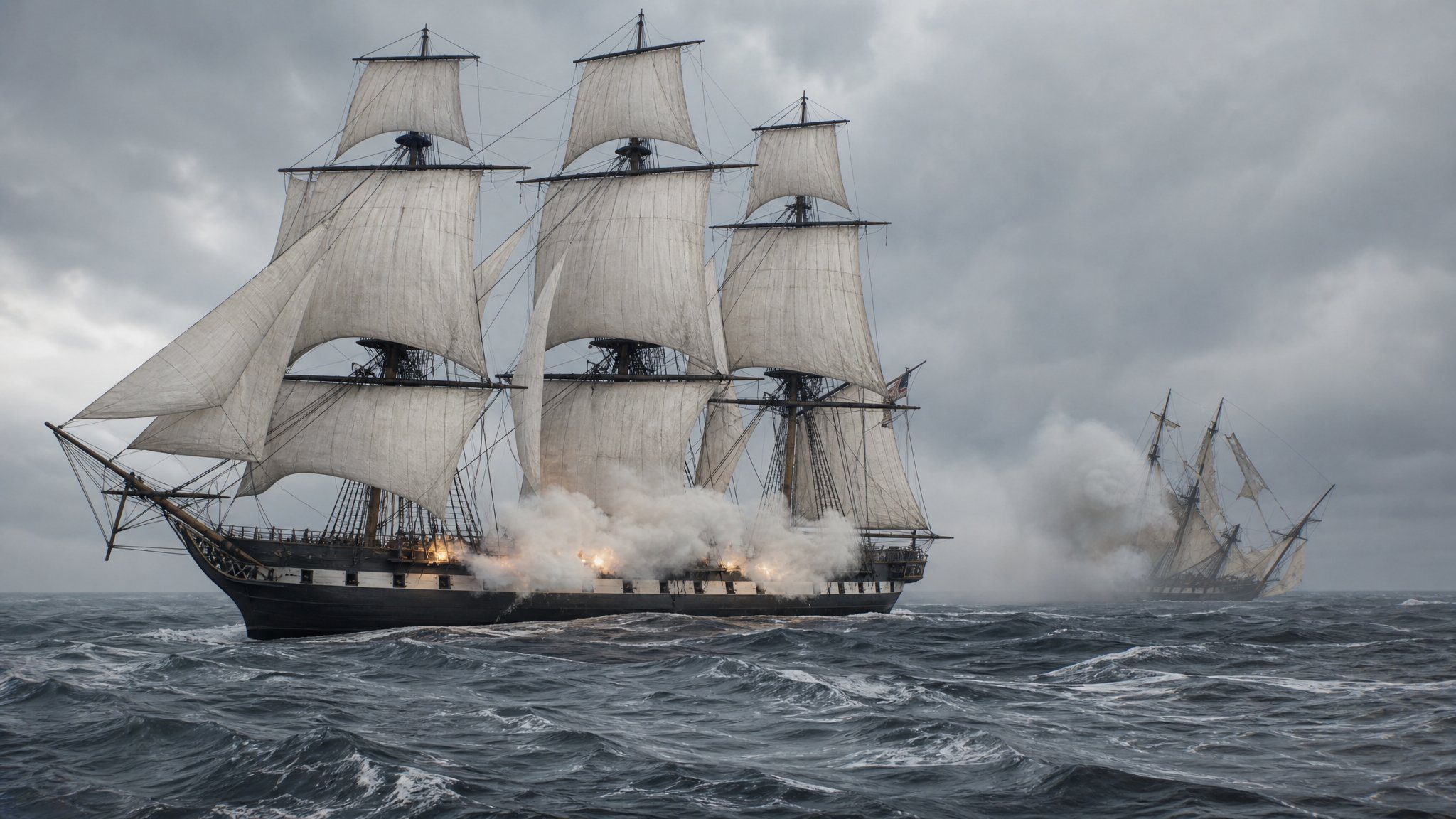
In 1812 a wooden American frigate earned a metal name, because some of the cannonballs fired at her bounced off her oak sides and fell into the sea.
USS Constitution was launched into Boston Harbor on October 21, 1797, from Edmund Hartt’s shipyard in Boston. She was one of six frigates authorized by an act of Congress approved on March 27, 1794, a program that gave a young United States its first real navy to protect American merchant ships.
Her frames were cut from southern live oak, a dense, hard timber that gave her hull unusual strength, and she was planked with white oak. During the War of 1812 those thick oak sides became part of her legend when she fought the British frigate HMS Guerriere in the North Atlantic.
A Warship Built for a Small Navy With Large Problems
The United States entered the 1790s with no navy of its own and serious threats to its merchant ships, above all from the Barbary states of North Africa, which seized American vessels and demanded tribute. Congress answered in 1794 by authorizing six frigates. Constitution was rated as a 44-gun ship and designed to outgun any frigate of her size and outsail anything too powerful to fight.
Joshua Humphreys, the shipbuilder who designed the frigates, favored ships that were larger and more heavily built than typical European frigates. Constitution was a three-masted, square-rigged ship with a covered gun deck. In 1812 that deck carried 30 long guns firing 24-pound shot, and her upper deck carried two dozen short-range carronades.
Her strength came from the quality and arrangement of her timbers as much as from her guns. The USS Constitution Museum explains that live oak in her closely spaced frames let the ship carry heavy armament while still sailing fast. The National Park Service describes the wood as weighing up to 75 pounds per cubic foot and highly resistant to rot, and shipbuilders found it extremely hard to cut and shape.
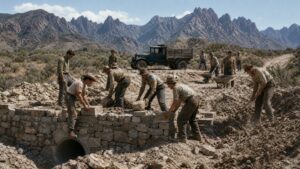
Getting that timber to the shipyard in Boston was a slow and punishing job. In the 1790s live oak that the new country could reach grew mainly on the swampy, thickly wooded coastal islands of Georgia. The Navy first sent axmen and specialist woodcutters from New England, and within months many had died of disease and most of the rest had deserted.
A Navy captain sent south to ship the timber found that almost nothing had been done, and he turned to local enslavers. The Navy paid plantation owners for the labor of enslaved men, who first cleared roads to the stands of live oak and later did much of the cutting. The USS Constitution Museum, which has researched this history, says some of that timber is still part of the ship today.
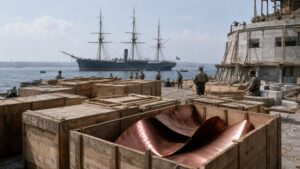
Constitution also carries a link to a famous name from the American Revolution. Paul Revere supplied the copper bolts and spikes used in her construction. A few years later, after he had opened a copper rolling mill in Canton, Massachusetts, he supplied the thousands of copper sheets used to sheathe her hull during an early refit.
Her name came from a list of ten that Secretary of War Timothy Pickering sent to President George Washington in March 1795. Washington chose Constitution, United States, President, Constellation and Congress. The launch itself took three tries, because the ship stuck on the ways twice before she finally slid into the harbor on October 21, 1797. She first put to sea in July 1798.
Read next
Woodstock ’99: The Toilets, the Heat and the Fires at Griffiss
How did USS Constitution get the name Old Ironsides?
The United States declared war on Britain in June 1812, against long odds at sea. The Royal Navy was the largest in the world and had enormous prestige, while the US Navy had fewer than two dozen ships. British officers expected to win every fight, and few people on either side expected an American frigate to beat a British one.
Constitution very nearly never reached the fight that made her name. In July 1812, under Captain Isaac Hull, she ran into a British squadron that included Guerriere. When the wind died, Hull’s crew towed the ship with boats, soaked the sails to catch every breath of air and hauled her forward on anchors dropped ahead, and after two days they escaped.
On August 2, Constitution sailed from Boston again, and on the afternoon of August 19 she met Guerriere, under Captain James Richard Dacres, in the waters southeast of Halifax, Nova Scotia. The National Park Service says Dacres announced that he would take the American ship within thirty minutes.
Guerriere fired first, and her early broadsides fell short of the American ship. The crew asked Hull for permission to answer, and he refused, because he did not want to waste the first broadside. He held his fire until Constitution came directly alongside the British ship, and then he gave the order to fire.
It was during this exchange that the ship earned her name. The Navy’s official history says that some of Guerriere’s shot fell harmlessly into the sea or glanced off Constitution’s hull. One American sailor was heard shouting, “Huzza! Her sides are made of iron! See where the shot fell out!”
Lieutenant William Sharp Bush, commander of her Marines, was shot dead as he climbed up to lead a boarding party, and First Lieutenant Charles Morris was badly wounded. At one point Guerriere fired straight into Constitution’s stern cabin and set it on fire.
The American broadsides brought down Guerriere’s mizzenmast and then her foremast and mainmast, leaving her a hulk rolling in the swell.
Dacres, who had been wounded in the back by a musket ball, surrendered. The Navy’s history describes the fight as a battle of only half an hour. Guerriere was so badly damaged that she could not be saved, and the next morning Hull had his crew blow her up.
The victory had little effect on the course of the war, and the National Park Service says as much. Its effect on American morale, however, was enormous and immediate. It was the US Navy’s first victory over a Royal Navy frigate in a single-ship fight, and when Constitution reached Boston with her British prisoners on August 30, cheering crowds met Hull and his crew.
Constitution won two more famous fights at sea before the war ended in 1815. In December 1812 she defeated the British frigate Java off the coast of Brazil, and in February 1815 she captured the warships Cyane and Levant in a single action. The Navy credits her with capturing 33 vessels in 57 years of active service.
The Poem, the Repairs, and the Ship That Stayed Afloat
In September 1830 a 21-year-old student named Oliver Wendell Holmes read in the Boston Daily Advertiser that the Navy planned to scrap the ship. He wrote the poem “Old Ironsides” in protest, and the Advertiser published it on September 16. The Navy’s history says the public feeling it helped stir up led Congress to pay for a reconstruction instead, which began in 1833.
The threat to the ship came back in 1905, from the top of the Navy itself. Charles Bonaparte, President Theodore Roosevelt’s Secretary of the Navy, wrote that so much of the ship had been replaced that she was no longer the vessel Hull had sailed. He suggested that she could be used for target practice by the Atlantic fleet and sunk. Roosevelt, himself a historian of the naval War of 1812, disagreed, and money was found for her first true restoration in 1906 and 1907.
Repairs and restorations have continued in almost every decade since then. A wooden warship cannot survive more than two centuries without constant replacement, and Constitution’s planking, beams, masts and rigging have all been renewed many times. Isaac Hull himself wrote in 1819 that within about eight years of her building, every beam in her had been replaced.
The oldest surviving material is concentrated low in the ship, in parts of the keel and the lower timbers. Nobody knows exactly how much of the 1790s ship remains. In 2018 Margherita Desy, the Navy’s historian for the ship, wrote that her detachment’s best guess was about 8 to 10 percent, and she described that figure as an educated estimate based on the records of past rebuilds.
A major restoration in the 1990s prepared the ship for her 200th birthday. On July 21, 1997, Constitution sailed under her own power for the first time in 116 years, and she did so again on August 19, 2012, the 200th anniversary of the Guerriere fight.
Constitution remains in commission as the world’s oldest commissioned warship afloat. She is berthed at the Charlestown Navy Yard in Boston, where an active-duty Navy crew shows her to visitors and takes her out for ceremonies.
More from Terribly Interesting
Sources
- Naval History and Heritage Command (NHHC) fact sheet
- NHHC Dictionary of American Naval Fighting Ships (DANFS)
- National Park Service
- NPS
- USS Constitution Museum
- History.com
- USS Constitution Museum
- GBH News
- USS Constitution Museum (Rebuilt, Preserved, Restored)
- US Naval Institute Proceedings (September 1947)
- New England Historical Society