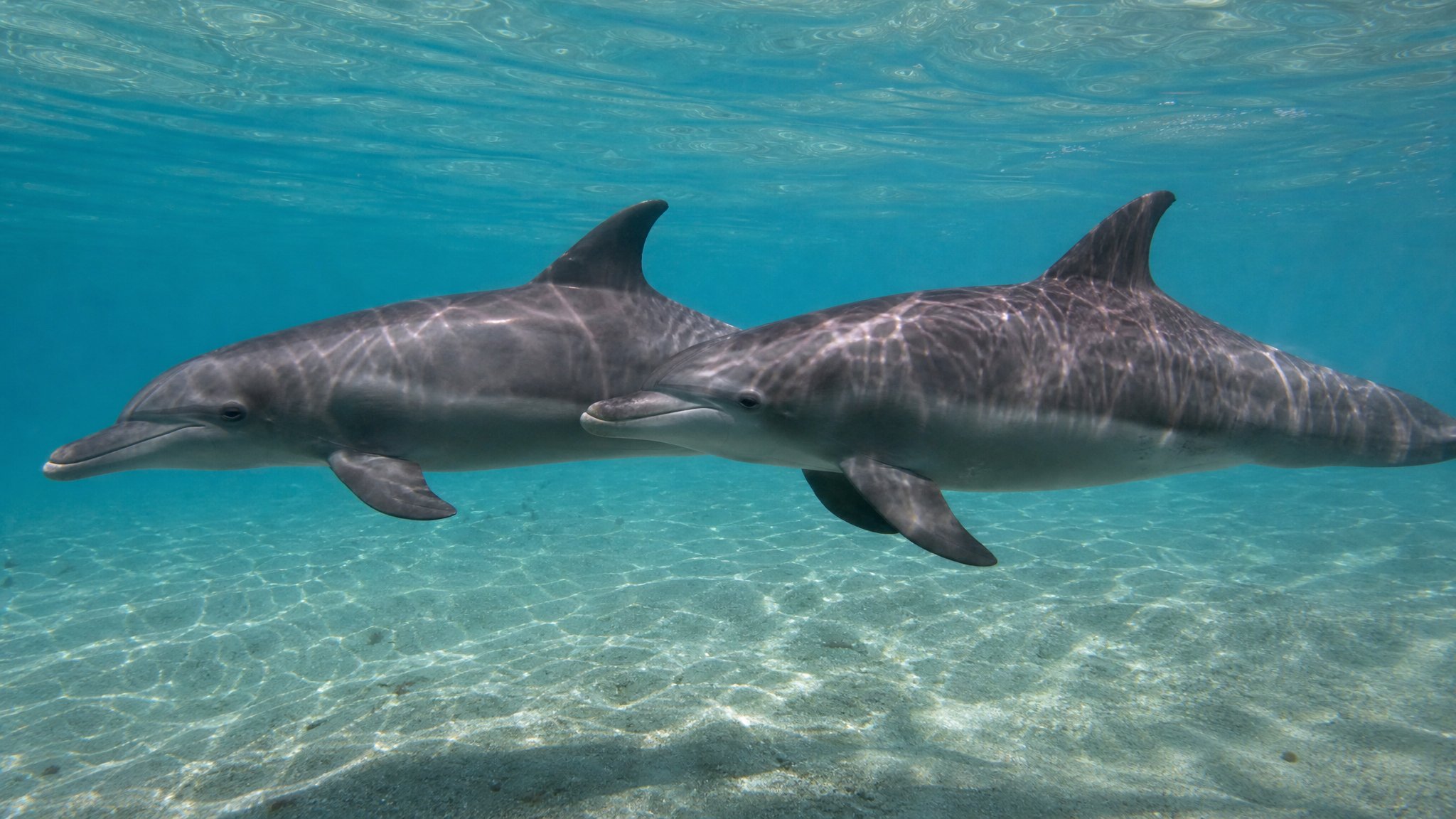
Bottlenose dolphins can tell whether a sample of urine poured into the water came from a dolphin they know or from a stranger, without seeing or hearing the animal that produced it.
The finding came from experiments by Jason Bruck, Sam Walmsley and Vincent Janik of the University of St Andrews in Scotland, published in the journal Science Advances in May 2022. The work took place at Dolphin Quest facilities in Bermuda and Hawaii, where the dolphins live in natural seawater. The researchers poured small samples of urine in front of dolphins and timed how long each one spent sampling the water with its mouth open. The dolphins spent longer on urine from dolphins they knew than on urine from dolphins they had never met.
The team then paired urine samples with recordings of signature whistles, the individually distinctive calls that dolphins use much like names. The dolphins lingered longer when the whistle and the urine came from the same animal than when they came from two different companions. The researchers concluded that the dolphins recognized an individual through taste alone and linked that taste to the individual’s whistle, the first time recognition of another animal by taste has been shown in any animal.
Tasting Without Smelling
Dolphins have no sense of smell in the usual mammalian sense. They lack an olfactory bulb, the brain structure that handles smell, the nerve that serves it is underdeveloped, and their nasal passage is separated from the mouth and throat. Anything a dolphin detects in the water, it detects by taste.
Their sense of taste is also unusual when compared with that of other mammals. Genetic studies have shown that dolphins lost the receptor genes for four of the five basic mammalian tastes, sweet, sour, bitter and umami. “We still know very little about how the sense of taste works in dolphins,” Janik said when the study was published. “But they have unusual sensory cells on their tongue that are probably involved in this detection of individual tastes of other animals.”
Dolphins are exposed to the taste of other dolphins all the time, mostly through urine and other excretions in the water around them. Urine plumes also stay in the water for some time after the animal that produced them has swum away, which could let a dolphin know that a particular individual has recently passed by even if it never called.
The Urine Experiments
The Dolphin Quest dolphins had been trained to give urine samples voluntarily, which were collected in syringes, cataloged and frozen, so the researchers could build a library of samples and move them between facilities. Nineteen dolphins aged 3 to 48 acted as donors. Ten dolphins aged 3 to 31, eight males and two females, served as test subjects.
Each test session began with a presentation of ice water, which the dolphins were used to receiving as enrichment and readily sampled. The experimenter then walked along the dock with the dolphin following and dropped a sample of about 20 milliliters into the water half a meter to a meter in front of its rostrum. The dolphins spent about twice as long sampling urine as they spent sampling plain water, and every animal tested explored urine for longer than water.
In the second experiment, every dolphin spent longer sampling urine from a familiar dolphin than urine from a dolphin it had never associated with. The sex of the donor and the age of the sample, which ranged up to 37 days old, made no difference. The dolphins also whistled more in response to familiar urine. Their response to unfamiliar urine was about the same as their response to plain water, which showed that strangers’ urine did not repel them.
Read next
What Crows Do When They Find One of Their Own Dead
Matching a Taste to a Name
The third experiment tested whether the dolphins connected the two kinds of identity. After pouring a urine sample in front of a dolphin close to an underwater speaker, the researchers played either the signature whistle of the dolphin that had given the urine or the whistle of another dolphin the subject knew. In almost all trials the donor animals were dolphins the subject was living with at the time.
Most dolphins stayed near the presentation area longer when the taste and the whistle matched. That was the reverse of the usual pattern in experiments of this kind, in which animals pay more attention to a mismatch because it violates their expectations. The researchers suggested that mismatches are common in a dolphin’s daily life, since urine lingers in the water while whistles carry over long distances, so a match may be the more notable event.
Janik said the results showed that the dolphins could tell animals apart by taste and could also recognize them across their senses, “hinting at a complex representation of familiar animals in a dolphin’s brain.” The researchers argued that it pointed to a labeled concept of each known dolphin, with the signature whistle serving as its label. Cross-modal recognition of other individuals, matching a voice to a face or a scent, had already been shown in animals including crows, cats, dogs, horses and chimpanzees, but never through taste.
Signature Whistles as Names
Bottlenose dolphins develop their signature whistles early in life, apparently by copying whistles they hear and then changing them into a new pattern of their own. The identity is carried in that invented pattern of rising and falling pitch rather than in the sound of the dolphin’s voice. In playback experiments, dolphins responded to computer-generated versions of a whistle, stripped of the caller’s voice features, in the same way as to the real whistle.
Parrots and dolphins are the only non-human animals that have been trained to copy new sounds and then use them as labels, and both use labels in their natural communication as well. Between 38 and 70 percent of the whistles made by wild bottlenose dolphins are signature whistles. Dolphins also copy the signature whistles of others, mostly between close associates such as mothers and calves or allied males, and wild dolphins respond specifically when they hear their own whistle played back. When two groups meet at sea, they exchange signature whistles before joining up. A dolphin’s signature whistle also stays stable for decades, which the University of Chicago noted makes it a more lasting identifier than a human face.
Bruck had shown nine years earlier how long dolphins remember these names. For a study published in the Proceedings of the Royal Society B in 2013, he tested dolphins in a breeding program run by six institutions, including the Brookfield Zoo near Chicago and Dolphin Quest in Bermuda. The program had moved dolphins between facilities for decades and kept records of which animals had lived together, and when.
Twenty Years Apart
Bruck first played a dolphin a series of signature whistles from dolphins it had never met, until it lost interest. He then played the whistle of a dolphin it had once lived with, followed by the whistle of a stranger of the same age and sex as a control. Dolphins responded much more strongly to the familiar whistles, often swimming quickly to the speaker, hovering near it and whistling at it as if trying to get it to answer.
The dolphins in the study ranged from four months to 47 years old, and some had been housed apart for as long as 20.5 years. Bruck also drew on recordings of 20 more dolphins made by researchers at the Woods Hole Oceanographic Institution in the 1980s and 1990s. The strongest response did not depend on how long the animals had lived together, whether they were related, or their sex. In one case, Bruck played the whistle of a female named Allie, who lived at Brookfield Zoo, to a female named Bailey at Dolphin Quest in Bermuda. The two had last lived together at Dolphin Connection in the Florida Keys, when Allie was 2 and Bailey was 4. Bailey recognized Allie’s whistle 20 years and six months after they had parted. Bailey, then 24, had lived at Dolphin Quest Bermuda since 1996, and Allie had moved to Chicago.
The study was the first to show social recognition lasting at least 20 years in a non-human animal. Wild bottlenose dolphins live about 20 years on average, and some reach 45 or more, so a memory of that length can span most of a dolphin’s life. “This shows us an animal operating cognitively at a level that’s very consistent with human social memory,” Bruck said. He added that the study could only be done with dolphins in human care, since in the wild nobody knows how long two animals have been apart. Janik and his colleagues have said their next step is to find out what else dolphins can learn from the urine they encounter. That could include what another dolphin has been eating or where a female is in her reproductive cycle.