At about 11:30 on a Friday night in August 2020, a medevac plane circled over the village of Igiugig, Alaska, to collect a sick child, and the runway below it was completely dark.
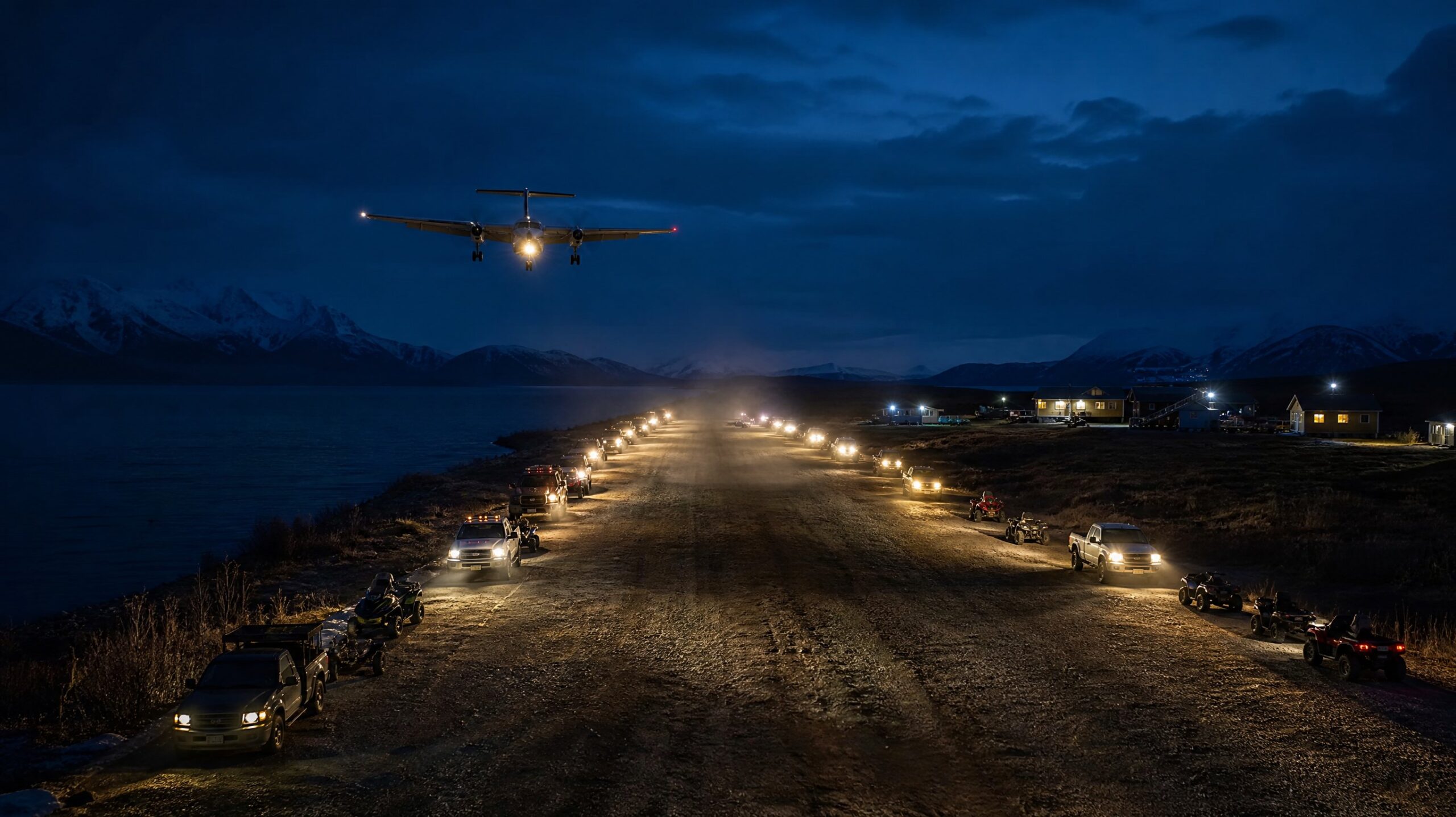
The child needed to be flown to a hospital in Anchorage, and LifeMed Alaska had sent a King Air air ambulance from Kodiak, a flight of about 30 minutes. When it arrived on August 28, 2020, the lights on Igiugig’s state-owned runway would not switch on, either by radio from the aircraft or by hand from the ground. Residents of the village of about 70 people drove cars, trucks and four-wheelers onto the airfield and lined them up along the length of the runway with their headlights on. The pilot landed, loaded the patient and took off again while every vehicle held its position.
The child reached a hospital in Anchorage in stable condition, and the state later explained why the runway had been dark. The Alaska Department of Transportation and Public Facilities said the lights had been out since February, damaged over the winter by snow removal equipment. Its crews had already been to the airport three times that year to work on them.
Igiugig, Where Iliamna Lake Meets the Kvichak River
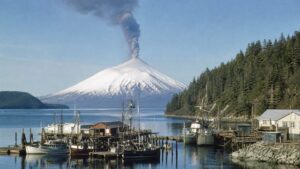
Igiugig sits at the southwest end of Iliamna Lake in southwestern Alaska, at the point where the lake drains into the Kvichak River. The name means “like a throat that swallows water” in the Yup’ik language, and the Yup’ik and Aleut people of the area have lived there for more than 8,000 years. For most of that time they moved with the seasons to follow their food, and the village settled in one place when it opened a school to keep its young people at home.
The village has no road access, and like most rural Alaska communities it depends on its airport for medical transport, mail and supplies. Across the state, more than 80 percent of communities cannot reach the road system year-round. The Alaska Department of Transportation and Public Facilities (DOT&PF) owns and manages 235 of these rural airports, and as of early 2024, 64 of their 243 runways had no lights at all.
Thirty-Two Phone Calls Before Midnight
Ida Nelson, the head tribal clerk, lives near the runway and had just come out of a steam bath when she heard the aircraft pass low over the village. She took it for an unfamiliar truck at first. “Normally planes don’t fly around at 11:30 at night, so I instantly knew something was wrong,” she told CNN. When she looked toward the airfield she could see that the runway lights were off.
Pilots at Igiugig normally switch on the runway lights by keying their radio from the aircraft, and residents can also turn them on from a button on the ground. “Normally if you push the button like 10 or 15 times the lights will just light up,” Nelson told Alaska Public Media. That night neither method worked, and the LifeMed plane flew on over the village without landing.
Nelson rode her four-wheeler the few hundred yards to the airstrip, where a local pilot was already trying to work out what was wrong with the lights. She offered to light one end of the runway, and a neighbor who had called to ask whether the plane was landing began phoning for more vehicles. “She started calling other people and waking them up. Like, ‘Get up, get out of bed, come line up the runway,'” Nelson said. The neighbor made 32 calls, which Nelson said covered almost every household and cellphone in the village. Many of the people who answered were already in bed, and a lot of them turned out in their pajamas.
The local pilot climbed into his own plane and talked to the LifeMed crew by radio, then passed their plan to the neighbor, who was organizing the villagers by phone. Everyone was to line up along the runway, with one vehicle at each of the dead runway lights and more in between. About 20 vehicles arrived within 20 minutes, driven by people ranging in age from 8 to about 70, and they staggered themselves along the full length of the strip facing east. Nelson said the idea was to let the pilot see the runway from one end to the other.
Read next
Albert Gunter and the Bus That Jumped Tower Bridge in 1952
Landing the King Air by Headlight
The weather was calm, and the LifeMed crew made several low passes over the airfield before deciding whether a landing was possible. Russ Edwards, the chief executive of LifeMed Alaska, said runway conditions, icing and snow had kept his crews from landing in rural Alaska before. “I don’t recall that runway lights not working has ever kept us from landing,” he told CNN.
Before the plane touched down, the village’s on-call health aide told everyone to stay exactly where they were. The health aide brought the patient to the aircraft, and the villagers kept their vehicles in place with the lights on while the pilot taxied down the runway and took off again. “I was feeling nervous, anxious because this is late at night and this is someone’s child,” Nelson said. “The only thing I could think of was how quickly I could get other people here to help because what if that was my baby’s plane?”
LifeMed briefly posted a photo of the scene on Facebook that was almost completely black except for a straight row of lights in the distance. “What appears to be a blurry, dark photo is actually a view of what an amazing community can do with a lot of determination,” the company wrote. Edwards said the crew and the people on the ground had come up with a safe and creative way to land, and that without all that cooperation it would not have happened.
Nelson said afterward that if the village ever had to light the runway again it now knew how to do it faster, but that she wanted the state to fix its runway lights “so we never have to do this again.”
Why Igiugig’s Runway Lights Had Failed
Sam Dapcevich, a spokesman for the department’s South Coast region, said a contractor in the community operating the state’s snow removal equipment had damaged the lights over the winter. State crews went out in early May to repair them and set upright the lights that had been knocked over, then found a wiring problem that could not be fixed until the ground thawed. When they returned the week before the medevac to work on the wiring, they found that several more lights had been run over. Crews flew back to Igiugig on the Tuesday after the medevac and put the lights back into service.
Damage of this kind is a known problem across the state system. Most of Alaska’s rural airports are maintained by contractors from a nearby village, usually with one equipment operator and one or two plows. Clearing snow off the runway with that equipment without burying or hitting the edge lights is difficult. Most of these contractors are not trained to repair lighting, so the rural airports rely on traveling electricians who fly out with tools and parts, and a community can wait days or weeks for repairs.
The department keeps battery-powered modular runway lights that can be driven or flown to a village when the permanent lights fail, and it has seven emergency lighting trailers staged around the state. Many airports also carry a pack of six emergency lights for short-term use.
Deering Lit Its Runway the Same Way in 2022
On a Sunday night in December 2022, the Northwest Alaska village of Deering faced the same problem. Its runway lights had been out for more than a week and only daytime flights were operating when an infant needed to be flown to the hospital in Kotzebue. When the airport worker Calvin Moto asked residents to bring their vehicles for the Guardian Flight medevac, more than 25 volunteers gathered near the Deering Clinic at about 9 p.m.
Moto and resident Alvin Iyatunguk Sr. had the drivers park beside each runway light with their lights all pointing the same way. “That way the pilot from one direction can see their headlights and then in the other direction he can see everybody’s tail lights,” Moto told the Anchorage Daily News. He added the lights of a loader and a grader, and the volunteers ran a test before the plane left Kotzebue. It landed at about 10 p.m. in a temperature of minus 8 degrees Fahrenheit with a wind chill of 20 below.
A DOT&PF spokesman, John Perreault, later said it was not the first time Deering residents had lit their runway with their vehicles. In March 2024 the Alaska Aviation System Plan published a fact sheet on rural airport lighting. It named Deering and Igiugig as examples of communities where residents had lined up cars, trucks and ATVs along the runway so that medevac planes could land at night.