In 2006 a 12-year-old Florida schoolgirl named Jasmine Roberts tested ice from fast-food restaurants against water from the same restaurants’ toilets and found the ice dirtier 70 percent of the time.
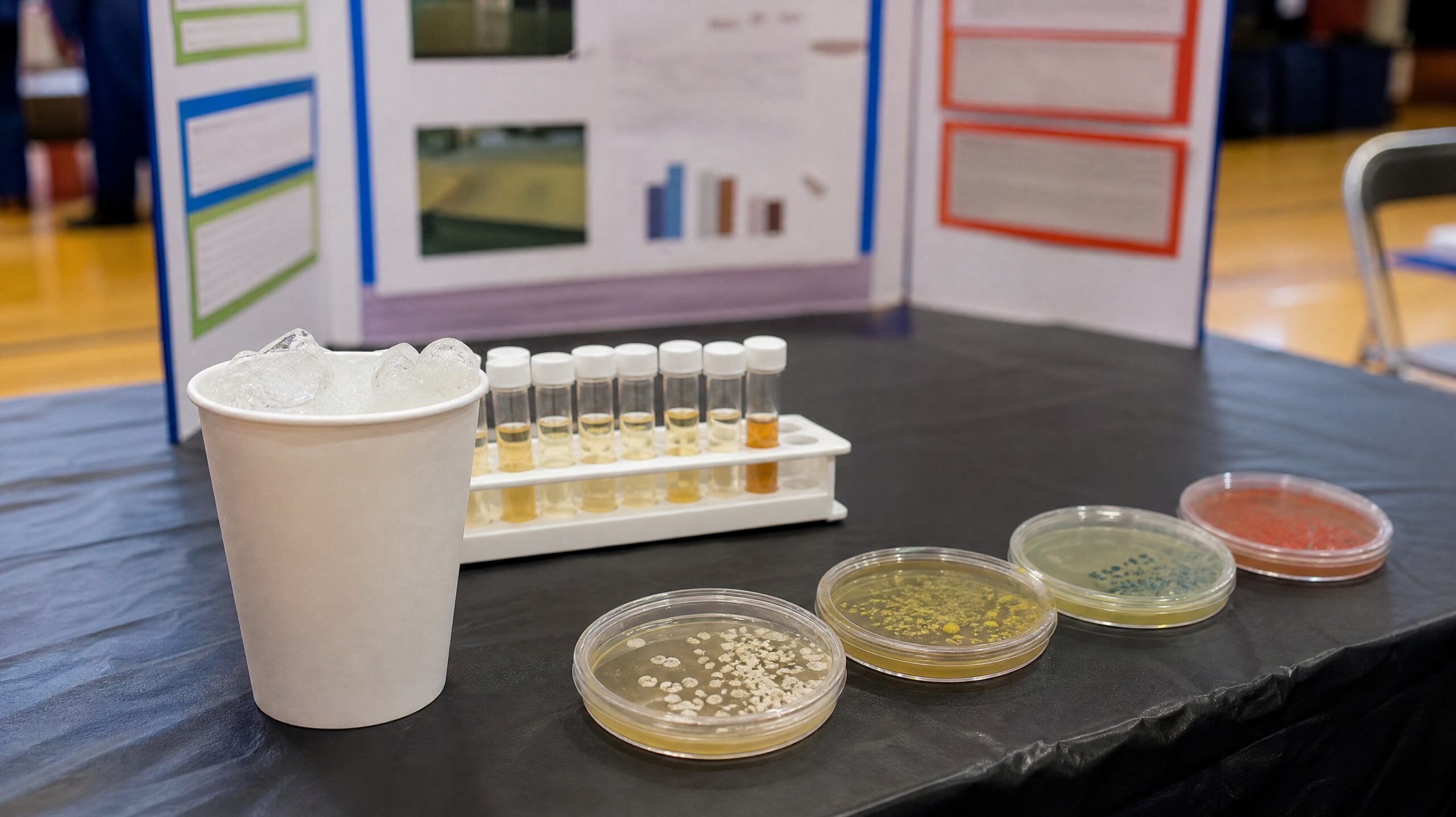
Roberts, a seventh-grader, collected ice from five fast-food restaurants in South Florida for a middle school science project. She took some samples from the self-serve machines inside the restaurants and some from the drive-thru windows, where staff filled the cups. She also collected water from the toilets in the same five restaurants, and had all the samples tested for bacteria at the University of South Florida. It was a school project covering five restaurants, not a published study.
In most of the comparisons the ice carried more bacteria than the toilet water, and several ice samples tested positive for E. coli, a bacterium that lives in the human gut and signals contamination by feces. The project won an award and was reported nationally by ABC’s Good Morning America in February 2006. Eleven years later, a British consumer program found bacteria of fecal origin in the ice at branches of McDonald’s, Burger King and KFC.
How a Seventh-Grader Set Up the Test
Roberts said she got the idea from a newspaper article about bacteria in the water served on airplanes, and she wanted to try something similar. She also had a personal reason for choosing ice. All of her friends chewed it, she said, and that habit drove her crazy. “I just picked the not-obvious choice,” she told ABC News.
Contaminated water on airplanes had been in the news for more than a year before her project. In August and September 2004 the US Environmental Protection Agency randomly tested the drinking water on 158 passenger aircraft. It found coliform bacteria in the water of 20 of them, 12.6 percent, and E. coli in two.
Roberts’s hypothesis, as she wrote it, was that “the fast food restaurants’ ice would contain more bacteria than the fast food restaurants’ toilet water.” Pairing each ice sample with toilet water from the same building made the result easy to grasp, since both came through the same plumbing.
Why was the toilet water cleaner than the ice?
The toilet water came out cleaner because, in a restaurant connected to the public supply, the water in the toilet tank and bowl is the same treated, disinfected city water that feeds the taps.
Ice goes through more steps between the tap and the customer, passing through a machine and often a storage bin before it is scooped or dispensed into a cup. Roberts and David Katz, the physician who discussed her results on Good Morning America, both put the contamination down to two causes: machines that are not cleaned properly, and people scooping ice with unwashed hands.
Katz told viewers that the bacteria did not belong in ice. “It’s not cause for panic, although it is alarming because what she found is nothing new. You’re not more likely to get sick now. But she’s done us a favor by sounding the alarm.” Under the US Food and Drug Administration’s model Food Code, which state and local health departments use as the basis for their rules, ice is defined as food.
Read next
Why Apollo 11 Left Soviet Cosmonaut Medals on the Moon
The BBC Watchdog Tests of 2017
In June 2017 the BBC consumer program Watchdog tested ice from 10 branches each of three British coffee chains. A microbiologist at Leeds Beckett University, Margarita Gomez Escalada, found fecal coliforms in the ice at seven of 10 Costa Coffee branches and three of 10 branches each of Starbucks and Caffè Nero. She said the ice was most likely contaminated by dirty hands, and that where the legal limit for tap water is around 10 microorganisms per milliliter, “we found hundreds per millilitre.”
Three weeks later, in July 2017, Watchdog tested ice from 10 branches each of McDonald’s, Burger King and KFC in the United Kingdom. It found coliform bacteria in samples from three McDonald’s branches, six Burger King branches and seven KFC branches, with significant levels in four of the Burger King samples and five from KFC.
“We are shocked and extremely disappointed by these results,” a KFC spokesman said, and the company shut down ice machines at the affected restaurants for inspection. McDonald’s cited the food safety scientist Tom Humphrey, who noted that E. coli, the most reliable indicator of fecal contamination, had not been found in any of its samples. He added that coliforms and enterococci are widespread in the environment and are not reliable indicators of a health risk.
Tony Lewis of the Chartered Institute of Environmental Health took a harder line on the coffee chain results. “The bacteria found are opportunistic pathogens, the source of human disease,” he said. “These should not be present at any level, never mind the significant numbers.” Costa said it had reviewed its food safety procedures, updated its ice-handling guidelines and begun introducing new ice storage equipment. Caffè Nero said a thorough investigation was under way, and Starbucks said it had moved quickly to conduct its own.
When Contaminated Ice Makes People Sick
Most bacteria found in restaurant ice are indicators of poor hygiene rather than causes of illness in themselves, but ice has been the source of real outbreaks. The best-documented case in the United States began with a flood. On September 8, 1987, torrential rain flooded Conestoga Creek in southeastern Pennsylvania, and the water got into the wells of an ice manufacturer beside it. In the following week the plant produced 60 to 300 tons of ice, which was sold to distributors in Pennsylvania, Delaware and New Jersey.
On September 19, the University of Pennsylvania played Cornell University at football in Philadelphia, and within 48 hours 158 students had gone to the university health service. Among people at the game who had consumed ice, 62 percent fell ill, compared with 10 percent of those who had not. Almost all of them felt nauseated and three-quarters vomited, usually about a day and a half after the game, and the illness lasted 12 to 48 hours. Two days later, Delaware health officials were told of another outbreak among the roughly 750 guests at a museum fund-raiser in Wilmington, where iced drinks had been served.
The Penn football team then used the same ice at practice, and 55 players fell sick on September 24 and 25. Tests found high concentrations of fecal coliforms in both the ice and the well water. No bacterial cause was found in stool samples, but an electron microscope picked out tiny virus-like particles in a sample from one Penn student. Blood tests later showed that 13 of 19 patients tested had antibodies pointing to Norwalk virus, now known as norovirus. From the attack rates, the Centers for Disease Control estimated that more than 5,000 people may have become ill. The manufacturer recalled the ice and agreed to decontaminate its wells and machinery before reopening.
In March 2015 more than 200 high school students fell ill with gastroenteritis during a graduation trip to Kenting, a resort area in southern Taiwan, and investigators traced the illness to iced tea served at the resort’s breakfast. Norovirus turned up in the ice, in the water on both sides of the ice machine’s filter and in samples from 16 sick students. The machine did have a filter, but its pores were 5 micrometers across, far too large to stop a virus the size of norovirus.