
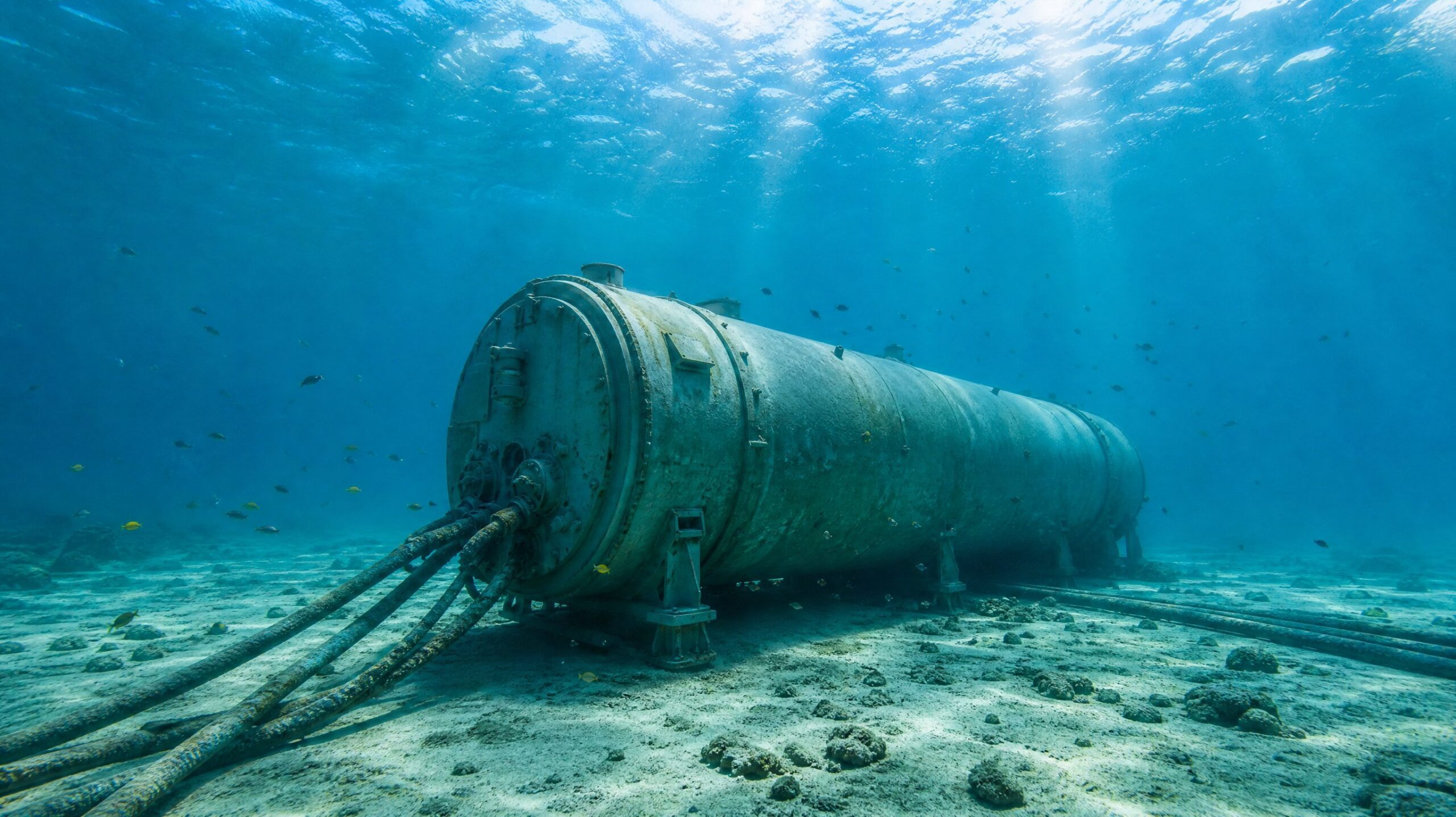
Off the coast of Hainan island in southern China, sealed steel capsules full of computer servers sit on the seabed about 35 meters down, cooled by the seawater around them.
The facility, off Lingshui county in Hainan province, began commercial operation in March 2023 and was billed as the world’s first commercial underwater data center. It was built by the Chinese company Beijing Highlander Digital Technology with the state-owned China Offshore Oil Engineering Company. Its early customers included China Telecom, the internet company Tencent and the Hong Kong AI company SenseTime. Each module is a pressure-resistant cylinder that transfers the heat of its servers straight into the surrounding water.
A second project, off Shanghai, went into full commercial service in May 2026. Its modules sit between the two phases of an offshore wind farm and take their power directly from the turbines. Its developers say it runs at a power usage effectiveness of about 1.15. For every unit of electricity used by the computers, only about 0.15 units go to cooling and other overheads.
Why Cooling Shapes Every Data Center
Every server turns the electricity it uses into heat, and a data center packed with thousands of them has to remove that heat continuously or the equipment fails. Land-based facilities do it with chillers, cooling towers, air handlers and, in many cases, large volumes of fresh water that evaporate to carry the heat away. All of that equipment draws power on top of the computing load.
The industry measures this overhead with power usage effectiveness, or PUE, the ratio of a facility’s total electricity use to the electricity used by its IT equipment. A PUE of 2.0 would mean cooling and other overheads use as much power as the servers themselves. The Uptime Institute’s 2024 global survey found an average PUE of 1.56 among the data centers that responded, a figure that had barely changed for five years.
An underwater module replaces most of that equipment with the sea. The servers sit in a sealed shell on the seabed, and their heat passes out into the surrounding seawater without chillers or cooling towers. Highlander says that 100 modules at the Hainan site would save 122 million kilowatt-hours of electricity and 105,000 tons of fresh water a year. They would also free 68,000 square meters of land that a conventional facility would occupy.
The Capsules on the Seabed Off Hainan
Highlander ran its first underwater test in January 2021 in the port of Zhuhai in Guangdong province, and announced the commercial project in early 2022. Several Chinese regions wrote underwater data centers into their five-year plans after the early tests. The Hainan project was supported by the Sanya city government and the provincial state assets commission, with Highlander’s subsidiary Shenzhen HiCloud handling design and deployment.
The system lowered into the sea off Lingshui weighed about 1,300 tonnes, and lowering a module into place takes about three hours. The modules are designed to last 25 years, and Highlander said one could process more than four million high-definition images in 30 seconds, which it described as equivalent to 60,000 traditional computers working at once.
The company has said it plans to place 100 modules over an area of about 68,000 square meters of seabed, a build-out expected to take about five years. In February 2025 it added a module holding more than 400 high-performance servers for artificial intelligence work. Chinese state media reported that the new module could handle up to 7,000 queries a second to the DeepSeek AI model. Ten companies had signed up to use the site for model training, industrial simulation, game development and marine research.
Wind Power Off Shanghai
The Shanghai project is in the Lingang Special Area, part of the China (Shanghai) Pilot Free Trade Zone. HiCloud signed a cooperation agreement with the Lingang administrative committee and a Lingang state investment group in June 2025. The first phase was a 2.3-megawatt demonstration, and the second phase raised capacity to 24 megawatts.
The Chinese government announced in October 2025 that construction was complete. In February 2026 Lingang officials said the 1.6 billion yuan facility, about $228 million, had been launched after initial trials, and full commercial operation followed in May. The modules sit next to the turbines, and electricity from the wind farm travels to them through subsea cables that also carry fiber-optic data lines, without passing through the onshore grid.
Its developers say the design cuts electricity use by 22.8 percent compared with a land-based equivalent, uses no fresh water for cooling, and needs more than 90 percent less land. Computing clusters from China Telecom and local providers are installed in the modules, running GPU servers for tasks such as data annotation and training Chinese large language models. HiCloud has described the site as the start of an offshore wind-powered underwater complex that could eventually reach 500 megawatts.
Read next
Teddy Roosevelt’s Tied-Up Bear and the Brooklyn Couple Behind It
What Microsoft Learned Off Orkney
Microsoft was the first company to test the idea at scale. It came out of the company’s ThinkWeek event in 2014, where employees pitched unconventional ideas, partly because more than half the world’s population lives within about 120 miles of a coast. In 2015 Microsoft’s Project Natick ran a small underwater data center in the Pacific Ocean off the US coast for 105 days.
In spring 2018 the Natick team lowered a larger module, called Northern Isles, to the seabed 117 feet down at the European Marine Energy Centre off Scotland’s Orkney Islands. The steel tube held 864 servers in 12 racks and was filled with dry nitrogen before it was sealed. Orkney’s power grid runs entirely on wind, solar and experimental marine energy, which the team saw as a test of running on a less stable supply. Tidal currents at the site reach up to 9 miles per hour, and in storms the waves there grow to more than 60 feet.
The module was hauled up in the summer of 2020, coated with algae, barnacles and sea anemones. Its servers had failed at one-eighth the rate of an identical set of servers kept on land for comparison. “Our failure rate in the water is one-eighth of what we see on land,” said Ben Cutler, the project’s leader. The team thought the main reasons were the nitrogen atmosphere, which is less corrosive than oxygen, and the absence of people bumping into components while replacing others.
Microsoft said the lessons would feed into its land data centers and into Azure units that serve customers in remote places. William Chappell, an Azure vice president, said that learning “how to make datacenters reliable enough not to need human touch is a dream of ours.” The company never built underwater data centers commercially, however, and in 2024 the trade publication Data Center Dynamics confirmed that the company had ended its undersea data center work.
The Risks Under the Water
Underwater modules bring their own engineering problems, including saltwater corrosion, keeping seals intact under pressure for years, and the difficulty of replacing hardware that fails. The Natick team’s answer to the last problem was to leave failed servers switched off instead of repairing them, since the rest proved reliable enough to cover the loss.
In 2024 researchers at the University of Florida and the University of Electro-Communications in Japan identified another weakness, which is that water carries sound far more efficiently than air. The team tested the idea in a laboratory tank and a lake on the Florida campus. An off-the-shelf pool speaker playing a tone at five kilohertz, a frequency that makes hard drives vibrate, crashed servers from 20 feet away, and a few minutes of exposure permanently destroyed some drives.
“The main advantages of having a data center underwater are the free cooling and the isolation from variable environments on land,” said Md Jahidul Islam, a marine robotics specialist at the University of Florida and a co-author of the study. “But these two advantages can also become liabilities, because the dense water carries acoustic signals faster than in air, and the isolated data center is difficult to monitor or to service if components break.”
The team tried soundproof panels, which made the servers too hot, and active noise cancellation, which was too costly for every module. It settled on a machine-learning system that recognizes the pattern of an acoustic attack so that the network can shift work to other servers before the system crashes. Its co-author Kevin Butler said the tests showed such disruption could also happen by accident, for example from a loud submarine sonar blast.
After the Orkney module was recovered in 2020, Cutler said he was already thinking about placing an underwater data center beside an offshore wind farm. A power line from shore, bundled with the fiber-optic cable, would serve as a backup. Six years later the Shanghai modules went into commercial service between the turbines of the Lingang wind farm.