
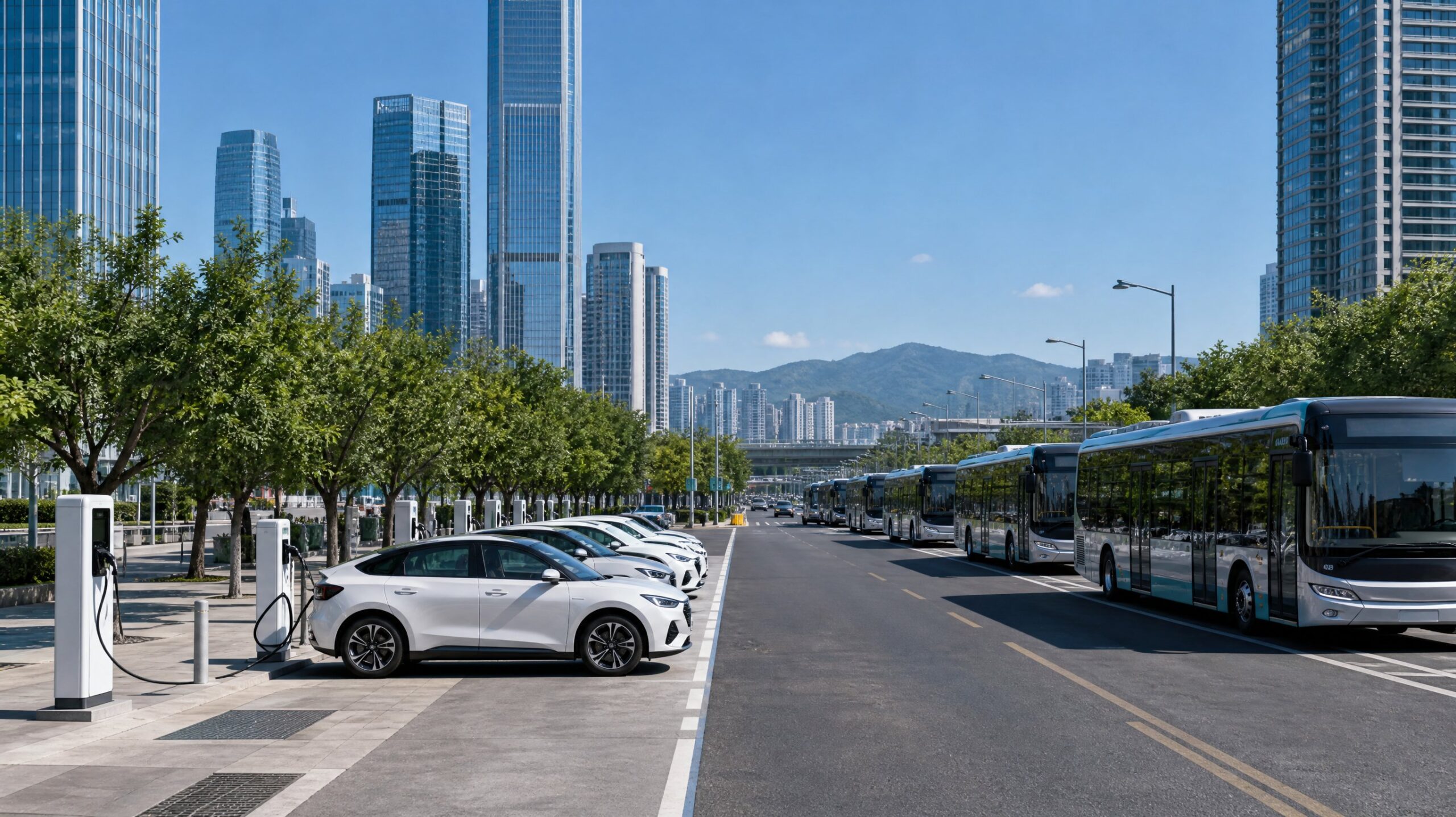
By 2023, China’s switch to electric and other new energy vehicles had cut fine particle pollution along the roads of 150 Chinese cities by almost a quarter and prevented an estimated 262,000 deaths.
The estimate comes from a study published in the journal Nature Health on May 13, 2026, by a team that included the geographer Meng Gao of Hong Kong Baptist University. The researchers combined satellite measurements of air pollution, ground monitoring stations, weather records and city-by-city vehicle registrations. They used machine learning to compare the air in each city with a modeled version in which every car still burned gasoline or diesel.
New energy vehicles are a Chinese category covering battery-electric, plug-in hybrid and hydrogen fuel cell vehicles. They accounted for a 23.80 percent fall in PM2.5, the fine particles most closely linked to death from air pollution. The same shift cut carbon monoxide by 30.67 percent, which the researchers linked to about 75,000 further deaths avoided. Nitrogen dioxide and coarser particles fell much less, because heavy diesel trucks were still largely unelectrified, and the benefits were concentrated in China’s richer cities.
Building a China Without Electric Cars
Air pollution in a city comes from power plants, factories, construction, heating, dust and weather as well as traffic, so separating the effect of one change is difficult. The team used high-resolution images from the Landsat 8 satellite, readings from ground-level monitoring stations and meteorological data from the European Copernicus climate service. It added provincial vehicle ownership figures from the China Statistical Yearbook and city figures from China’s Ministry of Public Security.
It then trained 100 machine-learning models of the random forest type to predict pollution near roads from all these inputs. A technique called SHAP analysis measured how much each input, including the number of new energy vehicles, contributed to each prediction. Running the models with the new energy vehicles replaced by conventional cars produced the counterfactual city, and the difference between the two gave the effect of electrification on roadside air.
To turn cleaner air into lives, the researchers used population figures from China’s 2020 census and published estimates of how mortality rises with exposure to each pollutant. “This topic was previously explored by some studies, but these assumed some of the conditions, whereas we had real and more accurate data,” Gao told the news site Reasons to be Cheerful. Earlier work on electric vehicles and air quality in China had mostly modeled future scenarios instead of observed pollution.
What Fell and What Did Not
Fine particulate matter fell by 8.97 micrograms per cubic meter along roads, and carbon monoxide by 0.26 milligrams per cubic meter. PM2.5 particles are small enough to reach deep into the lungs and the bloodstream. The World Health Organization estimates that about 68 percent of premature deaths from outdoor air pollution are due to heart disease and stroke. Most of the rest come from lung disease and respiratory infections.
The authors were open about the pollutants on which electrification made little difference. Nitrogen dioxide, a gas produced when fuel burns at high temperature, fell by only 1.81 micrograms per cubic meter, and PM10, the coarser particles, fell by about 15 percent. The authors traced both gaps to heavy-duty diesel trucks and called for faster electrification of heavy diesel vehicles. That shift has begun, and sales of electric and hybrid heavy trucks in China topped 231,000 in 2025.
The benefits were also spread unevenly between richer and poorer parts of the country. Avoided deaths were concentrated in economically developed cities, where new energy vehicles had spread fastest, and less-developed regions gained less. The authors described this as a socioeconomic inequality in who benefits and recommended pushing new energy vehicles into poorer regions.
Read next
Dutch Startup Created Concrete Designed to Grow Moss
How China Built the Market
China’s government made new energy vehicles a national strategy in 2009, with the aims of leading the technology, reducing dependence on imported oil and cleaning up city air. Its roots went back to a 2001 national technology program, and about 500 Chinese-made new energy vehicles were on show at the 2008 Beijing Olympics. In January 2009 the government launched a program called Ten Cities, Thousand Vehicles, which paid large subsidies for electric buses, taxis and official cars in pilot cities. Only seven of the 25 cities that eventually joined met the target of 1,000 vehicles.
The policy gained force over the following decade as the government added tax breaks and city incentives. In 2014 China exempted new energy passenger cars from the vehicle purchase tax, worth 10 percent of the sticker price, and it kept extending the exemption even after central purchase subsidies ended with 2022. Beijing began limiting new vehicle registrations in 2013 to curb air pollution, and big cities issued extra license plates to new energy vehicles and exempted them from driving bans on restricted days.
China has been the world’s largest market for new energy vehicles since 2015. The International Energy Agency reported that more than 13 million electric cars were sold there in 2025, about six in every ten sold worldwide. Electric cars made up nearly 55 percent of the country’s new car sales. By the end of 2025 an estimated 44 million electric cars were on Chinese roads, around 13 percent of all cars.
The Air China Was Trying to Clean
The vehicle study measured one part of a much larger cleanup. Beijing’s car fleet grew from about 1 million vehicles in 2000 to five times that by 2010. In 2008 the United States embassy in Beijing began posting readings from its own air monitor online, and residents noticed that its figures were far worse than the city government’s. In November 2010, when PM2.5 in Beijing reached 20 times the WHO guideline, the embassy labeled the air “crazy bad.”
In 2013 Beijing’s average PM2.5 level was 17 times what the World Health Organization then considered safe. In January 2014 monitors recorded 30 to 45 times recommended daily levels, and officials told residents to stay indoors. Across China, the average person breathed PM2.5 at 52.4 micrograms per cubic meter. Research cited by Reasons to be Cheerful estimates that air pollution contributed to more than 1.2 million premature deaths in China in 2010.
Late in 2013 the government published a National Air Quality Action Plan, which set aside $270 billion to cut air pollution, and Beijing’s city government added $120 billion. At the start of 2014, Premier Li Keqiang opened the annual National People’s Congress by declaring a “war against pollution.” The Air Quality Life Index, produced at the University of Chicago, found that particulate pollution in China fell by about 41 percent in the following decade. It calculated that the improvement adds about 1.8 years to average life expectancy if it holds.
The Nature Health study isolates one strand of that cleanup. It credits the switch to new energy vehicles alone with cutting fine particles along city roads by almost a quarter and preventing an estimated 262,000 deaths, and its authors say the next gains will have to come from the heavy diesel trucks that electric cars have not replaced.