On February 11, 1986, in front of television cameras in Washington, Richard Feynman lifted a clamped scrap of rubber from a glass of ice water and showed that it no longer sprang back.
The rubber came from an O-ring, the type of seal used in the joints of the space shuttle’s solid rocket boosters. Feynman, a Nobel Prize-winning physicist from Caltech, was serving on the presidential commission investigating the loss of the shuttle Challenger. Challenger had broken apart 73 seconds after lifting off from Kennedy Space Center on January 28, 1986, killing all seven people aboard. The demonstration showed that the booster seals lost their resilience in freezing weather.
Challenger had launched with the air near the pad at 36 degrees Fahrenheit, 15 degrees colder than at any previous shuttle launch. A seal that is slow to spring back after being squeezed cannot close the narrow gap it is meant to fill in time. The commission later concluded that hot combustion gas had leaked through the aft field joint on Challenger’s right solid rocket booster. That leak weakened or penetrated the external fuel tank and started the structural breakup of the vehicle.
The crew lost on Challenger were commander Dick Scobee, pilot Michael Smith and mission specialists Judith Resnik, Ellison Onizuka and Ronald McNair. With them were payload specialist Gregory Jarvis and Christa McAuliffe, a New Hampshire schoolteacher chosen to be the first teacher in space.
How a Caltech Physicist Joined the Rogers Commission
President Ronald Reagan created the commission by Executive Order 12546 on February 3, 1986, giving it 120 days to report. Its task was to establish the probable cause of the accident and to recommend corrective action. It was chaired by William P. Rogers, a former secretary of state, with Neil Armstrong as vice chairman. Its members included the astronaut Sally Ride, Brigadier General Charles Yeager and Air Force Major General Donald J. Kutyna, who became a close friend of Feynman’s.
Feynman’s invitation came a few days after the accident in a telephone call from William Graham, the acting head of NASA. Graham had once been his student, both at Caltech and at the Hughes Aircraft Company. Feynman’s first instinct was to refuse, since he kept a personal rule of having nothing to do with Washington or government. His wife, Gweneth, persuaded him otherwise, arguing that he could contribute something no one else on the commission would.
He accepted expecting to spend about six months on the work, and he set aside the physics problem he had been enjoying. He had no idea how long the shuttle fleet would stay grounded. From the start he wanted to talk directly to the engineers and assembly workers who built and prepared the shuttle. Much of his investigation consisted of chasing technical questions with them on his own.
Feynman was also in poor health, having been treated for cancer in the years before the accident. During the hearings his cardiologist in California was trying to look after him by telephone. He later described his independence as his particular advantage on the commission. Kutyna answered to the Air Force and Ride still had a job at NASA, while Feynman belonged to no organization except Caltech.
A Carburetor Question and Sally Ride’s Data
The clue that pointed Feynman at the seals came from Kutyna, who telephoned him early in the inquiry. Kutyna explained that he had been working on the carburetor of his car, then asked, “What, sir, is the effect of cold on the rubber seals?” Feynman replied that cold made them stiff and took away their resiliency. He later wrote that the insight earned him a great deal of credit even though the idea had been Kutyna’s.
Kutyna had his own source, and he protected it for more than a quarter of a century. Sally Ride had become the first American woman in space in 1983, flying aboard Challenger itself. She was still a NASA employee while she sat on the commission. She passed Kutyna an internal NASA document comparing launch temperatures with the resilience of the booster O-rings at different temperatures.
Handing over that paper put Ride’s job at risk, so Kutyna raised the question without naming her. He revealed her part only after she died in 2012.
Other warnings about the seals were surfacing in the same week. On February 9, 1986, The New York Times reported on a memo by a NASA budget analyst named Richard Cook. Written the previous year, it warned his superiors that engineers were worried about the booster seals. Feynman had also asked NASA for figures on how resilient the O-ring rubber was, and he judged the stack of papers that came back useless.
Read next
The Girl Who Compared Fast-Food Ice With Toilet Water
Pliers, Clamps and a Glass of Ice Water
The idea for the demonstration came to Feynman at dinner on February 10, after a closed session of the commission. He noticed a glass of ice water on the table and realized he could test the rubber himself by chilling and squeezing a sample. Doing it at the next day’s open hearing would put something new in front of the public.
NASA kept strict count of flight hardware and would not simply hand him a piece of O-ring. Graham remembered, however, that a model of the booster field joint held two pieces of the real rubber. Each was about an inch and a half long, and NASA planned to use the model again at the open hearing.
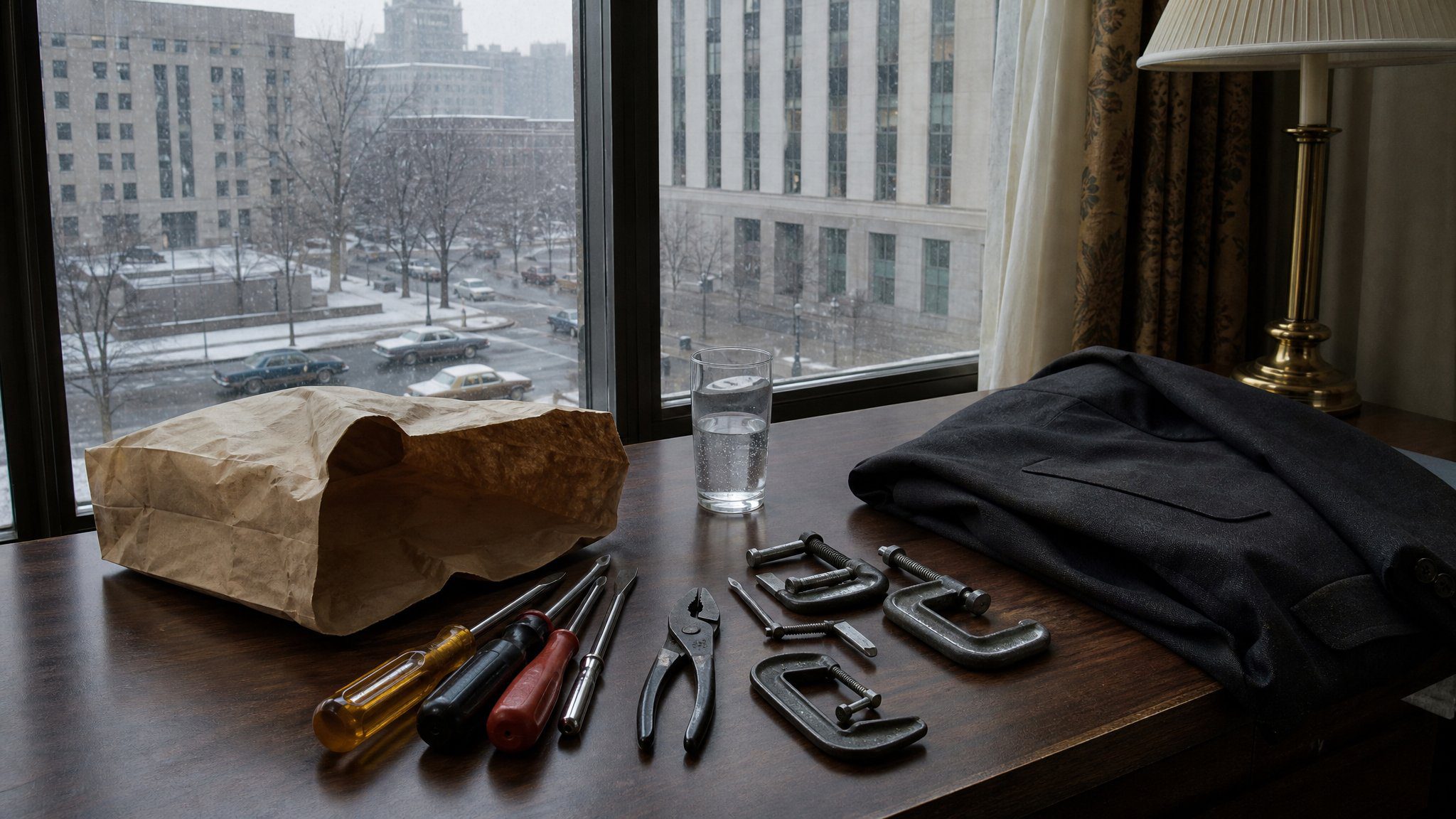
The next morning, with a little snow falling, Feynman left his hotel in his suit and asked a taxi driver for a hardware store. The driver eventually found one some distance from downtown Washington. Feynman waited for it to open and bought screwdrivers, pliers and clamps, unsure exactly what he would need. In Graham’s office he found that the model came apart easily with a pair of pliers.
He admitted later that he tried the experiment in private first, because a failure in public would have been a flop. During the hearing Kutyna sat next to him and kept him waiting with the words “Copilot to pilot: Not now!” Feynman went ahead only when Kutyna finally gave him the signal to begin. He had pressed the rubber in a small clamp and left it standing in his ice water.
When he took it out and loosened the clamp, the rubber stayed pressed out of shape where it had been squeezed. He told the commission that “there is no resilience in this particular material when it is at a temperature of 32 degrees.” He added, “I believe that has some significance for our problem.”
The commission’s own tests later bore out what the glass of water had shown. Its report stated that numerous O-ring tests had found resiliency degrading as the temperature fell. In tests with the smallest initial gap, sealing without any gas blowing past the ring did not occur consistently until 55 degrees Fahrenheit. Feynman wrote afterward that the cold rubber was very likely a partial cause of the accident, and that the commission came to agree.
What Morton Thiokol’s Engineers Had Warned
The seals had worried engineers at Morton Thiokol, the Utah company that built the solid rocket motors, long before Challenger’s last flight. On July 31, 1985, Thiokol engineer Roger Boisjoly sent a memo to a company vice president about the field joints. He warned that a joint failure would be “a catastrophe of the highest order, loss of human life,” and urged the company to set up a dedicated team to solve the problem.
On the evening of January 27, 1986, with a hard freeze forecast for the launch site, Thiokol engineers joined a teleconference with NASA managers. Robert Lund, Thiokol’s vice president of engineering, presented the engineers’ recommendation that the shuttle should not fly below 53 degrees. That was the coldest temperature at which they had flight experience with the joints. Boisjoly and his colleague Arnold Thompson argued strongly against launching, and George Hardy of NASA’s Marshall Space Flight Center said he was appalled by the recommendation.
Thiokol’s managers then held a private caucus, during which senior vice president Jerald Mason asked Lund to “take off his engineering hat and put on his management hat.” Lund changed his position, and Thiokol vice president Joseph Kilminster gave NASA a recommendation to launch. Thiokol faxed it at about 11:45 p.m. Eastern time. The commission later concluded that the decision to launch had been flawed and that the officials who made it were unaware of the engineers’ objections.
Appendix F and a Telegram to William Rogers
The commission delivered its report to President Reagan on June 6, 1986, after a late dispute over Feynman’s name. The commissioners had agreed on nine recommendations when Rogers proposed a tenth, urging continued support for NASA from the administration and the nation. Feynman objected because the commission had never discussed the idea and it fell outside the president’s instructions.
He also feared that his own report on NASA’s safety culture would be cut or buried. He sent Rogers a telegram asking him to “please take my signature off the front page of the report” unless two conditions were met. There was to be no tenth recommendation, and his report had to appear as an appendix without modification. Kutyna was asked to talk him round, and the dispute ended with the tenth recommendation softened into a concluding thought.
Feynman’s report appeared as Appendix F, titled “Personal Observations on the Reliability of the Shuttle.” In it he noted that estimates of the chance of losing a shuttle ranged from roughly 1 in 100 to 1 in 100,000. The 1 in 100 estimate came from working engineers and the 1 in 100,000 estimate from management. He argued that O-ring erosion on earlier flights had been treated as a sign of safety, when “erosion was a clue that something was wrong.”
He closed with the line, “For a successful technology, reality must take precedence over public relations, for nature cannot be fooled.” Feynman died of cancer at the UCLA Medical Center on February 15, 1988, at the age of 69.
The hardware-store clamps Feynman bought that snowy morning turned out to be too big to fit in a glass. The small clamp that squeezed the O-ring in front of the cameras came from NASA’s own medical department.
More from Terribly Interesting
Sources
- Literary Hub, excerpt from Kevin Cook, The Burning Blue (Henry Holt, 2021)
- Richard Feynman, “Mr. Feynman Goes to Washington,” Engineering & Science (Caltech), Fall 1987
- Rogers Commission Report, Vol. I, Ch. IV
- Encyclopaedia Britannica
- Rogers Commission Report, Vol. I, Ch. III
- NASA, “35 Years Ago: Remembering Challenger and Her Crew”
- Ronald Reagan Presidential Library
- Rogers Commission Report, Commission members page
- SpaceFlight Insider
- NASA biography of Sally Ride
- Nautilus
- Rogers Commission Report, Vol. I, Ch. V
- AmericaSpace
- NASA, Rogers Commission report index
- Rogers Commission Report, Vol. II, Appendix F
- Caltech, “Richard Feynman Remembered”