In 1905 the largest gem diamond ever found crossed from South Africa to London in a plain box sent by parcel post, while a decoy sailed under guard.
The stone was the Cullinan diamond, a rough crystal weighing 3,106 carats that was pulled from the wall of the Premier Mine near Pretoria in late January 1905. Word spread that the diamond would travel by sea under heavy protection. While attention followed that ship, the real stone moved through the ordinary mail and reached England without incident.
After it arrived in London, the Cullinan was taken to Buckingham Palace so that King Edward VII could inspect it. In 1907 the government of the Transvaal Colony bought the stone and presented it to the king. The gift was meant to help restore relations between Britain and South Africa after the Second Boer War.
In 1908 the diamond made a second secret crossing, this time to Amsterdam, where the Asscher diamond firm split and polished it into nine major gems and dozens of smaller ones. Those pieces became part of the British Crown Jewels, and since 2022 South African activists and politicians have called for the largest of them to be returned.
A Glint High Up the Side of the Premier Mine
Thomas Cullinan, who discovered the Premier Mine and chaired the company that worked it, had promised his wife in 1903 that he would bring her the biggest diamond in the world. Two years later the promise was kept by his surface manager, Frederick Wells, who saw something glittering in the sunlight high up the side of the open pit during a routine inspection.
The crystal lay about 18 feet below the surrounding ground surface, and Wells worked it free with his pocket knife. An African worker may have spotted it first and pointed it out to him, although the discovery has gone into the record under Wells’s name.
The stone measured roughly 4 by 2½ by 2 inches and weighed 621 grams, and the company named it after its chairman. It had a blue-white color, and it remains the largest gem-quality rough diamond ever discovered anywhere.
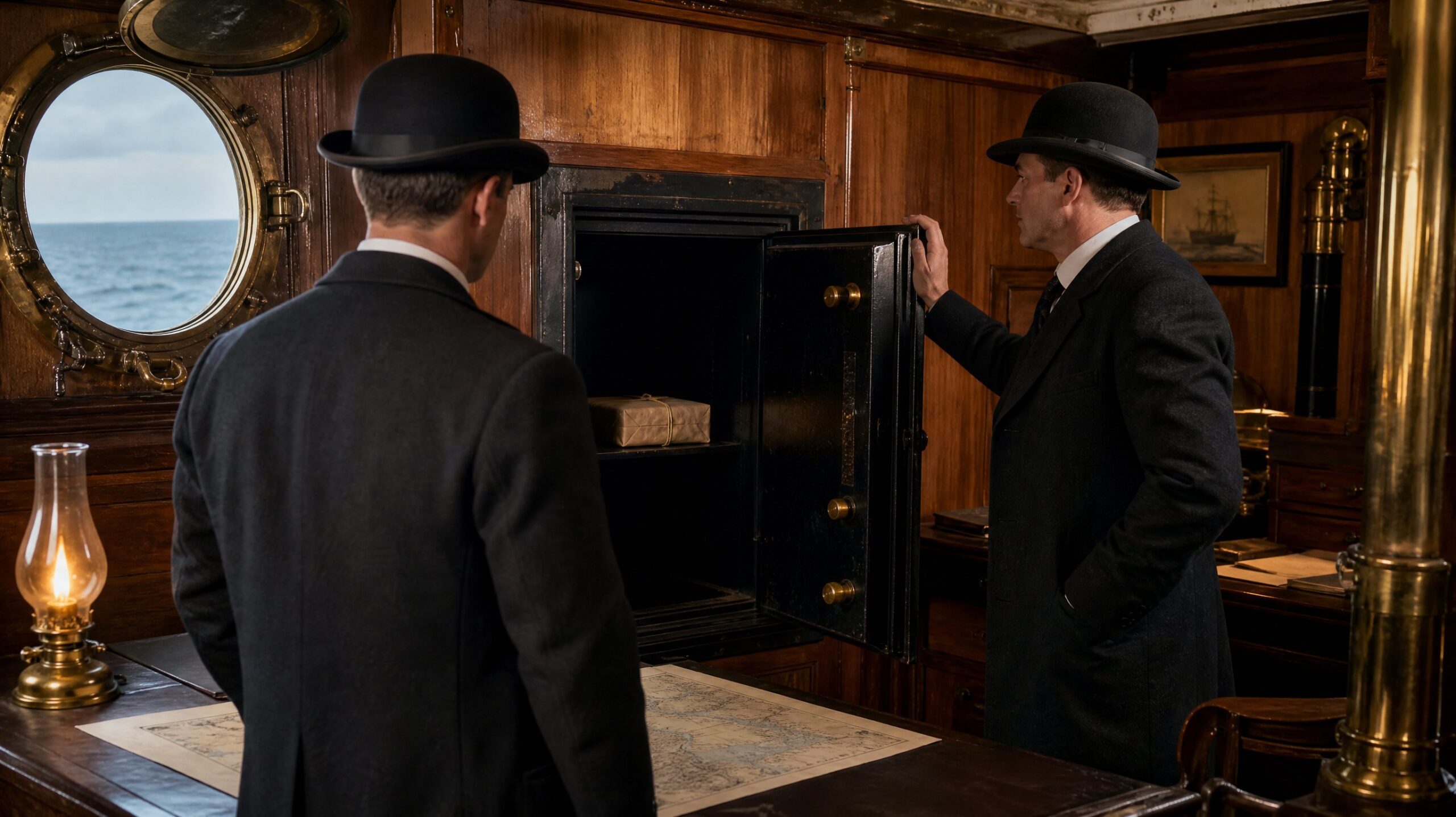
Detectives were assigned to the steamer rumored to be carrying the stone, and a parcel was ceremoniously locked in the captain’s safe and guarded for the whole voyage, which made the rumor look solid. The stone in that parcel was a fake, and the real Cullinan traveled in a plain box through the ordinary parcel post.
The diamond drew considerable interest from potential buyers once it was on show in London. Nobody bought it, however, and for two years the largest rough diamond in the world sat on the market without a purchaser.
A Birthday Present From the Transvaal After the Boer War
The Transvaal had been an independent Boer republic until Britain defeated it in the Second Boer War of 1899 to 1902 and brought it under British rule as a colony. Its prime minister in 1907 was Louis Botha, who had commanded Boer forces during the war and had beaten a British army at Colenso on December 15, 1899. Botha proposed that the colony buy the Cullinan and present it to Edward VII as a birthday gift.
The colony’s legislature approved the purchase in August 1907, and the Transvaal government paid £150,000 for the stone, roughly £14.9 million in 2023 money. In London the offer caused some hesitation, because the Prime Minister, Henry Campbell-Bannerman, first advised the king to decline it before deciding to leave the choice to Edward himself. Winston Churchill, then the Under-Secretary of State for the Colonies, persuaded the king to accept it.
Sir Richard Solomon, the Agent-General of the Transvaal Colony, presented the rough diamond to Edward VII at Sandringham House on November 9, 1907. The date was the king’s 66th birthday, and the handover took place in front of a large party of guests. Edward accepted it to be kept among the historic jewels that form the heirlooms of the Crown, and the London diamond brokers Arthur and Alexander Levy then helped arrange for the Asscher firm in Amsterdam to cut it.
Read next
The Civilian Conservation Corps Paid $30 a Month and Mailed $25 Home
How did the Cullinan diamond get to Amsterdam?
Abraham Asscher collected the Cullinan in London in January 1908 and took it home to Amsterdam as an ordinary passenger, carrying it in the pocket of his coat across the North Sea. At the same time a Royal Navy ship carried a sealed box across the same stretch of water that was supposed to hold the stone, and that box was empty. The real diamond reached the firm’s headquarters at Tolstraat 127 in Amsterdam, where the brothers had prepared a workshop for it.
In the firm’s workshop his brother Joseph Asscher spent days cutting a groove into the diamond, no deeper than a centimeter, to give his blade somewhere to bite. On February 10, 1908, he set a steel knife in the groove and struck it, and the blade broke while the diamond stayed whole.
A few days later Joseph returned with heavier blades made for the job, and with only a notary present he struck again and split the stone cleanly in two. The halves weighed about 1,977 and 1,040 carats, and further cleaving followed to work around flaws inside the crystal.
Press reports at the time said that Joseph had collapsed after the decisive blow, and the image of the cutter fainting over the world’s largest diamond has been repeated ever since. His nephew Louis Asscher later disputed the story, joking that if anything had gone to his uncle’s head that day it was the champagne.
Cutting and polishing the pieces took eight months, with three men working 14 hours a day under the supervision of the polisher Henry Koe. The work was finished in November 1908, by which point about 65 percent of the rough stone’s weight had been ground away. What remained was nine principal diamonds, 96 small brilliants and a few polished fragments.
Where the Nine Stones Went, and the Calls to Return Them
Edward VII received the two largest stones, Cullinan I and Cullinan II, on November 21, 1908. Cullinan I, a pear-shaped stone of about 530 carats and the largest colorless cut diamond in the world, was mounted in the Sovereign’s Sceptre with Cross in 1911 for George V’s coronation. Cullinan II, which weighs 317.4 carats, was set in the Imperial State Crown, and both remain among the Crown Jewels at the Tower of London.
Cullinan III to IX stayed with the Asscher firm as payment for its work, along with the small brilliants. Edward VII bought Cullinan VI later in 1908 as a gift for Queen Alexandra. After his death in 1910, the South African government bought the remaining stones and presented them to Queen Mary. Mary left Cullinan III to IX to her granddaughter, Elizabeth II, when she died in 1953.
For the coronation of Charles III on May 6, 2023, Queen Mary’s Crown was reset for Queen Camilla with Cullinan III, IV and V.
Mothusi Kamanga, a lawyer and activist in Johannesburg, promoted an online petition to Charles III that gathered thousands of signatures. It asked for Cullinan I to be returned and displayed in a South African museum. “The diamond needs to come to South Africa. It needs to be a sign of our pride, our heritage and our culture,” Kamanga said in May 2023. The Crown has never announced any intention to return the stones.
In 1958, during a state visit to the Netherlands, Elizabeth II toured the Asscher works in Amsterdam wearing the brooch that holds Cullinan III and IV. She unpinned it and handed it to Louis Asscher, who had held the same stones in that building half a century earlier.