
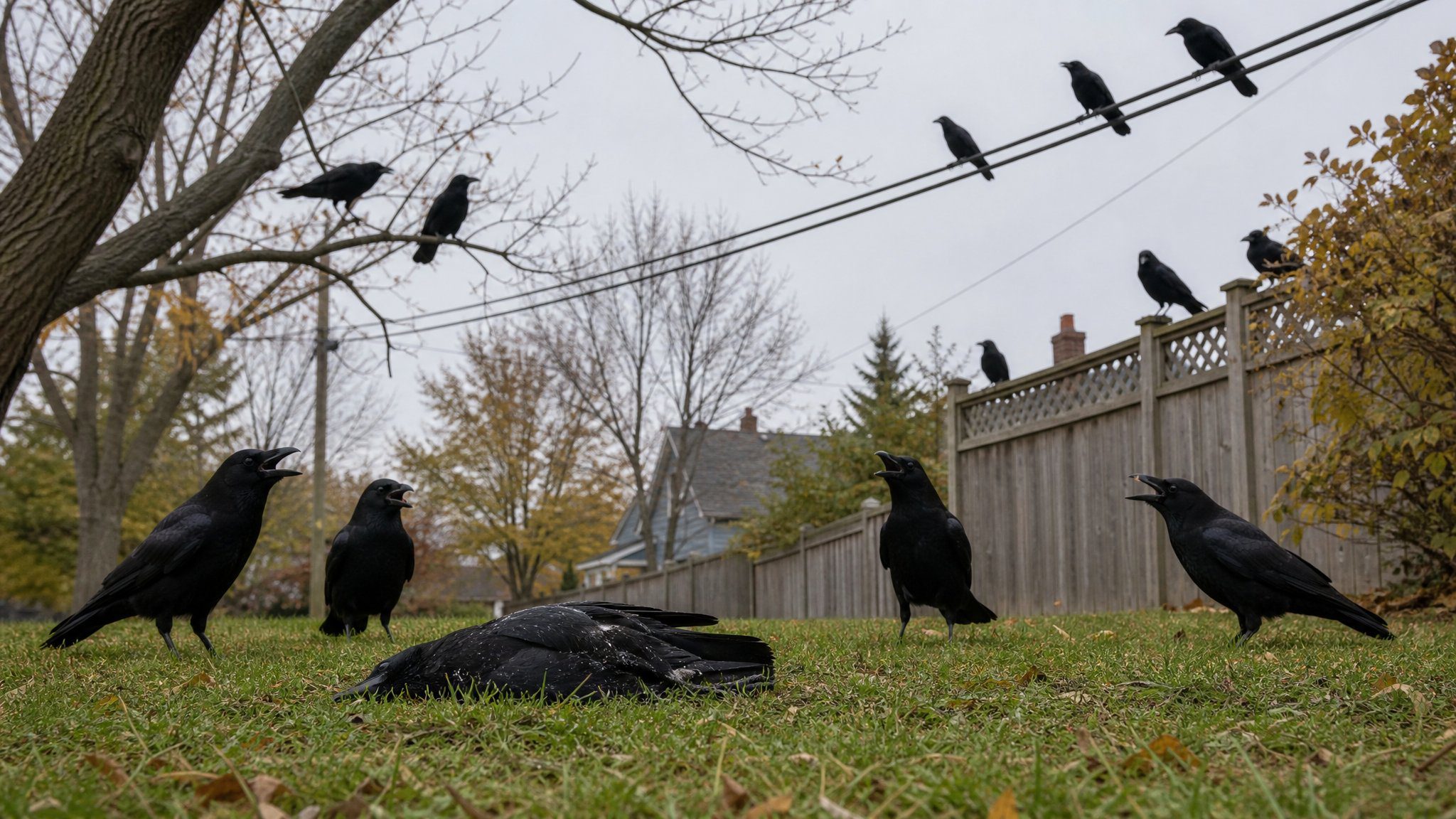
When American crows find a dead crow, they gather around it, call loudly and summon others, and from that moment they treat the place, and any person seen holding the body, as dangerous.
The gatherings are often called crow funerals, and they have been tested experimentally. In experiments around Seattle published in 2015, the ecologist Kaeli Swift and her adviser John Marzluff of the University of Washington showed volunteers holding taxidermied dead crows to wild crows at their feeding spots. The crows scolded and mobbed, and they were slow to return to food at the spot for the next three days. After a single encounter they learned to recognize and scold the masked person who had held the dead bird, and in 38 percent of cases the crows were still responding to that person six weeks later.
The crows reacted this way to dead crows but not to a dead pigeon, and the city’s rock pigeons showed no interest in their own dead. The researchers concluded that for crows a dead crow is a sign of danger in its own right, comparable to seeing a predator. The name funeral describes what the gathering looks like, not what the birds feel.
An Experiment With Masks and Taxidermy
Swift and Marzluff worked on the territories of crow pairs and families in and around Seattle, Redmond, Kirkland, Bellevue and Mercer Island. Crows there hold small territories of 25 to 150 hectares, and the test sites were spaced at least 90 meters apart so that neighboring birds would not influence one another. For three days, Swift put out a pile of raw peanuts and cheese puffs at the same place and time and timed how long the resident crows took to come to it.
On the fourth day, a volunteer wearing one of six realistic latex masks with a neutral expression stood 2 meters from the food, holding a stimulus. Some held a dead crow, some a mounted red-tailed hawk, some a hawk with a dead crow, and others nothing at all. Each volunteer wore a white sign reading “UW CROW STUDY” around the neck to reduce interruptions from pedestrians and police. No crows were trapped or handled for the study, and the test spots were set 35 to 45 meters from nests to avoid disturbing them. Of 24 crows that carried leg bands from earlier work, only one was seen joining a mob at a test site other than its own, which suggested the sites were independent.
Across the tests, which ran over several years, territorial adults scolded in 96 percent of the 102 trials in which they were shown a dead crow or a hawk, and other crows flew in to join them. They scolded in only 17 percent of trials in which a masked person stood there with nothing, and never when there was only food. The strongest reaction came when the hawk and the dead crow appeared together, which drew the most mobbing and the most avoidance of the food that day.
Learning Where Danger Is
The crows’ behavior at the feeding site changed after a single presentation. Over the following 72 hours they took longer to approach the food at sites where they had seen danger, even though nothing dangerous was there any more. The same mask worn without a dead bird or a hawk did not have this effect.
When the same masked volunteer came back in later weeks without any dead bird, the crows scolded the person on sight. A single exposure was enough for them to learn that a stranger seen with a dead crow was a threat. The researchers also found that repeated visits by the masked person without any danger did not quickly erase the memory.
The researchers compared crows with pigeons to see whether any dead animal would do. When volunteers held a dead pigeon, crows did not mob and did not avoid the food, although pigeons are about the same size. Rock pigeons shown a dead pigeon kept feeding as usual. The team concluded that crows pay close attention to their own dead as a way to gather information about threats to themselves.
Read next
Beaver Dam Succeeded Where a $1.2 Million Project Hadn’t
A Grudge That Outlived the Birds
The funeral experiments built on earlier work in Marzluff’s lab on how crows recognize people. In 2006 Marzluff wore a rubber caveman mask while trapping seven crows on the University of Washington campus, fitting them with leg bands and releasing them. In the following years he and his assistants walked the campus wearing the same mask, and the crows scolded them. Volunteers wearing a neutral mask, a likeness of the then vice president Dick Cheney, fed the crows and were left alone.
The scolding soon spread beyond the seven birds that had been caught. On one walk in the caveman mask, 47 of the 53 crows Marzluff encountered scolded him. Crows that had never been trapped, including young birds hatched after the original captures, learned to treat the mask as dangerous by watching other crows react to it.
A 2012 study by Heather Cornell, Marzluff and Shannon Pecoraro traced how the knowledge spread. The team wore unique masks while trapping 7 to 15 crows at each of five sites near Seattle, and then walked routes of 2 to 3.8 kilometers to count which crows scolded. Young crows whose parents had scolded the mask began scolding it themselves, and lone crows that had never been trapped also recognized it. At one site, scolding doubled in frequency and spread at least 1.2 kilometers from where the trapping took place over five years.
Crows that had been trapped themselves told the dangerous mask from neutral ones more precisely than crows that had learned about it secondhand. The reaction on the University of Washington campus peaked in 2013, about seven years after the trapping. It then declined as the birds that had been caught died and their descendants aged out of the population. In September 2023, about 17 and a half years after the original captures, Marzluff walked the campus in the caveman mask again, and not a single crow scolded him.
What Happens Inside a Crow’s Brain
Researchers in Marzluff’s group have also looked inside the brains of captive crows while they faced threats. In a study published in 2013, Donna Cross, Marzluff and colleagues used positron emission tomography to record brain activity as crows fixed their gaze on different dangers. A mounted red-tailed hawk, an innate fear, raised activity in a region called the caudal nidopallium, while a person who had previously handled the birds roughly activated the amygdala.
An unfamiliar person holding a dead crow, a new kind of threat, stimulated the hippocampus, a region involved in learning and memory. In every case, regions linked to attention, arousal and movement also became active as the crows watched the threat.
Crows are not the only birds that pay attention to their dead. Western scrub-jays mob when they find a dead jay, even without alarm calls, and feed less in the area for 24 hours after the body is removed. Common ravens and American crows mob and avoid places where a dead bird of their own kind is shown with recordings of distress calls.
The Crows That Touched the Dead
Swift later took the experiments a step further, using taxidermied birds so that she would not have to carry rotting carcasses around the city in summer. She placed them on sidewalks and other open ground in Seattle neighborhoods and watched from about 20 meters away. Because the mounted birds were strangers to the local crows, familiarity with the dead bird could not affect the results. In a study published in 2018 in the journal Philosophical Transactions of the Royal Society B, she and Marzluff described the reactions of 309 breeding pairs.
Most crows kept their distance, scolding and mobbing the body, and only in 24 percent of encounters did a crow touch it, with prods, pecks or tugs. In about 4 percent of encounters, a crow approached the dead bird in a mating posture and attempted to copulate with it. Those behaviors were limited to the first half of the breeding season. When Swift swapped the dead crows for mounted pigeons and squirrels, the crows handled those more often but raised far fewer alarms.
Swift also mounted dead crows in lifelike poses and in positions that looked dead. The lifelike crows were dive-bombed as if they were intruders, while the ones that looked dead drew cawing and mobbing, the calls that warn other crows of danger. Crows avoid touching dead crows most of the time, which Swift has noted makes sense for animals that could catch a disease or be caught by the predator that killed the bird.