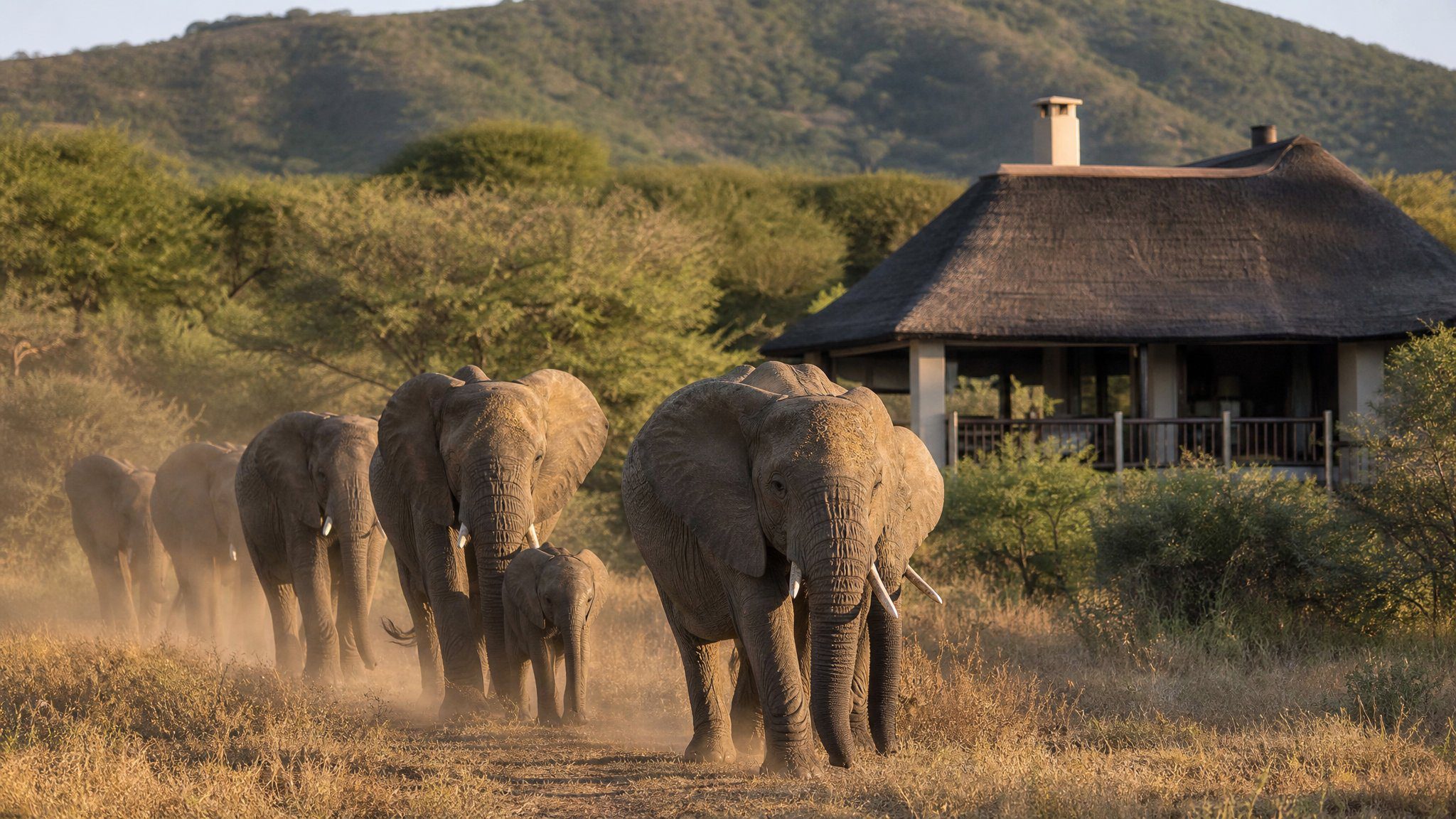
Two days after Lawrence Anthony died, the elephants he had once saved from being shot walked out of the bush to his home and stood near it.
Anthony was a South African conservationist who ran Thula Thula, a private game reserve in Zululand, in the province of KwaZulu-Natal. He became known around the world as the Elephant Whisperer after he took in a herd of wild elephants that was due to be destroyed because it kept breaking out of reserves.
The herd arrived at Thula Thula in 1999, and Anthony spent years earning the trust of its members, above all the trust of the lead cow, whom he named Nana. His account of that work, written with Graham Spence, became the 2009 bestseller The Elephant Whisperer.
He died of a heart attack on March 2, 2012, at the age of 61. On the Sunday that followed, the elephants came to the house where he had lived with his wife, Françoise Malby-Anthony.
The Condemned Herd at Thula Thula
The story began with a phone call from an elephant welfare organization, which asked Anthony whether he would take a troublesome herd from another reserve. The owners wanted the animals gone quickly, and if nobody took them, they would be shot. The caller warned that the matriarch had learned to beat electric fences by twisting the wire around her tusks until it snapped.
The round-up went badly from the start, and one of the adult females and her calf were shot and killed while the herd was being captured. Seven elephants reached Thula Thula alive: the matriarch and her baby bull, three more females, an 11-year-old bull and a 15-year-old bull whose mother had been among those killed.
Anthony described the young bull charging the fence the moment he was unloaded from the trailer. His head ranger, David, named him Mnumzane, a Zulu word meaning “Sir.” Anthony named the matriarch Nana, and he named the herd’s feisty second-in-command Frankie, after Françoise.
The herd was held in a secure enclosure inside the reserve while it settled, and it did not settle. Nana tested the electrified wire with her trunk, took the shock, backed off, and then led her family along the whole perimeter of the enclosure. Everyone at the reserve knew that another breakout would almost certainly end with the herd being shot.
Anthony decided that the only way to keep them alive was to stay with them. He camped near the enclosure, talked to the elephants and sang to them for weeks. In The Elephant Whisperer he describes standing in the dark at 4:45 a.m. in front of Nana, who was preparing to flatten an 8,000-volt fence, and pleading with her to stay because she and her family would be killed if they escaped again.
He wrote that some brief spark of recognition passed between them before Nana turned back into the bush and the rest of the herd followed her. From then on the elephants began to accept Thula Thula as home. They stopped trying to escape, and Nana would later reach out her trunk to touch his face.
The elephants never became tame, and Anthony never claimed that they had. He preferred to be called the Elephant Listener, and Françoise remembered him saying that the elephants talked to him if they wanted to and that he simply listened.
The Day the Elephants Came Back
By early 2012 Anthony had been living with a heart condition. Françoise later wrote that he had suffered a second heart attack in the previous September and had been told not to fly. He had insisted all the same on a weeklong business trip to Johannesburg. The call telling her he had collapsed came at seven o’clock on the morning of Friday, March 2.
The reserve by then held two elephant herds, the original family and its descendants, and neither had come near the house for some time. His son Dylan told local reporters that the herds had not visited the house for a year and a half, and he estimated that the walk would have taken them about 12 hours.
The first herd arrived on Sunday, March 4, two days after Anthony’s death, and the second herd came a day later. In Dylan’s account, the elephants stayed around the homestead for about two days before they made their way back into the bush.
Françoise wrote her own account of the first evening, years later, for Guideposts magazine. She had shut herself in their bedroom while visitors came to pay their respects, until she heard shouting and went downstairs to find the staff outside staring toward the fence. On the other side stood 21 elephants, with Nana at the front looking straight at her.
She wrote that the elephants stayed in place for more than an hour and then walked up and down along the fence, rumbling in the low sound they had always used with her husband. Then they lined up one behind the other and walked back into the bush. Other retellings of the story, many of them circulating by email, put the number at 20.
Thula Thula says the visits did not stop with that first weekend in 2012. Its published history records that the elephants came to the main house on the anniversary of his death in 2013, again in 2014, and for a third consecutive year after that. The reserve describes each visit as happening on the same day and at the same time as the one before.
Read next
Bottlenose Dolphins Can Recognize Companions by Taste
What Science Can Say About Elephant Loss
Elephants are long-lived, social animals, and their family groups depend on memory. Older females carry knowledge of places, routes and other elephants, and younger animals learn from them. Elephants recognize familiar individuals by sight, smell and sound, and they can hold on to that knowledge for years.
Elephants can also tell different groups of humans apart by their voices. In a 2014 study in the Proceedings of the National Academy of Sciences, Karen McComb and her colleagues played recordings of human voices to 47 elephant families in Amboseli National Park, Kenya. The elephants bunched together defensively more often when they heard Maasai men, whose community has a history of spearing elephants, than when they heard men from the farming Kamba community.
Elephants also behave in unusual ways around their own dead, and researchers have tested this. In a 2006 study in Biology Letters, McComb, Lucy Baker and Cynthia Moss laid out objects in front of wild elephants in Amboseli. The elephants spent far more time investigating elephant skulls and ivory than natural objects or the skulls of other large mammals, although they did not pick out the skulls of their own relatives.
A 2020 review in the journal Primates by Shifra Goldenberg and George Wittemyer gathered 32 observations of wild elephants at carcasses from 12 sources across Africa. The most common behaviors were approaching the dead elephant, touching it and examining it, and elephants sometimes tried to lift fallen animals that had just died. They showed interest even in bodies that had long decayed and in animals that were not close relatives.
Asian elephants show related behavior, which two researchers in India documented in 2024. Parveen Kaswan of the West Bengal Forest Department and Akashdeep Roy of the Indian Institute of Science Education and Research in Pune described five cases of dead calves being carried and then buried in the irrigation drains of tea estates in northern Bengal. They reported that the elephants in the area afterward avoided the paths where the calves were buried.
The Reserve After Anthony
Thula Thula continued after Anthony’s death, and Françoise took over its running. In August 2012 she founded the Thula Thula Rhino Fund, after poachers shot at one of the reserve’s orphaned rhinos two weeks after her husband died. In 2016 she created the South African Conservation Fund to raise money for more land for the growing elephant herd.
She later wrote her own books about life on the reserve after his death. An Elephant in My Kitchen, a sequel to The Elephant Whisperer, came out in 2018, and The Elephants of Thula Thula followed in 2022. Her work at the reserve earned her a French knighthood in the National Order of Merit in February 2022.
Anthony’s conservation work had never been limited to Thula Thula and its elephants. In 2003, during the US-led invasion of Iraq, he left South Africa for Kuwait and became one of the first civilians outside the media to enter Iraq. He drove into Baghdad to help rescue the surviving animals at the Baghdad Zoo, which had been damaged and badly looted. He told that story in the 2007 book Babylon’s Ark, and the work earned him the United Nations Earth Day Medal.
The herd has kept growing in the years since his death. Thula Thula says the seven elephants that arrived in 1999 have become a family of about 28, and in 2024 the reserve dropped the fences on new community land to give them more room.
More from Terribly Interesting
Sources
- Thula Thula
- Guideposts (Françoise Malby-Anthony)
- Publishers Weekly (Spence co-author credit)
- Beliefnet (book excerpt from The Elephant Whisperer)
- Grist
- Snopes (text of the circulated email, rating “research in progress”)
- Thula Thula history timeline
- McComb et al. 2006
- PNAS
- Scientific American
- Royal Society Publishing
- Springer
- Save the Elephants
- Journal of Threatened Taxa