At Woodstock ’99, at least 100 young people dove into a shallow mud puddle beside the toilets to cool off, not knowing that the mud covering them was human waste.
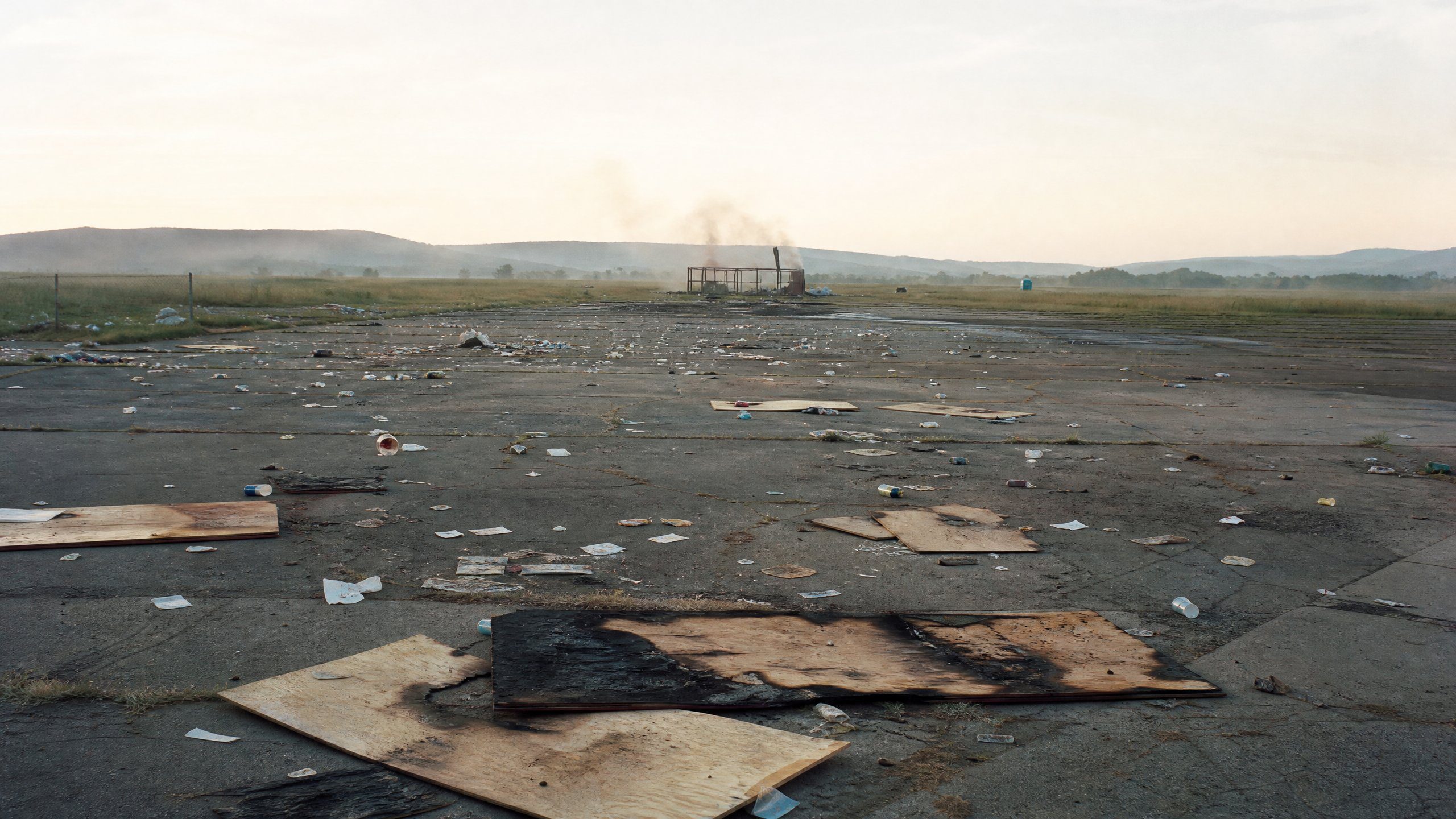
Woodstock ’99 ran from July 22 to 25, 1999, on the former Griffiss Air Force Base in Rome, New York, and it drew roughly 220,000 people to a treeless stretch of tarmac in heat above 100 degrees. The portable toilets clogged and overflowed by Saturday morning, broken water lines mixed with the sewage, and some of the free drinking water was contaminated with E. coli. On the final night, candles handed out for a peace vigil were used to light bonfires, and the 30th-anniversary festival ended with looting, burning trailers and hundreds of state troopers on the field.
Three people died during the weekend, thousands were treated for heat and injuries, and police investigated reports of rape. The promoters, Michael Lang and John Scher, had set out to show that a Woodstock could be both secure and profitable.
A Superfund Site With a Twelve-Foot Fence
Lang had helped create the original festival in 1969, and Scher, his co-promoter, had lost money on Woodstock ’94. “You can have a Woodstock, and it can be a safe and secure environment,” he said. “We’re going to try and make a profit on this one.”
Griffiss had closed as an Air Force base in 1995 and had once been listed as a Superfund site, and the organizers liked it as a site they could defend. They raised a 12-foot fence of steel and plywood to keep out gatecrashers, in a production that cost $38 million. Three-day tickets sold at $150 in advance and $180 at the gate, about eight times the price of a 1969 ticket.
The site had two main stages more than two miles apart, joined by paved runway with almost no shade. Ticket holders were told not to bring their own food, on the promise of fairly priced concessions inside. Order on the ground fell largely to an unarmed hired force called the Peace Patrol, while the state police kept a separate detail of about 540 members.
The Water and the Toilets
The heat settled above 100 degrees and radiated off the tarmac at close to 110, in what the reporter for Spin magazine called the hottest July New York had ever seen. Water at the concession stands cost $4 a bottle, and free spigots stood far from the stages at the end of long lines. Some attendees had run out of money for food and supplies by the end of the first day, and frustrated people waiting at the fountains broke the pipes.
The promoters had provided at least 2,000 portable toilets, and by Saturday morning they were clogged and spilling into the field. Water from the broken pipes met the waste and spread across the ground, and several dozen makeshift showers without drains added soapy runoff to the mix. The Spin reporter described small lakes of waste moving through several camping areas by Sunday.
Some of the free water still running from the spigots was contaminated with E. coli. Medics spent the weekend treating heat exhaustion and dehydration, with thousands of cases in all, and at least one fan who collapsed from overheating died of the complications.
Read next
How Vesta Stoudt’s Letter to Roosevelt Gave Soldiers Duct Tape
Saturday Night and the Peace Candles
Limp Bizkit’s Saturday set brought the crowd’s anger into the open, with fighting, vandalism and plywood torn from the barriers, and later reports of sexual assaults in the crush. Fred Durst, the band’s singer, told the crowd, “People are getting hurt. Don’t let anybody get hurt. But I don’t think you should mellow out.” Police later investigated at least four reported rapes during the festival.
On Sunday night, the anti-gun group Pax handed out thousands of candles for a vigil for the victims of the Columbine shooting. During the closing set by the Red Hot Chili Peppers, the crowd used them to light fires. Pieces of plywood mural and trash went onto growing piles, and five large bonfires were soon burning close to the stage. Anthony Kiedis, the band’s singer, told the crowd from the stage that “it looks like Apocalypse Now out there.”
The fires reached garbage piles and sections of the “Peace Fence,” and one took an audio tower. After the music stopped, people tore down fencing, looted and burned vendor stands and trailers, broke into ATMs and overturned a vehicle. Some of the portable toilets went up in flames too.
State Troopers and the Promoters’ Explanation
The state police later described a festival that had been mostly calm, with few arrests, until disorder broke out on Sunday evening. They recalled almost 150 members of Troop D and 80 more from other troops to clear the field, and some attendees threw bottles and debris at them and at firefighters. Scher had said a fire truck would have to come in, but it didn’t arrive in time, and a trailer carrying refrigeration units exploded in the flames.
Fire crews didn’t gain control until well after dawn, and arrests came to more than 40. The state police investigation into the disorder and the sexual assaults continued for months, with the department asking the public for help in identifying those involved.
Scher said at a news conference the following week that he was “bummed big time,” and he suggested, “I think it was an anti-Establishment statement.” Lang told Billboard a decade later that “it was really a couple of hundred kids who were running rampant,” and that the imagery of the fires was more dramatic than the event itself. Attendees said they’d been treated like animals in unsafe conditions.