The young men of the Civilian Conservation Corps earned $30 a month, and the government mailed most of it to their families before they ever saw it.
Between 1933 and 1942 the Civilian Conservation Corps, a New Deal relief program created under President Franklin D. Roosevelt, put about three million unemployed young American men to work in camps across the country’s forests and parks. Each enrollee was paid $30 a month, and as a condition of joining, the program sent between $22 and $25 of it home to his family, usually $25, which left him about $5 for the month. Over nine years those allotments added up to $663 million.
The crews planted billions of trees, fought forest fires, strung telephone lines through the backcountry and built the roads, trails, lodges and lookout towers of hundreds of state and national parks. Much of that stone and timber work is still in use, from the overlooks of Skyline Drive in Virginia to the canyon buildings of Bandelier National Monument in New Mexico.
The law that created the Corps barred racial discrimination in hiring, yet by 1935 its director had ordered the camps fully segregated. When Congress shut the program down in 1942, many of the men still enrolled went straight into the armed forces of World War II.
How Roosevelt’s Tree Army Was Raised in Three Months
Congress moved quickly on the legislation, which was introduced in the Senate on March 27, 1933, and signed by Roosevelt on March 31 as the Emergency Conservation Work Act. An executive order on April 5 set the program in motion, and Robert Fechner, a Boston labor leader, was appointed its director. Four federal departments shared the work, with War, Labor, Agriculture and the Interior all represented on an advisory council.
The Department of Labor chose the enrollees through state agencies and welfare offices, while Army reserve officers ran the camps and supplied the food, clothing and shelter. The first rules admitted unmarried, unemployed men between 18 and 25 years old who stood between 5 and 6.5 feet tall, weighed more than 107 pounds and had at least six teeth. The age range was later widened to 17 through 28.
The first enrollee was taken on April 7, 1933, and ten days later the first camp, Camp Roosevelt, was occupied in the George Washington National Forest near Luray, Virginia. By early July well over a quarter of a million men had enrolled and more than 1,400 working camps had been set up, a mobilization that took less than three months. The Corps reached its peak in September 1935, when about 500,000 men were living in roughly 2,600 camps.
Over its lifetime the program ran some 4,500 camps in all 48 states as well as Alaska, Hawaii, Puerto Rico and the US Virgin Islands. The press and the public gave the enrollees nicknames such as Roosevelt’s Tree Army and Soil Soldiers, and the men themselves were often called the CCC boys.
Reveille, Roll Call and $5 to Spend
Daily life in the camps borrowed heavily from the Army that ran them, with early rising, roll call, exercise drills and barracks discipline. The Army’s role was limited to housing, feeding and supervising the men, and the camps did not offer military training. Their wage worked out to $1 a day, paid in six-month terms of enrollment that could be renewed.
Much of the skilled teaching came from local experienced men, unemployed craftsmen and foresters from the surrounding area who were hired to supervise the crews on the job. At Bandelier National Monument they taught enrollees carpentry, tinwork, furniture making, carving and masonry, and the results still furnish the park’s buildings. Evening classes ran in the camps as well, and more than 90 percent of enrollees took part in lessons that ranged from reading and writing to commercial art and technical trades.
The literacy work had measurable results, since more than 40,000 young men who arrived unable to read or write learned to do both in the camps. In 1937 the Corps appointed Clarence S. Marsh as its first Director of Education to organize the effort on a national scale.
Sport filled much of the time left over, and at a forestry camp near Poplar Bluff, Missouri, an enrollee named Archie Moore practiced his boxing every day and organized bouts for the men around him. Moore went on to a professional career that lasted decades, and in 1952, at the age of 39, he beat Joey Maxim in St. Louis to win the world light heavyweight title.
Read next
The Wooden Warship That Earned a Metal Name
The Roads, Towers and Lodges Still Standing
Estimates of how many trees the Corps planted range from 2.3 billion to 3.5 billion, and three billion is the figure most often given. Enrollees also built more than 3,000 fire lookout towers, laid tens of thousands of miles of fire roads and spent 6.5 million working days fighting fires. They helped create more than 700 state parks, many of which opened with roads, cabins and picnic shelters built by CCC crews.
At Bandelier National Monument, where a camp operated from 1933 to 1941, the Corps built 31 stone buildings in a Pueblo Revival design by the architect Lyle Bennett. Enrollees cut the stone from local sources because funding was limited, and they filled the buildings with hand-carved wooden furniture and pierced-tin light fixtures made on site. The camp also built the road into Frijoles Canyon, which opened as a truck trail in 1933.
In Shenandoah National Park in Virginia, ten camps operated between May 11, 1933, and March 31, 1942, with more than 1,000 young men at work at any given time under Army supervision. They built the overlooks, guard walls and stone gutters along Skyline Drive, along with trails, fire towers, log comfort stations, picnic grounds and campgrounds. To supply the work they ran a sawmill that turned out chestnut building material, along with a blacksmith shop, a sign shop and plant nurseries.
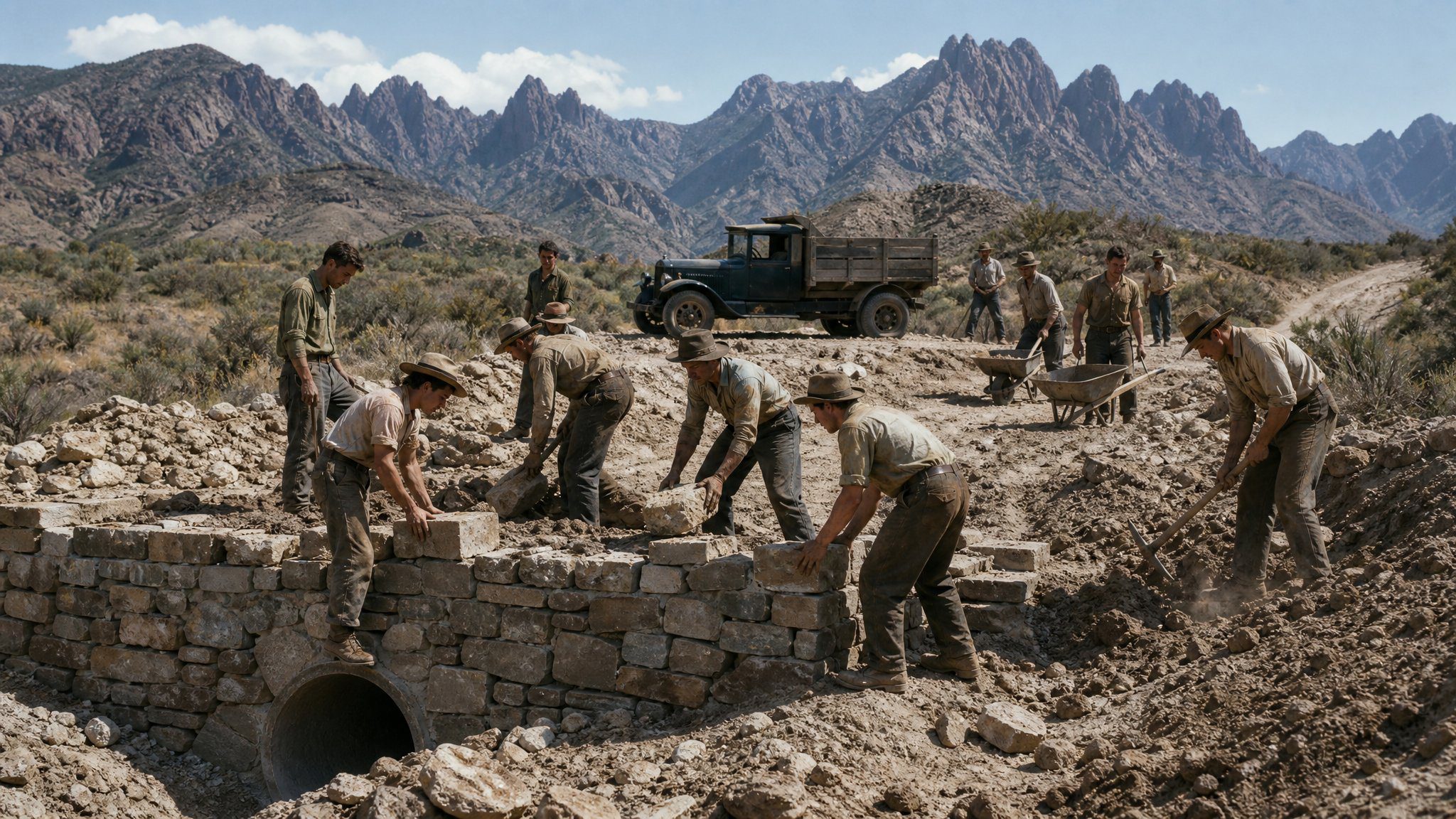
In the Chisos Mountains of West Texas, the first CCC camp at what became Big Bend National Park opened in 1934 with 200 young men, about 80 percent of them Hispanic. Using hand tools and a single dump truck, they built a seven-mile all-weather road into the Chisos Basin, scraping, digging and blasting some 10,000 truckloads of earth and rock to do it.
Segregation Under a Law That Forbade Discrimination
The anti-discrimination clause in the 1933 act came from Representative Oscar DePriest of Illinois, who was then the only Black member of Congress. It barred discrimination on account of race, color or creed in hiring for the program, and more than 200,000 African American men eventually served, roughly 10 percent of the total.
Robert Fechner capped Black enrollment at 10 percent, and in 1935 he ordered the complete segregation of Black and White enrollees, insisting in his own words that “segregation is not discrimination.” Nearly 150 all-Black companies were formed, and many were moved to remote areas after White communities protested against having a Black camp nearby. The first all-Black camp with African American leadership did not open until 1940, at Gettysburg, Pennsylvania.
Company 818 at the Grand Canyon was one of the exceptions, working the North Rim in summer and the bottom of the canyon in winter from 1933 to 1936. Its Black and White enrollees did the same work at Phantom Ranch and built the Colorado River Trail, the most difficult trail in the park. One of its members, John B. Scott, joined in June 1935 at the age of 19, became a seasoned trail worker who trained newer men and wrote for the camp newspaper, Ace in the Hole.
Native Americans served through a separate branch run by the Bureau of Indian Affairs, later named the CCC Indian Division, which employed somewhere between 80,000 and 88,000 men. Its crews worked on reservations, building roads, telephone lines, fences and water projects, and those who lived in camps were paid $30 a month plus room and board, while women were left out of the Corps entirely.
From the Camps to the War
The Army officers who ran the camps gained experience of their own, and one of them was George C. Marshall, who took command of CCC District F in June 1933 and oversaw 10 camps holding 1,879 men across Georgia and Florida. He went on to supervise 11 camps in South Carolina and later 27 camps in Oregon and southern Washington from Vancouver Barracks. Marshall called the work “the most instructive service I have ever had, and the most interesting,” and as Army chief of staff in World War II he mobilized a force made up largely of civilians.
Enrollment began to fall in the early 1940s as the economy recovered and young men joined the military, especially after the peacetime draft began in 1940. Fechner led the Corps until 1939, and James J. McEntee directed it through its final years. In June 1942 the House voted 158 to 151 to cut its funding, and Congress then set aside $8 million to wind the program down, with the liquidation virtually completed by June 30, 1943.
Big Bend became a national park in June 1944, two years after its last CCC camp closed, and the Chisos Basin road built by the first camp still drains through 17 stone culverts the enrollees constructed. The second camp, which arrived in 1940, built the Lost Mine Trail and four stone and adobe cottages that visitors still rent as lodging.
More from Terribly Interesting
Sources
- Civilian Conservation Corps Legacy
- PBS American Experience
- Living New Deal
- Library of Congress, In Custodia Legis
- CCC Legacy
- National Park Service
- National Park Service
- National Park Service
- Living New Deal
- National WWII Museum
- Encyclopedia of Arkansas
- Encyclopedia.com
- National Park Service
- Roosevelt House Public Policy Institute at Hunter College
- CCC Legacy
- National Archives
- George C. Marshall Foundation
- Minnesota Historical Society MNopedia