On March 31, 1943, Second Lieutenant Owen Baggett hung wounded beneath his parachute over Japanese-held Burma, and when a Japanese fighter slowed almost to a stall beside him, he drew his .45 pistol and fired four shots into its open cockpit.
Baggett, a 22-year-old copilot from Graham, Texas, was serving with the 7th Bombardment Group in British India. Japanese fighters shot down his B-24 Liberator on a raid against a railroad bridge at Pyinmana, in central Burma. He watched the fighter stall and drop away after his shots, then landed, was captured, and spent more than two years as a prisoner of the Japanese.
Whether those shots brought the aircraft down has been argued over ever since the war ended. Air Force Magazine concluded in 1996 that there appeared to be no reasonable doubt, although it described the evidence as largely indirect and circumstantial, resting on a story passed to Baggett by a fellow prisoner. Postwar study of Japanese records points the other way, since the unit that fought the bombers that day recorded no pilot losses.
The mission, the loss of the bomber, Baggett’s wound and his long imprisonment are all on the record. The fate of the fighter depends on what Baggett saw from his parachute and on an account that reached him at third hand inside a prison camp.
The Pyinmana Bridge Raid and the Tenth Air Force
Baggett had graduated from Hardin-Simmons University in Abilene in 1941, where he was drum major of the band. He then moved to New York to work for a defense contractor in an office on Wall Street, until he joined the Army Air Forces, which accepted him on July 26, 1942. He completed pilot training as a second lieutenant and was posted to India to fly B-24 Liberators.
In early 1943 the Tenth Air Force, based in India, was the smallest combat air force in the US Army Air Forces. Its task was to protect the supply route to China and to cut the Japanese supply lines running north from the port of Rangoon. Its heavy bombers belonged to the 7th Bombardment Group, which flew B-24 Liberators from Pandaveswar, northwest of Calcutta, on long missions over Burma.
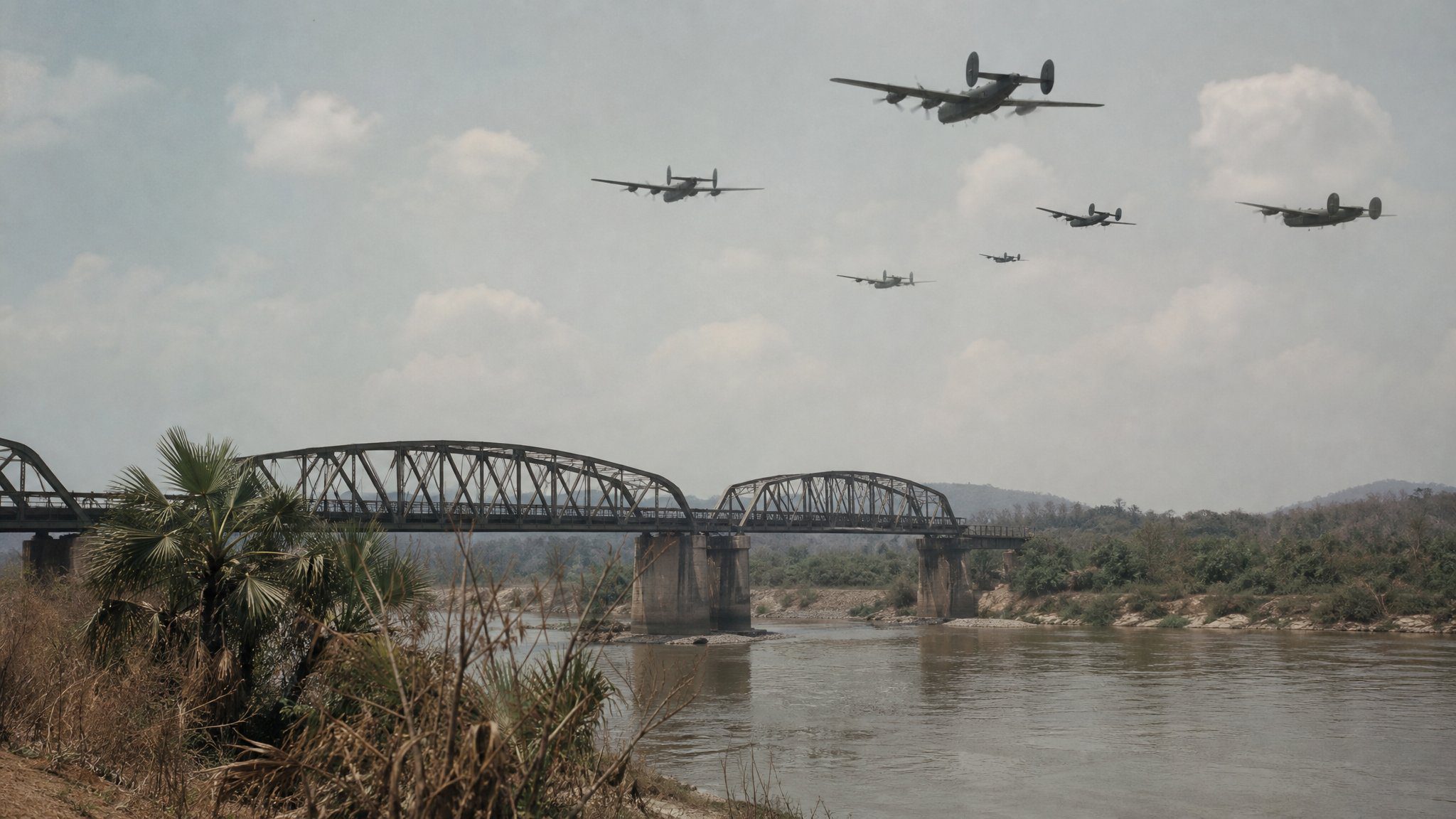
The Burmese railways were the main target, and the official history of the Army Air Forces lists Pyinmana among the most important points attacked on the rail system, alongside Toungoo, Yamethin and Prome. The Tenth had no long-range fighters until late in 1943, so the bombers flew these missions without escort. The bridge at Pyinmana stood roughly midway between Rangoon and Mandalay, close to two Japanese fighter bases.
On March 31, Colonel Conrad F. Necrason led the group’s 9th Bomb Squadron against the bridge. Baggett flew as copilot to First Lieutenant Lloyd Jensen in the bomber on Necrason’s right wing, and before the formation reached the target it was intercepted by 13 Japanese fighters.
The attack left Necrason badly wounded and Jensen’s aircraft critically damaged, with hits to the fuel tanks and shattered oxygen bottles feeding a fire in the rear of the fuselage. Sergeant Samuel Crostic, the 19-year-old top turret gunner, climbed down with two fire extinguishers and fought the flames from the catwalk over the open bomb bay while the fighters kept attacking.
Baggett took over the top turret while Crostic worked, and when the intercom failed he signaled the gunners by hand to bail out. He then struggled into his own parachute while half overcome by fumes, and as he fell clear he counted four other canopies opening before the Liberator exploded.
The Fighter That Came Back
The Japanese pilots then turned on the men hanging in their parachutes, making firing passes at the crew as they descended, and two of the bomber’s crew were killed in the air. Baggett was grazed on the arm during one of these passes, and he let himself hang limp in the harness in the hope that the pilots would take him for dead.
One fighter circled back toward him and came in nose high, slowing until it was close to a stall. Its pilot slid back the canopy as he drew within a few feet of the parachute, apparently to get a closer look at the man hanging under it. Baggett had kept his .45 caliber M1911 automatic out of sight against his leg, and when the fighter was alongside he raised it and fired at the open cockpit.
The fighter stalled and spun away below him, which was the last Baggett saw of it, and the whole encounter took place at an altitude of about 4,000 to 5,000 feet.
Japanese fighters were still strafing when he reached the ground, so Baggett took cover behind a tree until they left. Jensen and one of the gunners came down nearby, and all three men were seized by Burmese and handed over to the Japanese. Crostic had also survived the jump, and he was later held as a prisoner alongside the officers.
Read next
The Attic Scrapbook That Revealed 669 Children Saved From the Nazis
Captivity Near Singapore and a Story From Harry Melton
Baggett and Jensen were flown out of Burma aboard a Japanese bomber and held as prisoners of war near Singapore, where Baggett spent the rest of the war. During his captivity his weight fell from 180 pounds to 90, about half of what he had weighed on the morning of the raid.
Shortly after he arrived, Baggett, Jensen and another officer were brought before the Japanese major general responsible for all prisoners in the area, a man who was later executed as a war criminal. The general treated Baggett with unusual deference and offered him instructions in ritual suicide as the honorable course, an offer Baggett declined.
The only corroboration of the shooting came to Baggett through Colonel Harry R. Melton Jr., a West Point graduate from Wickliffe, Kentucky, who commanded the 311th Fighter Group. Melton had been flying a P-51A Mustang as a bomber escort over Rangoon on November 25, 1943, when he traded fire with the Japanese pilot Yohei Hinoki and his fighter was hit. He bailed out as his aircraft lost speed, and the Japanese captured him as soon as he came down.
Melton was held first in Rangoon Jail and later moved to Singapore to be shipped on to Japan. In the camp he passed on what a Japanese colonel had told him. By that account the pilot Baggett fired at had been thrown clear when his fighter crashed, and he was found dead of a single pistol bullet.
Melton did not live to see the end of the war. He left Singapore on September 6, 1944, aboard the Rakuyo Maru with about 2,200 British and Australian prisoners bound for Japan, and died on September 14, two days after the American submarine USS Sealion torpedoed the ship.
Baggett was freed when the war ended, one of 38 prisoners released by a team from the Office of Strategic Services, the wartime American intelligence agency, whose agents parachuted into Singapore to reach them. He had been a prisoner for about two and a half years.
What the Japanese Records Show
Postwar study of Japanese records found that Baggett and the early accounts had misidentified the attacking fighters. They were Nakajima Ki-43 Hayabusas of the Japanese Army Air Force’s 64th Sentai, a different aircraft from the Navy’s A6M Zero named in most retellings. The 64th Sentai’s records show that every one of its pilots survived the action of March 31, 1943.
Those records contain nothing that matches a crashed fighter or a dead pilot found near the parachutes, although they cannot show what Baggett saw from his parachute.
John L. Frisbee set out the case for Baggett in Air Force Magazine on July 1, 1996. He noted that no American fighters were in the area to account for a Japanese loss, and he described the colonel’s story, as Melton relayed it, as largely indirect and circumstantial evidence. His conclusion was that there appeared to be no reasonable doubt that Baggett had performed a unique act of valor, unlikely to be repeated in air warfare.
The weakness in that case is the route the story traveled, from a Japanese officer to Melton and from Melton to Baggett, with no written record at any stage that has surfaced since. Baggett himself rarely spoke about it, and when Frisbee wrote his piece the retired colonel, then living in San Antonio, was still reluctant to discuss the incident although he believed his account.
After the Prison Camp
Baggett stayed in uniform after his release and served in the Air Force until 1973, retiring as a colonel at the age of 53. He then worked as a manager for a defense contractor, and in his home town of Graham the Young County Museum of History and Culture keeps his story among its local veterans.
He died in New Braunfels, Texas, on July 27, 2006, at the age of 85, more than sixty years after the raid on Pyinmana. His obituary still gave the fighter as a Zero, the identification Japanese records had overturned decades earlier.
More from Terribly Interesting
Sources
- Air & Space Forces Magazine (John L. Frisbee, “Valor: David and Goliath”)
- Young County Museum of History & Culture
- WW2DB
- The Army Air Forces in World War II, Vol. IV, ch. 14 (HyperWar)
- War History Online (imprisonment)
- Pacific Wrecks
- Smithsonian Air & Space
- This Day in Aviation
- Hardin-Simmons University
- U.S. National Park Service
- San Antonio Express-News obituary via Legacy.com