
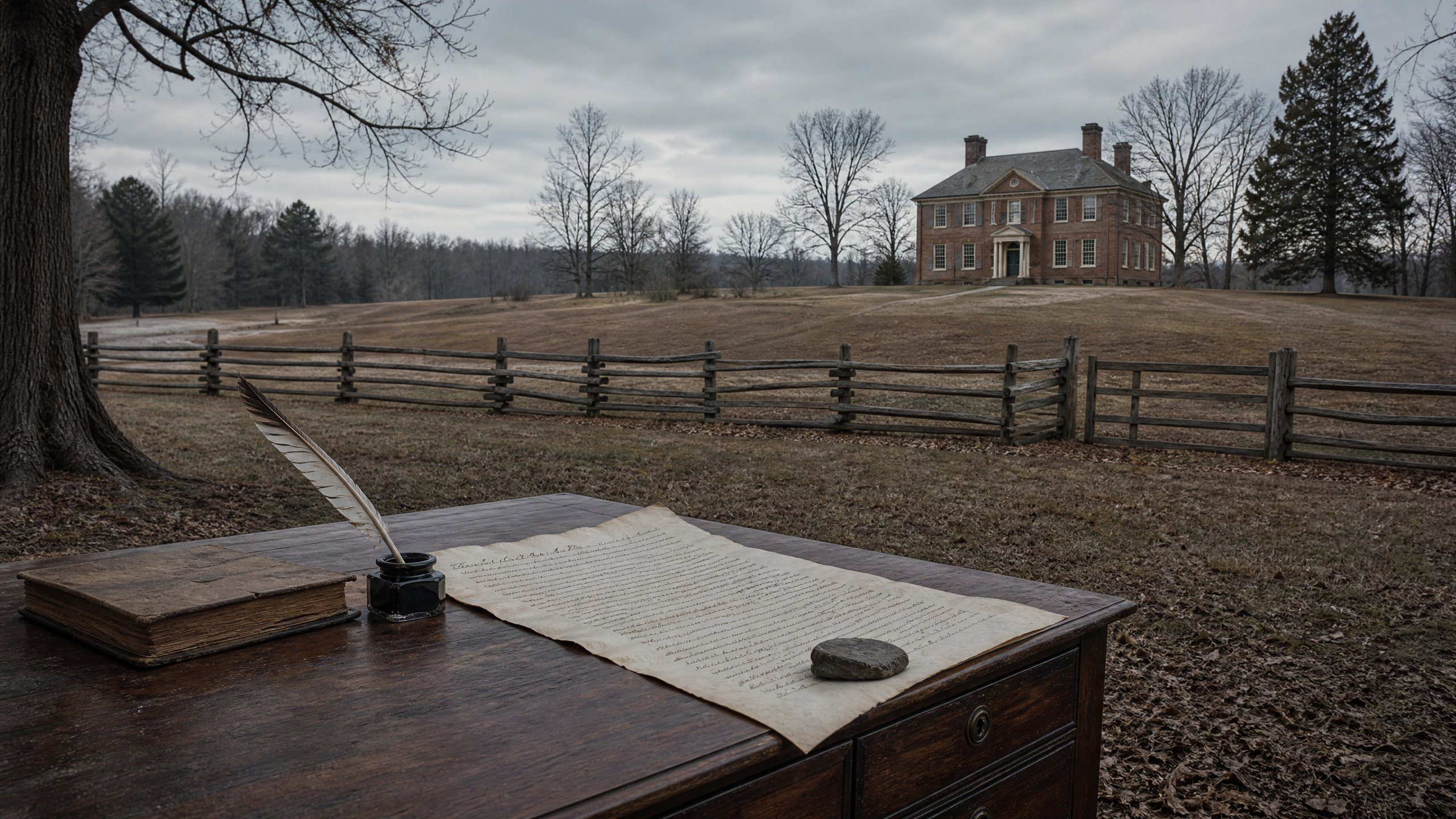
On August 1, 1791, Robert Carter III, one of the wealthiest planters in Virginia, signed a deed to free the hundreds of people he held in slavery.
The document, known as the Deed of Gift, was recorded in the Northumberland District Court on September 5, 1791. At a time when Virginia held about 292,000 enslaved people, it named 452 men, women and children on Carter’s plantations and set out a schedule for freeing them in groups, oldest first, starting in January 1792. Children were to go free when they came of age, and over the following decades between 500 and 600 people gained their freedom under it.
Carter built the plan around Virginia’s 1782 manumission act, which let owners free enslaved people without asking the government’s permission. His sons and sons-in-law, his neighbors and one county court tried to slow or stop it, and the last certificates of freedom under the deed were still being issued decades after his death. It was probably the largest emancipation by a single person in the United States before 1860.
The Deed of Gift
| Signed | August 1, 1791 |
|---|---|
| Recorded | September 5, 1791 |
| People named | 452 |
| Freed in all | between 500 and 600 |
| First group | 29 people, February 28, 1792 |
| Upheld | Virginia Court of Appeals, March 24, 1808 |
The Grandson of King Carter
Carter was born on February 9, 1728, probably at Corotoman, the Lancaster County plantation of his grandfather, Robert “King” Carter, a land baron who sat on the governor’s Council. After his father died in May 1732, a Virginia law of 1734 entitled the boy to more than 65,000 acres and several hundred enslaved people when he turned 21.
He sat on the governor’s Council from 1758 until the Council ended with the Revolution in 1776, and he lived at Nomony Hall, the Westmoreland County mansion he had inherited from his father.
Why did Robert Carter III free the people he enslaved?
Robert Carter III freed the people he enslaved because, after a religious conversion, he came to believe that keeping them in slavery was wrong. In June 1777 Carter announced that he had converted to evangelical Christianity. He joined the Morattico Baptist Church in 1778. Ten years later, in January 1788, he left the Baptists for the teachings of the Swedish theologian Emanuel Swedenborg and the Church of the New Jerusalem.
By then he had become convinced, in his own words, that keeping people in slavery was “contrary to the true principles of Religion & Justice.” He was also frustrated that the General Assembly refused even to consider a general emancipation. Proslavery petitions in 1784 and 1785 had shown him how strongly his neighbors would resist, and he shaped his plan to give them as little to fight as possible.
A census of his plantations taken on January 1, 1791, counted 455 enslaved people aged 45 or younger, and the deed named 452 of them. Of those, 148 were legal adults, meaning men of 21 and older and women of 18 and older. Fifteen adults were to be freed on January 2, 1792, starting with the oldest and working down by age. Fifteen more were to follow each New Year’s Day until all 148 were free in 1801.
Children named in the deed were to be freed as they reached adulthood. People older than 45 were left off the list and were allowed to farm land at Nomony for the rest of their lives. Carter concluded that the law would not let him deed enslaved family members to relatives who had already been freed, so he allowed freed people to hire their family members instead.
Read next
Pelican 9: The 1960 Air Force Catch of a Spy Satellite’s Film
Twenty-Nine People Instead of Fifteen
The first group appeared in Westmoreland County Court on February 28, 1792, about two months late, and it held 29 people instead of 15. More groups were accepted in April and May of that year, and on January 1, 1793, 27 adults and 30 elderly people were freed. Each person had to appear in court and pay a fee of five shillings for a certificate of freedom, and each could choose a first and last name. Among them were blacksmiths, carpenters, coopers, shoemakers, millers, cooks, seamstresses and farmers.
Carter offered some of the skilled workers wage contracts and leases of land before their court dates, so that they could stay and earn a living as free people. Tenants and neighbors complained about him renting land to the people he had freed. His son John Tasker Carter threatened to sell enslaved people to a place “where they will never hear talk of Freedom.”
On April 26, 1793, Carter leased Nomony Hall to John Tasker Carter and handed control of the remaining manumissions to Benjamin Dawson, a Baptist minister. On May 8 he sailed for Baltimore to be closer to the Church of the New Jerusalem, and he never went back to Nomony.
The Fight Over the Deed After 1793
Dawson carried on the work under a power of attorney, and in 1798 Carter deeded the people who were still enslaved to Dawson himself. The minister had a reputation for carelessness with money, and Carter revoked his power of attorney in 1801. Carter’s sons-in-law resented how little control they had over the estates they expected to inherit, and one of them, Spencer Ball, physically attacked Dawson.
Robert Carter III died suddenly in Baltimore on March 11, 1804, and he asked to be buried in an unmarked grave in the garden at Nomony Hall. His heirs then went to the Frederick County Court for an injunction, arguing that Dawson owed Carter money. The court accepted the argument, and 13 people who were due their freedom were held back.
In 1806 Virginia passed a law requiring newly freed people to leave the state within a year or risk being enslaved again. On March 24, 1808, the Virginia Court of Appeals ruled in Dawson’s favor and the manumissions resumed. Even with their certificates, people freed under the deed still faced assault, kidnapping, false imprisonment and impressment by the British navy.
Dawson was still certifying freedom in 1826, and the last recorded certification under the deed was made in Fairfax County in 1839. When the people freed under the deed stood before the courts to claim their certificates and chose their own surnames, they took dozens of family names, and not one of them chose Carter.
More from Terribly Interesting
Sources
- Encyclopedia Virginia, “Deed of Gift, Robert Carter III’s”
- Westmoreland County Court Order Book entry of February 28, 1792, cited by the Foundation for Historic Christ Church
- Encyclopedia Virginia, “Carter, Robert (1728 to 1804)”
- Bill of Rights Institute
- Nomini Hall Slave Legacy Project
- Nomini Hall Slave Legacy Project