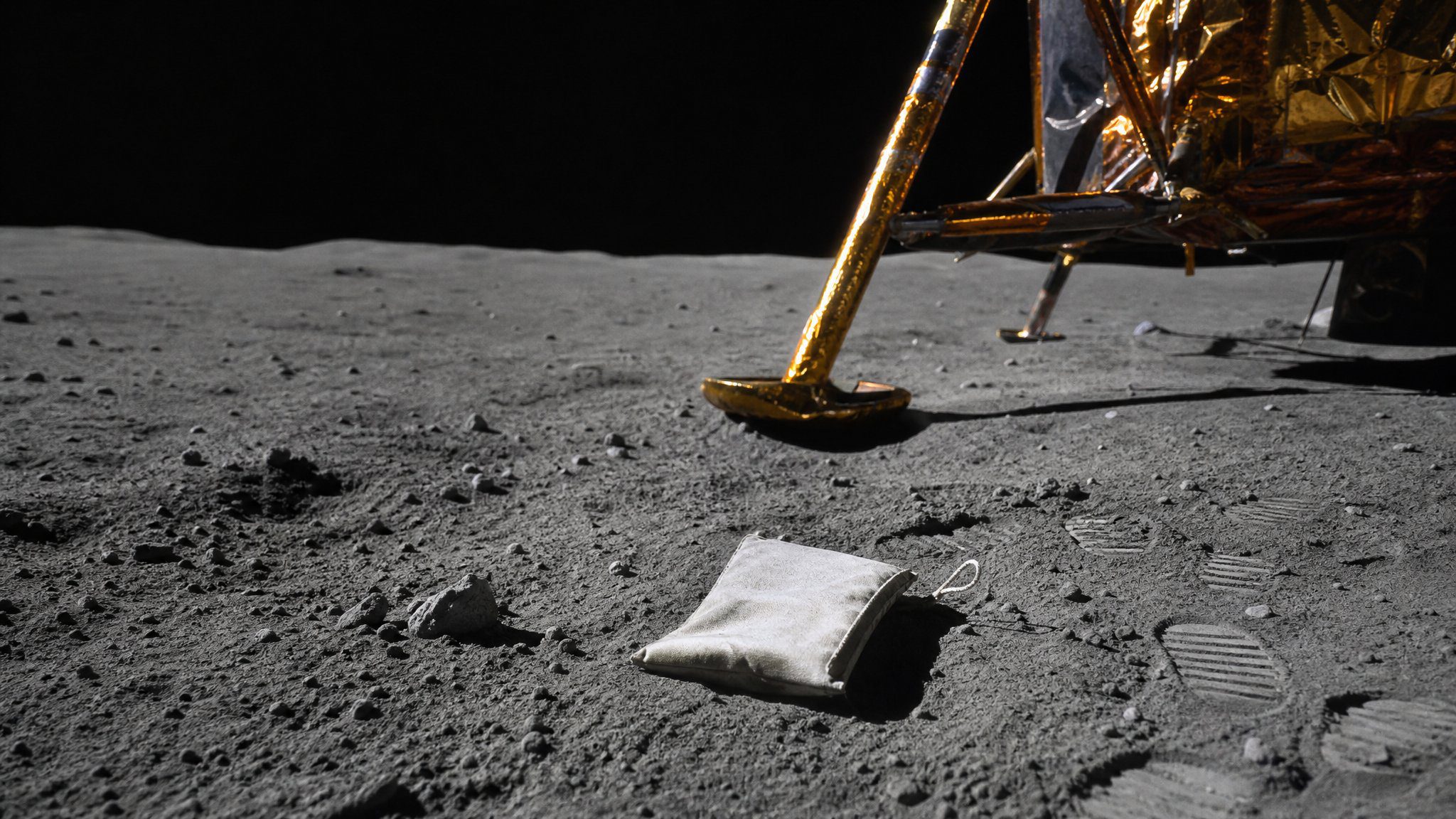
At the end of the first moonwalk, on July 20, 1969, a small packet was tossed onto the lunar surface holding two Soviet medals that honored the cosmonauts Yuri Gagarin and Vladimir Komarov, both killed before anyone reached the Moon.
The packet had been riding in a pocket on the shoulder of Buzz Aldrin’s spacesuit. Along with the Soviet medals, it held an Apollo 1 mission patch honoring the three American astronauts killed in a launchpad fire in 1967, and a small gold olive branch. A silicon disk carrying messages of goodwill from the leaders of 74 countries was also left behind. The astronauts nearly forgot the mementos altogether and left them on the surface only in the last minutes before climbing back into their lunar module.
The Soviet medals came to Apollo 11 through Frank Borman, the commander of Apollo 8, who received them in Moscow from the widows of Gagarin and Komarov. Borman made the first visit by an American astronaut to the Soviet Union in early July 1969, less than two weeks before Apollo 11 launched. On July 17, while the astronauts were on their way to the Moon, President Richard Nixon announced that they were carrying the medals.
Gagarin and Komarov
Yuri Gagarin became the first person in space on April 12, 1961. His Vostok 1 spacecraft lifted off from the Baikonur Cosmodrome at 06:07 Universal Time, and he made a single orbit of the Earth. Toward the end of the descent, with the capsule still about 7 kilometers up, Gagarin ejected and came down on his own parachute near Engels in the Saratov region of Russia. The flight lasted 108 minutes from launch to his ejection.
Gagarin, by then a national hero, never flew in space again. He was killed on March 27, 1968, when the jet he was flying crashed northeast of Moscow during a routine training flight.
Vladimir Komarov had commanded the Voskhod 1 mission in 1964, and in April 1967 he was chosen to fly the first mission of the Soviet Union’s new Soyuz spacecraft, with Gagarin as his backup. The plan was for a second Soyuz carrying three cosmonauts to launch the next day and meet Komarov’s ship in orbit, with two of its crew crossing to Soyuz 1 by spacewalk.
The Fall of Soyuz 1
Soyuz 1 launched on April 23, 1967, and ran into problems in orbit, and the second launch was called off. On the way down on April 24, a small drogue parachute came out, but the main parachute stayed jammed in its container. An investigation later found that the container had been deformed and that the pull needed to free the main canopy was far greater than the drogue could provide. The capsule hit the ground at more than 640 kilometers an hour near Orsk in the southern Ural Mountains, and Komarov was killed instantly.
The historian Asif Siddiqi has written that during pre-launch heat testing, a rough polymerized coating formed inside the parachute containers of both Soyuz 1 and the Soyuz 2 spacecraft waiting to follow it. “The most chilling implication of this manufacturing oversight was that both Soyuz spacecraft were doomed to failure,” he wrote. Had the mission gone as planned, the three cosmonauts of Soyuz 2 would have died as well.
Later accounts added a darker version of the story of Komarov’s death. A 2011 book, Starman, by Jamie Doran and Piers Bizony, claimed that engineers had found 203 faults in Soyuz 1 before launch. It said Komarov flew anyway so that Gagarin would not be sent in his place. Space historians including Siddiqi and Robert Pearlman of collectSPACE questioned those claims. They rest on the account of a single former KGB officer, Venyamin Russayev, whom no historian had heard of before and whose story has not been independently confirmed.
Komarov was the first person to die during a space mission. The Soviet program redesigned the Soyuz parachute containers, flew its first fully successful piloted Soyuz mission in October 1968, and in January 1969 finally carried out the crew transfer by spacewalk that Soyuz 1 and 2 had been meant to perform.
Read next
Richard Feynman’s Glass of Ice Water and the Challenger O-Rings
Borman’s Trip to Moscow
Borman had become famous as commander of Apollo 8, the first crewed mission to orbit the Moon, in December 1968. From July 2 to July 10, 1969, he and his wife, Susan, toured the Soviet Union, escorted by the cosmonauts Gherman Titov, Konstantin Feoktistov and Georgy Beregovoy. On July 5 he became the first American astronaut to visit Star City, the cosmonaut training center outside Moscow. He also met Mstislav Keldysh, president of the Soviet Academy of Sciences, and the Soviet head of state, Nikolai Podgorny.
During that visit Borman received the two medals from the widows of Gagarin and Komarov, which had been awarded to their husbands posthumously, and brought them back to the United States. Apollo 11 launched from Kennedy Space Center on July 16. The medals flew with it, together with an Apollo 1 crew patch and three commemorative medals for Gus Grissom, Ed White and Roger Chaffee. The three had died in the Apollo 1 fire on January 27, 1967.
Nixon’s statement of July 17 opened by saying that the two men who would set foot on the Moon “represent all mankind,” and it named all five of the dead. “There is no national boundary to courage,” it read. “The names of Gagarin and Komarov, of Grissom, White, and Chaffee, share the honor we pray will come to Armstrong, Aldrin, and Collins.” It ended with the hope “that if men can reach the moon, men can reach agreement.”
Nearly Forgotten at Tranquility Base
Armstrong and Aldrin landed in the Sea of Tranquility on July 20 and spent about two and a half hours outside the lunar module. They planted a flag, set up experiments and gathered rock samples. The commemorative items stayed in the pocket on Aldrin’s suit until the very end.
Armstrong remembered them only as the moonwalk was closing and the two men were getting ready to climb back in. The mission transcript records him asking, “How about that package out of your sleeve? Get that?” Aldrin said he had not, and Armstrong said he would take care of it. The packet was tossed from the ladder onto the surface as they climbed back in, and it settled in the dust without any ceremony. Once inside the lunar module, Armstrong confirmed that the disk with messages had been placed on the surface as planned.
The silicon disk, about the size of a half-dollar coin, carried microscopic messages from Nixon and the leaders of 73 other countries, collected by NASA’s administrator, Thomas Paine. Armstrong’s biographer, James Hansen, recorded which messages Armstrong liked best. One of them, from the president of the Ivory Coast, asked the first travelers to the Moon to “turn towards our planet Earth and cry out how insignificant the problems which torture men are, when viewed from up there.”
A Second Memorial on the Moon
Two years later another Apollo crew left a larger tribute to the dead of both countries. On August 2, 1971, near the end of the third Apollo 15 moonwalk, commander David Scott placed a small aluminum figure of an astronaut and a plaque in a shallow crater near the Hadley Rille. It lay about 20 feet from where he had parked the lunar rover. Scott said nothing about it while he was on the Moon and described it only after returning to Earth.
“There’s a simple plaque with 14 names and those are the names, in alphabetical order, of all of the astronauts and cosmonauts who have died in the pursuit of the exploration of space,” Scott said. Gagarin and Komarov were on the list, alongside the Apollo 1 crew. So were the three Soyuz 11 cosmonauts who had died about a month earlier, on June 30, 1971, when their capsule lost its air during the return from the first space station. The figure, known as Fallen Astronaut, has been credited to the Belgian artist Paul Van Hoeydonck, although Scott wrote in 2021 that it was made by NASA personnel. NASA required that the memorial not be commercialized, and the artist’s name was not made public until a replica was put on display at the Smithsonian’s National Air and Space Museum.
The Soviet Union never landed a cosmonaut on the Moon, and the medals of Gagarin and Komarov reached its surface in the pocket of an American astronaut’s suit.