
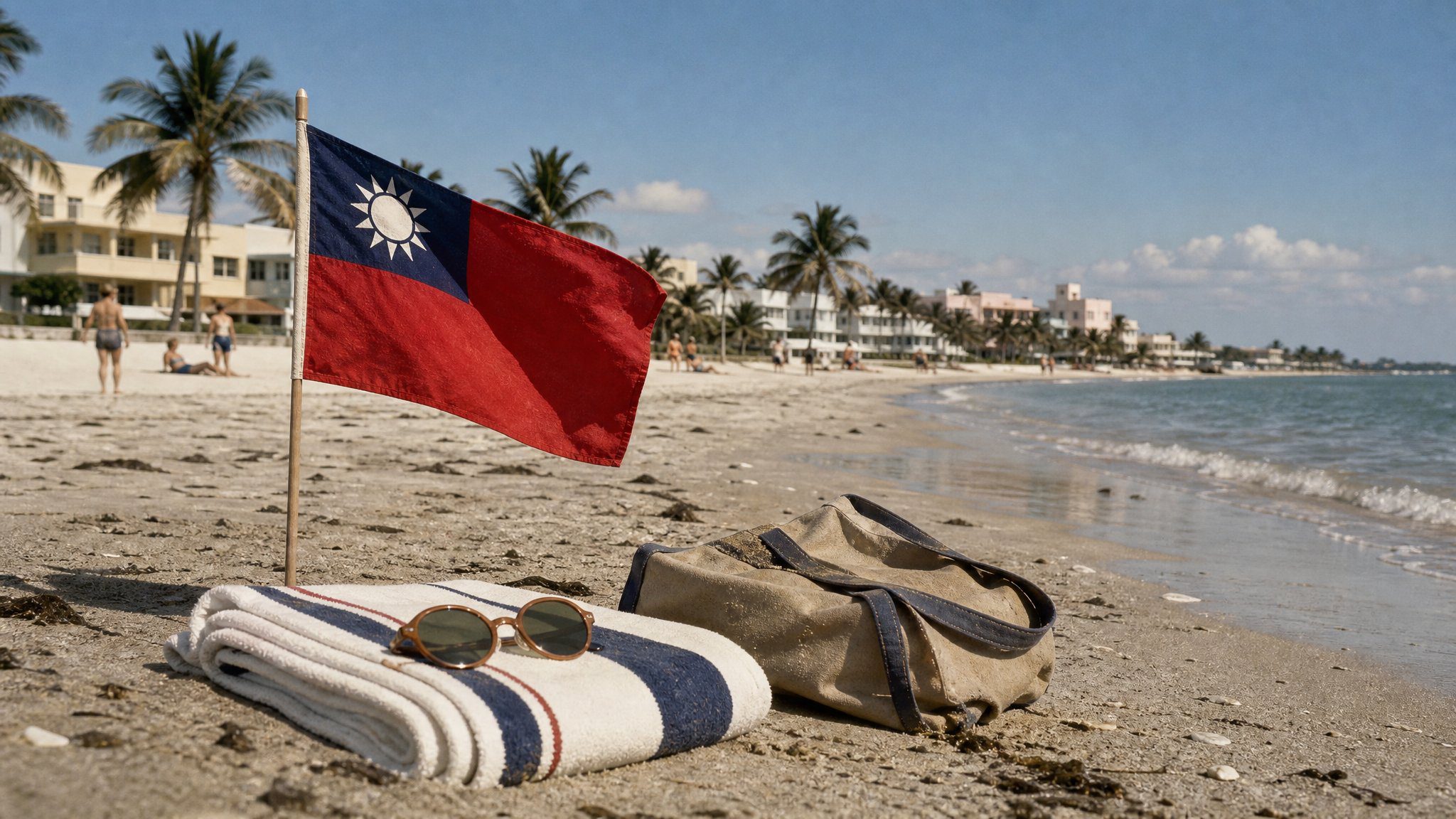
Eight days after Pearl Harbor, a Chinese American restaurant hostess named Ruth Lee went sunbathing on a Miami beach with a Chinese flag beside her so that nobody would take her for Japanese.
An Associated Press photographer captured the scene on December 15, 1941, and the caption that went with the picture explained it in a few lines. Lee worked as a hostess at a Chinese restaurant in Miami and liked to spend her days off in the sun. She had begun bringing the flag along because she did not want to be mistaken for Japanese, and the caption added that she was American-born, which made her a citizen of the United States.
The flag beside her belonged to the Republic of China, which had been at war with Japan since 1937. In the days after the attack on Hawaii it became a formal ally of the United States. Carrying it to the beach was Lee’s practical answer to a problem many Chinese Americans faced that December, when strangers often had no way of telling one Asian face from another.
Miami in the Week After December 7, 1941
The United States declared war on Japan on December 8, 1941, the day after the attack on Pearl Harbor. China followed on December 9 with a formal declaration of war against Japan, Germany and Italy. Its government, led from the wartime capital of Chongqing, had already been fighting an undeclared war against Japanese forces for more than four years.
Anger at Japan was fresh in the first days after the attack, and Chinese Americans on the street could be taken for Japanese even though China was now a partner in the same war. Miami was on the opposite side of the country from the West Coast, where most Japanese Americans lived, and it had no exclusion zone or military curfew.
Life magazine described the problem plainly in its issue of December 22, 1941. It told readers that many of the country’s 75,000 Chinese residents were “innocent victims in cities all over the country.” The same feature reported that the Chinese consulates had prepared identification buttons for their nationals during the previous week.
The Magazines That Tried to Tell Faces Apart
On December 22, 1941, Life and Time both published features that claimed to show readers how to distinguish Chinese people from Japanese people. Life ran a two-page spread on pages 81 and 82, built around photographs of a Chinese man and a Japanese man placed side by side. Handwritten notes and arrows pointed to supposed differences in skin tone, teeth and facial features.
Time’s version, published the same day, set out four portraits of young and middle-aged men, two Chinese and two Japanese, and invited readers to compare them. Its opening text conceded that there was no infallible way of telling them apart, and it then went on to list physical traits and personality types anyway, presenting crude racial stereotypes as practical guidance.
Scholars of race and visual culture have studied both features as examples of how wartime racial thinking worked in mainstream American media. They read them as attempts to sort people by appearance at a moment when appearance was what put people in danger.
The same Time feature also mentioned a man in Washington who had found a simpler method. The Chinese correspondent Joseph Chiang had started wearing a large badge on his lapel announcing that he was a Chinese reporter and asking people not to take him for Japanese. Time remarked that the badge made things much easier.
Read next
Teddy Roosevelt’s Tied-Up Bear and the Brooklyn Couple Behind It
Badges, Buttons and Consulate Cards
Chiang’s badge was one of many identity markers that appeared that month. Within days of Pearl Harbor, the Chinese consulate in San Francisco began issuing identification cards to Chinese immigrants and Chinese Americans. Lapel buttons and stickers carrying slogans such as “I am Chinese” spread through Chinatowns, and Korean Americans wore badges identifying themselves as Korean.
Most of the buttons were produced by Chinese Consolidated Benevolent Associations, the community organizations that had spoken for Chinatowns for decades. The historian William Gow studied the buttons in wartime Los Angeles for an article in the Western Historical Quarterly, published online in October 2021. He found that they reflected the official views of the Chinese consulates and their allies in those associations more than the views of many young Chinese Americans.
The Camps Out West
The confusion that Lee guarded against had a much harsher counterpart for Japanese Americans themselves. On February 19, 1942, President Franklin D. Roosevelt signed Executive Order 9066, which allowed military commanders to exclude civilians from designated areas. In the months that followed, more than 110,000 people of Japanese descent were forced from their homes on the West Coast.
They were moved first to assembly centers and then to 10 relocation camps in California, Arizona, Idaho, Utah, Wyoming, Colorado and Arkansas. The National Archives puts the number of people incarcerated at about 122,000. Nearly 70,000 of them were American citizens who had no charges brought against them and no way to appeal.
The 1943 Repeal of Chinese Exclusion
The wartime alliance with China also drew attention to a law that had stood for six decades. Under the Chinese Exclusion Act of 1882, Chinese immigration had been largely barred, and Chinese immigrants already in the country could not become naturalized citizens. Japanese propaganda made repeated use of that exclusion to weaken ties between the United States and the Republic of China.
Representative Warren G. Magnuson of Washington introduced the bill to repeal the exclusion acts, and the House passed it in the fall of 1943. Roosevelt backed the change, calling it “important in the cause of winning the war and of establishing a secure peace.” He signed the Magnuson Act into law on December 17, 1943.
The repeal set an annual quota of 105 Chinese immigrants, calculated from the size of the Chinese-origin population in the United States in 1920. Unlike the European quotas, which were based on citizenship, the Chinese quota counted ethnicity, so a person of Chinese descent born anywhere in the world counted against it. The act did give Chinese immigrants the right to naturalize for the first time in more than 60 years.
Ruth Lee had been born in the United States and was already a citizen on the day the photographer found her on the beach. The flag beside her belonged to a country whose emigrants could not become American citizens until Roosevelt signed the repeal on December 17, 1943, two years and two days after her picture was taken.
More from Terribly Interesting
Sources
- Associated Press photo caption via Alamy
- also
- Bridgeman Images catalog title
- Jewish Virtual Library, text of China’s declaration
- Jewish Virtual Library / standard chronology
- National Archives (exclusion zones were on the West Coast)
- transcription of the Life feature, Vintage Everyday
- History Hit
- TIME archive
- Ethnic Studies Review, “No Certain Way to Tell Japanese From Chinese”
- Getty Iris blog
- Rare Historical Photos summary and Densho Encyclopedia
- rafu.com
- Western Historical Quarterly abstract
- visitthecapitol.gov
- U.S. Department of State Office of the Historian
- HistoryLink